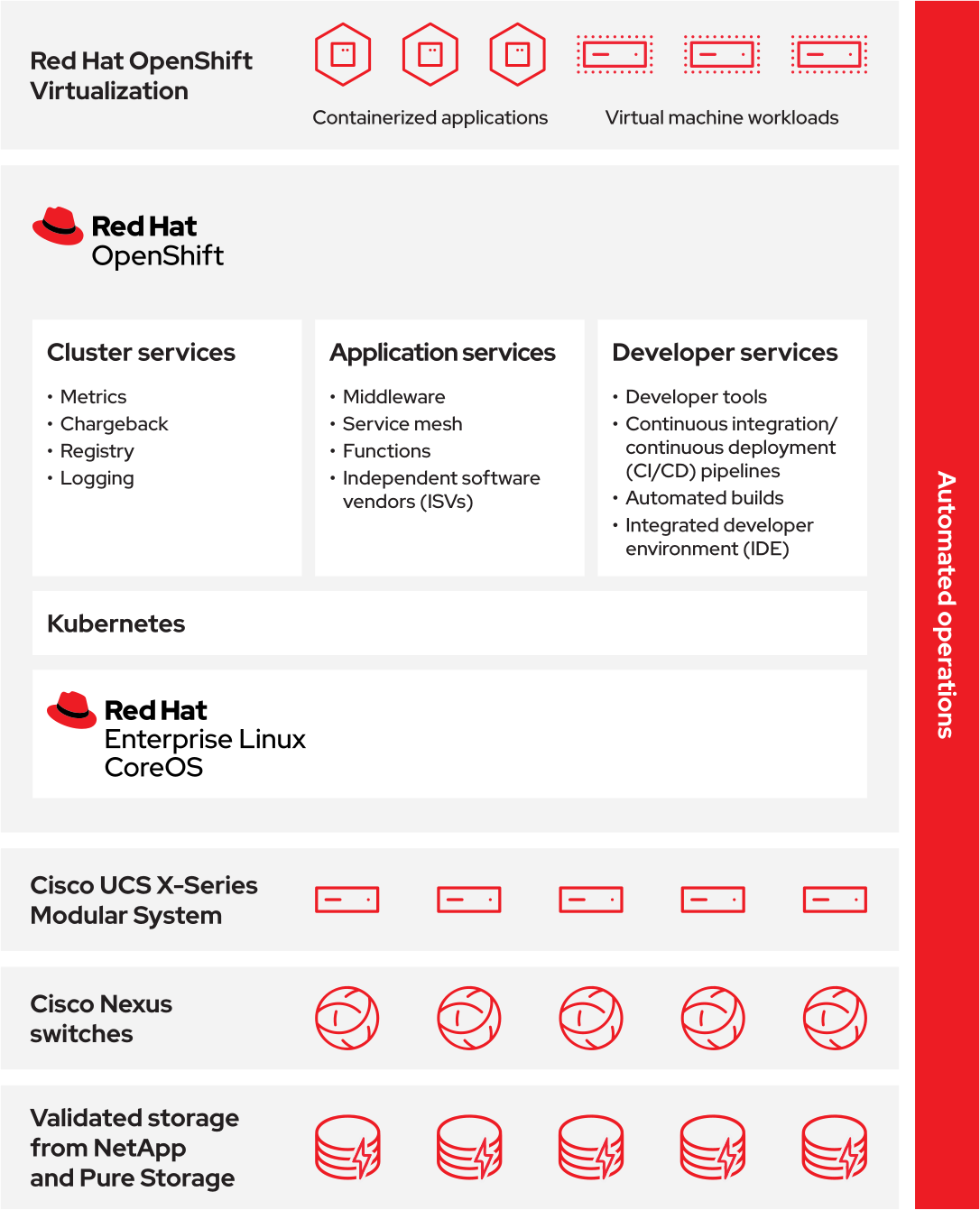
Integrated, validated joint reference architectures from Red Hat and Cisco provide a consistent, cloud-native experience that simplifies virtual machine and container operations, letting you focus on innovation and business value. Based on a flexible, modular, and highly available architecture, the solution reduces datacenter complexity and aligns with Red Hat and Cisco best practices.
Cisco Validated Designs with Red Hat OpenShift Virtualization provide complete solution architectures that include:
- Cisco Unified Computing System™ (Cisco UCS®) X-Series modular blade and rack servers.
- Cisco Nexus® 9000 Series switches.
- Cisco UCS 6000 Series fabric interconnects.
- Cisco Intersight® cloud operations platform.
- Red Hat OpenShift.
- Red Hat OpenShift Virtualization.
- Migration toolkit for virtualization.
- Your choice of validation storage arrays:
- NetApp AFF C-Series flash storage arrays and NetApp Trident.
- Pure Storage FlashArray//XL170 and Portworx by Pure Storage.
These components are integrated, validated, and automated wherever possible, allowing you to migrate, deploy, and manage virtual machines quickly and economically while eliminating many of the risks associated with researching, designing, building, and deploying similar solutions in-house.
Each component provides key capabilities for the overall solution. Consolidated onto a single, adaptable, modular system, Cisco servers, switches, and networking deliver efficient, high-performance, enterprise-grade software-defined compute, storage, and server networking for on-site datacenters. Cisco Intersight simplifies infrastructure provisioning, configuration, maintenance, and visibility across your environments. NetApp all-flash storage arrays offer superior performance, flexibility, and data services to manage and protect critical data. Pure Storage FlashArray provides all-flash storage backed by an enterprise-class array, data-at-rest encryption, and advanced data reduction technology.
Powered by containers, Kubernetes, and DevSecOps capabilities, Red Hat OpenShift provides a foundation for rapidly building, deploying, and running applications at scale and with security across hybrid, multicloud, and edge environments. Included with Red Hat OpenShift and based on the Kernel-based Virtual Machine (KVM) open source project, Red Hat OpenShift Virtualization supports virtual machine operations directly in the Red Hat OpenShift console. Create, manage, clone, and import Linux® and Windows virtual machines. Run containerized and virtual machine workloads simultaneously in a single cluster. Manage virtual machine network interfaces and storage disks. Live migrate virtual machines between cluster nodes. Plus, with the migration toolkit for virtualization, you can efficiently move existing virtual machines to Red Hat OpenShift Virtualization, saving you time and minimizing potential errors.
Once you understand how to migrate your virtual machines, you can use Red Hat Ansible® Automation Platform to migrate them at scale, including related infrastructure. Post-migration, you can automate a wide array of Day 2 operational tasks, as well as provisioning virtual machines on your new virtualization platform. Finally, Red Hat Ansible Automation Platform provides a centralized automation model across Red Hat OpenShift clusters that span multiple zones, datacenters, and cloud environments.