Skip to contentRed Hat AI
  • Overview

    • AI news
    • Technical blog
    • Live AI events
    • Inference explained
    • See our approach
  • Products

    • Red Hat AI Enterprise
    • Red Hat AI Inference
    • Red Hat Enterprise Linux AI
    • Red Hat OpenShift AI
    • Explore Red Hat AI
  • Engage & learn

    • Learning hub
    • AI topics
    • AI partners
    • Services for AI
Hybrid cloud
  • Platform solutions

    • Artificial intelligence

      Build, deploy, and monitor AI models and apps.

    • Linux standardization

      Get consistency across operating environments.

    • Application development

      Simplify the way you build, deploy, and manage apps.

    • Automation

      Scale automation and unite tech, teams, and environments.

  • Use cases

    • Virtualization

      Modernize operations for virtualized and containerized workloads.

    • Digital sovereignty

      Control and protect critical infrastructure.

    • Security

      Code, build, deploy, and monitor security-focused software.

    • Edge computing

      Deploy workloads closer to the source with edge technology.

  • Explore solutions
  • Solutions by industry

    • Automotive
    • Financial services
    • Healthcare
    • Industrial sector
    • Media and entertainment
    • Public sector (Global)
    • Public sector (U.S.)
    • Telecommunications

Discover cloud technologies

Learn how to use our cloud products and solutions at your own pace in the Red Hat® Hybrid Cloud Console.

Products
  • Platforms

    • Red Hat AI

      Develop and deploy AI solutions across the hybrid cloud.

    • Red Hat Enterprise Linux

      Support hybrid cloud innovation on a flexible operating system.

    • Red Hat OpenShift

      Build, modernize, and deploy apps at scale.

    • Red Hat Ansible Automation Platform

      Implement enterprise-wide automation.

  • Featured

    • Red Hat AI Enterprise
    • Red Hat OpenShift Virtualization Engine
    • Red Hat Desktop
    • See all products
  • Try & buy

    • Start a trial
    • Buy online
    • Integrate with major cloud providers
  • Services & support

    • Consulting
    • Product support
    • Services for AI
    • Technical Account Management
    • Explore services
Training
  • Training & certification

    • Courses and exams
    • Certifications
    • Skills assessments
    • Red Hat Academy
    • Learning subscription
    • Explore training
  • Featured

    • Red Hat Certified System Administrator exam
    • Red Hat System Administration I
    • Red Hat Learning Subscription trial (No cost)
    • Red Hat Certified Engineer exam
    • Red Hat Certified OpenShift Administrator exam
  • Services

    • Consulting
    • Partner training
    • Product support
    • Services for AI
    • Technical Account Management
Learn
  • Build your skills

    • Documentation
    • Hands-on labs
    • Hybrid cloud learning hub
    • Interactive demos
    • Training and certification
  • More ways to learn

    • Blog
    • Events and webinars
    • Podcasts and video series
    • Red Hat TV
    • Resource library

For developers

Discover resources and tools to help you build, deliver, and manage cloud-native applications and services.

Partners
  • For customers

    • Our partners
    • Red Hat Ecosystem Catalog
    • Find a partner
  • For partners

    • Partner Connect
    • Become a partner
    • Training
    • Support
    • Access the partner portal

Build solutions powered by trusted partners

Find solutions from our collaborative community of experts and technologies in the Red Hat® Ecosystem Catalog.

Search

I'd like to:

  • Start a trial
  • Buy a learning subscription
  • Manage subscriptions
  • Contact sales
  • Contact customer service
  • See Red Hat jobs

Help me find:

  • Documentation
  • Developer resources
  • Tech topics
  • Architecture center
  • Security updates
  • Customer support

I want to learn more about:

  • AI
  • Application modernization
  • Automation
  • Cloud-native applications
  • Linux
  • Virtualization
ConsoleDocsSupportNew For you

Recommended

We'll recommend resources you may like as you browse. Try these suggestions for now.

  • Product trial center
  • Courses and exams
  • All products
  • Tech topics
  • Resource library
Log in

Get more with a Red Hat account

  • Console access
  • Event registration
  • Training & trials
  • World-class support

A subscription may be required for some services.

Log in or register
Contact us
Red Hat logo
  • Home
  • Resources
  • Red Hat OpenShift Virtualization for defense IT operations

Red Hat OpenShift Virtualization for defense IT operations

June 11, 2025•
Resource type: Overview
Download PDF

Reduce dependence on legacy virtualization platforms

Defense agencies will continue to host and manage virtual machines (VMs). Today, hundreds of thousands of VMs contribute to defense operations across all agencies, many supporting mission-critical applications and systems. Their IT teams face increasing pressures to optimize costs, be more efficient, and reduce vulnerabilities to their networks.

Dependence on the existing VM hosting platform causes operational risk, limits paths to modernization, and inhibits innovation. To maintain dominance in modern warfare and improve their cyber posture, agencies need a modern, cloud-native virtualization infrastructure that:

  • Is secure, trusted, and reliable.
  • Allows rapid delivery of capabilities to support and heighten defense coverage and strength. This requires virtualization infrastructure that can run on any hardware, anywhere—at the tactical edge, in datacenters, and in public clouds.
  • Provides cloud-native development and delivery capabilities to accelerate agencies’ modernization efforts, such as automation (e.g., self-healing, software defined storage, and networking), artificial intelligence, and a single source of truth for configuration files.
  • Simplifies infrastructure and reduces maintenance requirements by hosting VMs and containers side-by-side on the same platform. 
  • Meets stringent compliance requirements, such as trusted software supply chain for platform components, zero trust strategies, ISO/IEC Standards, and others.

Unified platform for VMs and containers: Red Hat OpenShift Virtualization

A modern application platform

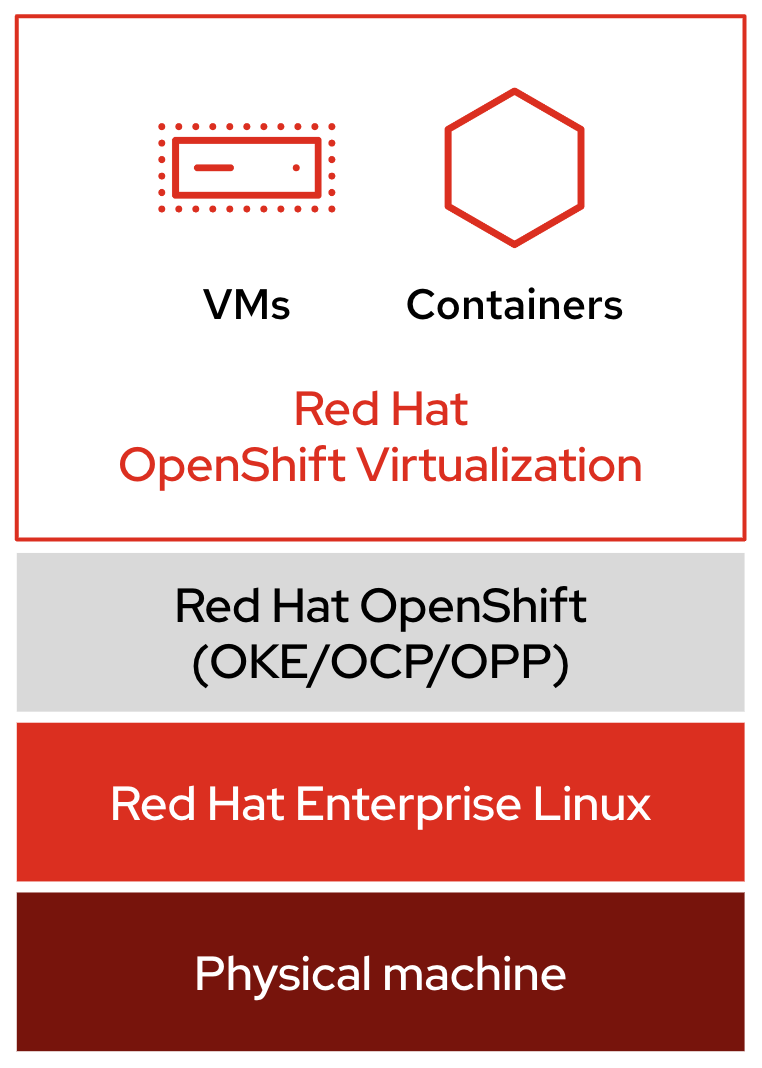
An included feature of all Red HatⓇ OpenShiftⓇ subscriptions, Red Hat OpenShift Virtualization is a modern application platform for running and deploying new and existing VM workloads alongside containers on the same OpenShift nodes. They behave as they would on a traditional VM platform while gaining the advantages of modern DevSecOps and GitOps pipelines. OpenShift is available as a fully managed public cloud service edition or as a self-managed edition that can be deployed across agencies’ hybrid cloud, including the tactical edge.

Tech stack showing VMs and containers running on Red Hat OpenShift Virtualization on Red Hat OpenShift

Simplify VM lifecycle by adding cloud-native capabilities

Red Hat OpenShift Virtualization is a Kubernetes Operator built atop the open source KubeVirt project. It provides additional capabilities that simplify management of VMs at large scale, inducing push-button automation and cloud native capabilities built into OpenShift. These capabilities include monitoring and alerting, traffic management and telemetry, serverless environments, continuous integration/continuous delivery (CI/CD) pipelines, GitOps, and more. Using either a graphical user interface (GUI) or command-line interface (CLI), defense agencies can:

  • Warm-migrate VMs onto the OpenShift platform at scale using the free tool, Migration Toolkit for Virtualization. The toolkit can import VMs from VMware vSphere, Nutanix, and other OpenShift clusters, and image repositories. Source VMs continue running while the data is copied, minimising downtime. When all data is copied, the administrator stops the running VM and the new instance begins running in the new location.
  • Create and manage new Windows and Linux® VMs.
  • Manage network interface controllers and storage disks attached to VMs.
  • Live migrate VMs between nodes in datacenters, cloud, and edge for continuity of operations. 

Mission value of OpenShift Virtualization for Defense

With Red Hat OpenShift Virtualization, defense agency software teams can preserve their existing investment in VMs while benefitting from the simplicity and speed of a modern hybrid cloud application platform.

Reduced operational risk. Bringing enterprise-class stability to open source software, Red Hat OpenShift lets agencies host VMs on any hardware platform, avoiding reliance on any single vendor. In addition, use of open source components supports defense agency efforts to strengthen the security of end-to-end software supply chains. Open source provides the visibility and traceability that proprietary software lacks, reducing the risk that components will inject malicious software or code into the enterprise.

Technology force multiplier. With a single platform for VMs, container-based, and serverless workloads, defense IT teams can standardize infrastructure deployment and use a common, consistent set of established tools. Defense IT software teams can also integrate Red Hat OpenShift with open source development tools they already use for container management, such as GitLab for DevSecOps and JFrog Artifactory for image storage. In addition to reducing Day 2 operational costs, consolidating VMs, Kubernetes containers, and serverless workloads on a single platform lowers infrastructure costs.

A path to infrastructure modernization. OpenShift Virtualization supports defense agency infrastructure modernization goals, which call for preserving existing virtualization investments while adopting modern application lifecycle practices such as DevSecOps and automation.

Automation and self healing. Used in conjunction with OpenShift Virtualization, Red Hat Ansible® Automation Platform can automate Day 2 VM operations such as configuration changes, patching, and rebooting. Automation also supports the goals of operating without disruption during local emergencies.

Increased flexibility and resilience. Envision a scenario in which VMs for a mission-critical system need to be stood up in a new location within 6 hours. With traditional VM hosting platforms, IT staff need to manually configure the VM for the new environment, a time-consuming and error-prone process that might not be completed by the mission deadline. When Red Hat OpenShift Virtualization is paired with Ansible Automation Platform, VM migration can be executed automatically. Code and files are stored in a centralized Git repository to ensure the configuration is accurate and secure.

Faster time to production for new VMs. By combining OpenShift Virtualization with modern application development processes and tools, such as Red Hat Trusted Software Supply Chain, Red Hat OpenShift Dev Spaces, and Red Hat Developer Hub, defense agencies can achieve the objective of delivering resilient software at the speed of relevance.

eSecurity compliance. Red Hat provides experts to help customers secure and validate their OpenShift Container environments. This includes implementing security practices such as zone isolation and microsegmentation, ensuring they meet all necessary requirements and can be validated against standards like DISA, STIG, BSI and E8.

For more information, check out Red Hat OpenShift Virtualization.

Tags:Virtualization

Red Hat logo

About Red Hat

Red Hat is the open hybrid cloud technology leader, delivering a trusted, consistent and comprehensive foundation for transformative IT innovation and AI applications. Its portfolio of cloud, developer, AI, Linux, automation and application platform technologies enables any application, anywhere—from the datacenter to the edge. As the world's leading provider of enterprise open source software solutions, Red Hat invests in open ecosystems and communities to solve tomorrow's IT challenges. Collaborating with partners and customers, Red Hat helps them build, connect, automate, secure, and manage their IT environments, supported by consulting services and award-winning training and certification offerings.

  • North America
  • Asia Pacific
  • Latin America
  • Europe, Middle East, and Africa
  • 888-REDHAT1
  • +6564904200
  • +5443297300
  • +0080073342835
  • www.redhat.com
  • apace@redhat.com
  • info-latam@redhat.com
  • europe@redhat.com
  • @red-hat
  • @redhat
  • @redhat
  • @red_hat

Copyright © 2026 Red Hat. Red Hat, the Red Hat logo, Ansible, and OpenShift are trademarks or registered trademarks of Red Hat, LLC or its subsidiaries in the United States and other countries. Linux® is the registered trademark of Linus Torvalds in the U.S. and other countries. The OPENSTACK logo and word mark are trademarks or registered trademarks of OpenInfra Foundation, used under license. All other trademarks are the property of their respective owners.

Red Hat logoLinkedInYouTubeFacebookXInstagram

Platforms

  • Red Hat AI
  • Red Hat Enterprise Linux
  • Red Hat OpenShift
  • Red Hat Ansible Automation Platform
  • See all products

Tools

  • Training and certification
  • My account
  • Customer support
  • Developer resources
  • Find a partner
  • Red Hat Ecosystem Catalog
  • Documentation

Try, buy, & sell

  • Product trial center
  • Red Hat Store
  • Buy online (Japan)
  • Console

Communicate

  • Contact sales
  • Contact customer service
  • Contact training
  • Social

About Red Hat

Red Hat is an open hybrid cloud technology leader, delivering a consistent, comprehensive foundation for transformative IT and artificial intelligence (AI) applications in the enterprise. As a trusted adviser to the Fortune 500, Red Hat offers cloud, developer, Linux, automation, and application platform technologies, as well as award-winning services.

  • Our company
  • How we work
  • Customer success stories
  • Analyst relations
  • Newsroom
  • Open source commitments
  • Our social impact
  • Jobs

Change page language

Red Hat legal and privacy links

  • About Red Hat
  • Jobs
  • Events
  • Locations
  • Contact Red Hat
  • Red Hat Blog
  • Inclusion at Red Hat
  • Cool Stuff Store
  • Red Hat Summit
© 2026 Red Hat

Red Hat legal and privacy links

  • Privacy statement
  • Terms of use
  • All policies and guidelines
  • Digital accessibility