Skip to contentRed Hat AI
  • Our approach

    • News and insights
    • Technical blog
    • Research
    • Live AI events
    • Explore AI at Red Hat
  • Our portfolio

    • Red Hat AI
    • Red Hat Enterprise Linux AI
    • Red Hat OpenShift AI
    • Red Hat AI Inference Server
  • Engage & learn

    • AI learning hub
    • AI partners
    • Services for AI
Hybrid cloud
  • Platform solutions

    • Artificial intelligence

      Build, deploy, and monitor AI models and apps.

    • Linux standardization

      Get consistency across operating environments.

    • Application development

      Simplify the way you build, deploy, and manage apps.

    • Automation

      Scale automation and unite tech, teams, and environments.

  • Use cases

    • Virtualization

      Modernize operations for virtualized and containerized workloads.

    • Digital sovereignty

      Control and protect critical infrastructure.

    • Security

      Code, build, deploy, and monitor security-focused software.

    • Edge computing

      Deploy workloads closer to the source with edge technology.

  • Explore solutions
  • Solutions by industry

    • Automotive
    • Financial services
    • Healthcare
    • Industrial sector
    • Media and entertainment
    • Public sector (Global)
    • Public sector (U.S.)
    • Telecommunications

Discover cloud technologies

Learn how to use our cloud products and solutions at your own pace in the Red Hat® Hybrid Cloud Console.

Products
  • Platforms

    • Red Hat AI

      Develop and deploy AI solutions across the hybrid cloud.

      New version
    • Red Hat Enterprise Linux

      Support hybrid cloud innovation on a flexible operating system.

    • Red Hat OpenShift

      Build, modernize, and deploy apps at scale.

    • Red Hat Ansible Automation Platform

      Implement enterprise-wide automation.

  • Featured

    • Red Hat OpenShift Virtualization Engine
    • Red Hat OpenShift Service on AWS
    • Microsoft Azure Red Hat OpenShift
    • See all products
  • Try & buy

    • Start a trial
    • Buy online
    • Integrate with major cloud providers
  • Services & support

    • Consulting
    • Product support
    • Services for AI
    • Technical Account Management
    • Explore services
Training
  • Training & certification

    • Courses and exams
    • Certifications
    • Red Hat Academy
    • Learning community
    • Learning subscription
    • Explore training
  • Featured

    • Red Hat Certified System Administrator exam
    • Red Hat System Administration I
    • Red Hat Learning Subscription trial (No cost)
    • Red Hat Certified Engineer exam
    • Red Hat Certified OpenShift Administrator exam
  • Services

    • Consulting
    • Partner training
    • Product support
    • Services for AI
    • Technical Account Management
Learn
  • Build your skills

    • Documentation
    • Hands-on labs
    • Hybrid cloud learning hub
    • Interactive learning experiences
    • Training and certification
  • More ways to learn

    • Blog
    • Events and webinars
    • Podcasts and video series
    • Red Hat TV
    • Resource library

For developers

Discover resources and tools to help you build, deliver, and manage cloud-native applications and services.

Partners
  • For customers

    • Our partners
    • Red Hat Ecosystem Catalog
    • Find a partner
  • For partners

    • Partner Connect
    • Become a partner
    • Training
    • Support
    • Access the partner portal

Build solutions powered by trusted partners

Find solutions from our collaborative community of experts and technologies in the Red Hat® Ecosystem Catalog.

Search

I'd like to:

  • Start a trial
  • Manage subscriptions
  • See Red Hat jobs
  • Explore tech topics
  • Contact sales
  • Contact customer service

Help me find:

  • Documentation
  • Developer resources
  • Skills assessments
  • Architecture center
  • Security updates
  • Support cases

I want to learn more about:

  • AI
  • Application modernization
  • Automation
  • Cloud-native applications
  • Linux
  • Virtualization
ConsoleDocsSupportNew For you

Recommended

We'll recommend resources you may like as you browse. Try these suggestions for now.

  • Product trial center
  • Courses and exams
  • All products
  • Tech topics
  • Resource library
Log in

Get more with a Red Hat account

  • Console access
  • Event registration
  • Training & trials
  • World-class support

A subscription may be required for some services.

Log in or register
Contact us
  • Home
  • Resources
  • Modern virtualization infrastructure with Red Hat and Portworx

Modern virtualization infrastructure with Red Hat and Portworx

May 12, 2025•
Resource type: Overview
Download PDF

Virtualization at a tipping point

Many organizations depend on virtualization for their most critical workloads, yet traditional virtualization is at a crossroads. The rise of cloud computing and an evolving application development space are putting pressure on conventional virtualization approaches. Meanwhile, shifts in the virtualization marketplace are forcing organizations to rethink their modernization strategies. Unsustainable cost models and a lack of innovation in traditional offerings add further uncertainty. Simply switching virtualization platforms or hastily migrating workloads to the cloud can lock in expensive cost models and limit long-term options and innovation—often adding even more complexity.

Red Hat and Portworx by Pure Storage provide a compelling alternative to traditional virtualization with long-term benefits. Red Hat® OpenShift® Virtualization1 provides a robust migration path to modern infrastructure for existing virtual machines (VMs). Portworx storage and data management incorporated with Red Hat OpenShift includes data services, backup, business continuity, and disaster recovery for business-critical applications, whether they are based on VMs or containers. Proven Portworx reference architectures help take the risk out of migrating VMs that have persistent data and storage requirements.2

In combination with Red Hat OpenShift hybrid cloud application platform, Portworx helps organizations:

  • Automate development and operations with self-service storage and databases, automated capacity management, and Kubernetes-native data management.
  • Protect the organization with enterprise business continuity, container-granular backups, and ransomware protection.
  • Unify the platform with simultaneous data management for VMs and containers, a cloud operating model for data, and a database platform as a service (DBPaas) for data services.

Highlights

Migrate virtual machines (VMs) with trusted and proven Red Hat OpenShift Virtualization and the migration toolkit for virtualization.

Accelerate deployment and reduce risk with documented Portworx storage and data services reference architectures. 

Manage VMs and containers side-by-side in a unified Kubernetes-native architecture with Red Hat OpenShift Virtualization.

Deploy enterprise-class data management capabilities such as high availability, performance, backup, and disaster recovery for both VMs and containers.

Develop and adopt modern applications and microservices at your own pace with a robust platform and ecosystem.

Modernize on your terms with Red Hat and Portworx

Not everyone with VM-based workloads is ready to re-engineer and modernize their applications. With more than 15 years of enterprise virtualization experience, Red Hat innovates on traditional virtualization concepts, providing a dedicated and tailored control view for VM administrators. Red Hat’s approach provides familiar administration concepts and actions, such as live migration and network connectivity, while also modernizing operations with comprehensive lifecycle and infrastructure management based on open cloud standards. With Red Hat OpenShift Virtualization Engine3 you can modernize at your pace, concentrating first on delivering and managing your existing virtualized workloads. This economical approach provides a solid and proven virtualization platform, migration tools, and the professional data and storage services required by demanding applications through a straightforward licensing model. Once Red Hat OpenShift platform is in place, you can optionally adopt cloud-native technologies, modernize your applications and development, and embrace emerging technologies (Figure 1).

Optimized for bare-metal servers, OpenShift Virtualization Engine includes the same core virtualization functionality as all Red Hat OpenShift editions but focuses exclusively on VMs. As your organization's needs evolve, you can explore other Red Hat OpenShift editions with containerization and modernization capabilities, including Red Hat OpenShift Container Platform and Red Hat OpenShift Platform Plus.

Figure showing how Red Hat and Portworx support your virtualization journey

Figure 1. Red Hat and Portworx support your virtualization journey

Throughout your journey, Red Hat and Portworx offer a customizable approach to facilitate your virtualization modernization strategy based on your specific business needs and your current state of readiness. This unique solution lets you:

  • Learn with roadshows and workshops. Red Hat and Portworx provide virtual and face-to-face hands-on workshops and roadshows worldwide to help you explore the solution.
  • Strategize with a virtualization migration assessment. Red Hat Services can help you understand your current VM architecture, analyze workloads, and propose a high-level design and roadmap for a strategic critical path forward.
  • Establish a foundation with tools and processes. Red Hat provides tools to help you deploy the Red Hat OpenShift cluster, enable and validate virtualization features, and automate Day-2 operations.
  • Expand your migration initiatives. Economize by prioritizing and planning to repeat migration patterns, validate migrations, and retire your existing platform.
  • Evolve your applications and development. Optionally modernize applications and explore machine learning operations (MLOPs) or generative artificial intelligence (AI) when you are ready.

A platform for modern virtualization

While many organizations seek cost-effective alternatives for their current VM infrastructure, most are also exploring container-native application development and deployment. In a recent Cloud Native Computing Foundation (CNCF) survey, 89% of respondents are adopting cloud-native techniques.4 Likewise, Gartner predicts that by 2027, more than 75% of all AI deployments will use container technology as the underlying compute environment, up from less than 50% today.5 

Organizations supporting both VMs and containers face infrastructure and development challenges. They must cost-effectively manage traditional infrastructure environments (along with associated aging application development modalities and methodologies). At the same time they need to explore declarative frameworks with the continuous integration/continuous deployment (CI/CD) methodologies and tools common to containerized workloads. 

Red Hat and Portworx facilitate this transition with a proven technology combination that supports VMs and containers. The solution is optimized to support AI workloads and MLOps on the same platform. A subscription model lets you select the right pricing model for your workloads, letting you optimize your cost structure so that you only pay for the services you need.

Red Hat OpenShift Virtualization

As an included feature of Red Hat OpenShift, OpenShift Virtualization delivers a modern platform for organizations to run and deploy their VM workloads. It allows for straightforward migration and management of traditional VM-based applications onto a trusted, consistent, and comprehensive hybrid cloud application platform. The platform offers a path for infrastructure modernization, preserving investments in existing virtualized applications while embracing hybrid cloud infrastructure and modern management and development principles. 

Red Hat OpenShift Virtualization offers a range of advantages over other approaches, letting you:

  • Ease migration. Red Hat OpenShift includes the migration toolkit for virtualization, which provides a simple way to migrate existing VMs from source providers. You can even migrate VMs to the cloud or between Red Hat OpenShift clusters in the hybrid cloud.
  • Speed time to production. Red Hat OpenShift accelerates infrastructure and application delivery with a platform that supports self-service options and integrations of CI/CD pipelines. Developers can build, test, and deploy workloads in less time with Red Hat OpenShift.
  • Manage everything from one platform. Red Hat OpenShift simplifies operations, providing a single platform for VMs, containers, and serverless workloads. Adopters can standardize infrastructure deployment and maintain all workloads using a common and consistent set of established enterprise tools.
  • Modernize your infrastructure. Migrating VMs from other platforms to OpenShift Virtualization honors existing virtualization investments. Organizations can then capitalize on cloud-native architectures, streamline operations and management, and explore new development approaches.

Portworx Enterprise on Red Hat OpenShift

Modern enterprises need a hybrid cloud platform with cloud-native storage and data management solutions to keep pace with application volume and customer demand for new products and services. Portworx adds critical cluster data services to Red Hat OpenShift, providing unique value to business-critical applications. As an enterprise-grade storage solution, Portworx Enterprise meets the performance and scalability needs of virtualized workloads within Red Hat OpenShift. Portworx offers robust management of persistent volumes for VM disks while providing an onramp for stateful containerized workloads and emerging technology like MLOps and AI. The unified storage solution ensures operational efficiency, helping enterprise organizations:

  • Accelerate time to revenue through one-click deployment and operation of multiple databases and storage, dramatically reducing application deployment time.
  • Maximize application performance by running business-critical applications in production with maximum performance, built-in high availability, and on-demand scalability.
  • Architect data resiliency with zero recovery point objective (RPO) disaster recovery across data centers and regions to reduce failover time, making your Red Hat OpenShift environment globally available, fault-tolerant, and resilient.
  • Achieve data agility with infrastructure flexibility that enhances developer agility and provides self-service access to any storage or data services and cloud data portability.
  • Rapidly scale Red Hat OpenShift in production with on-demand access to storage, high availability, and fault-tolerant performance.

Investment protection for future modernization

Because traditional workloads running in VMs are often not being replaced outright, it is undeniable that cloud-native and VM environments will continue to coexist for the foreseeable future. Supporting both environments is critical. The Red Hat and Portworx solution provides a unified platform where VMs and containers can run side by side (Figure 2) in the same Red Hat OpenShift cluster. This approach brings unified application management and dramatic simplification. It also provides a way to transition application components that are not easily containerized into Red Hat OpenShift. The solution offers:

  • VMs for traditional stateful applications
  • Containers for modern cloud-native microservices
  • Portworx storage and data services for both VMs and containers

Red Hat OpenShift Virtualization integrates directly into existing Red Hat OpenShift clusters. It supports native Kubernetes paradigms such as the container network interface (CNI), container storage interface (CSI), custom resource definitions (CRD), and custom resources (CR). VM resources are scheduled, connected, and consumed as container-native.


How the joint solution simultaneously supports both VM and application pods

Figure 2. The joint solution simultaneously supports both VM and application pods

A supported and documented path forward

When migrating critical VM-based services, organizations need more than assurances; they need comprehensive tools and a proven, established path that reduces risk and accelerates infrastructure migration.

Migration toolkit for virtualization

Red Hat OpenShift includes a migration toolkit for virtualization that simplifies VM migration to OpenShift Virtualization at scale. This process involves creating a choreographed plan to migrate VMs from their existing source provider to OpenShift Virtualization. The migration toolkit for virtualization lets administrators configure the following components:

  • Providers. Specifying providers involves detailing platform integrations and provisioning source and destination credentials. Supported providers include VMware vSphere, Red Hat Virtualization, OpenStack®, and more.
  • Network map. Network mapping addresses the translation between the source and destination networks. For example, network mapping might map between VMware networks and Red Hat OpenShift network layers.
  • Storage map. Analogous to network mapping, storage mapping translates between source and target data stores. Data stores on existing storage infrastructure are mapped to target storage classes accessible through Red Hat OpenShift, such as those provided by Portworx Enterprise.
  • Migration plan. Migration planning involves mapping the source and destination infrastructure and options. Administrators specify credentials to access the virtual machine on its existing infrastructure as well as those on the target Red Hat OpenShift namespace.

Once these maps and plans are in place, admins can select VMs and storage mapping from the user interface. The migration toolkit for virtualization will warn of any issues that will prevent successful VM migration. Migrations from source providers to Red Hat OpenShift can be cold or warm. Cold migration shuts down source VMs while VM data migration is underway. Warm migration copies VM data incrementally, leaving source VMs running until a final cutover. Red Hat Ansible® Automation Platform allows administrators to add “hooks” or triggers that can automatically execute Ansible Playbooks after a migration process is complete. This capability enables automation of post-migration tasks, such as configuration adjustments, application restarts, or validation checks, which can significantly accelerate and streamline mass migration efforts.

Portworx reference architectures

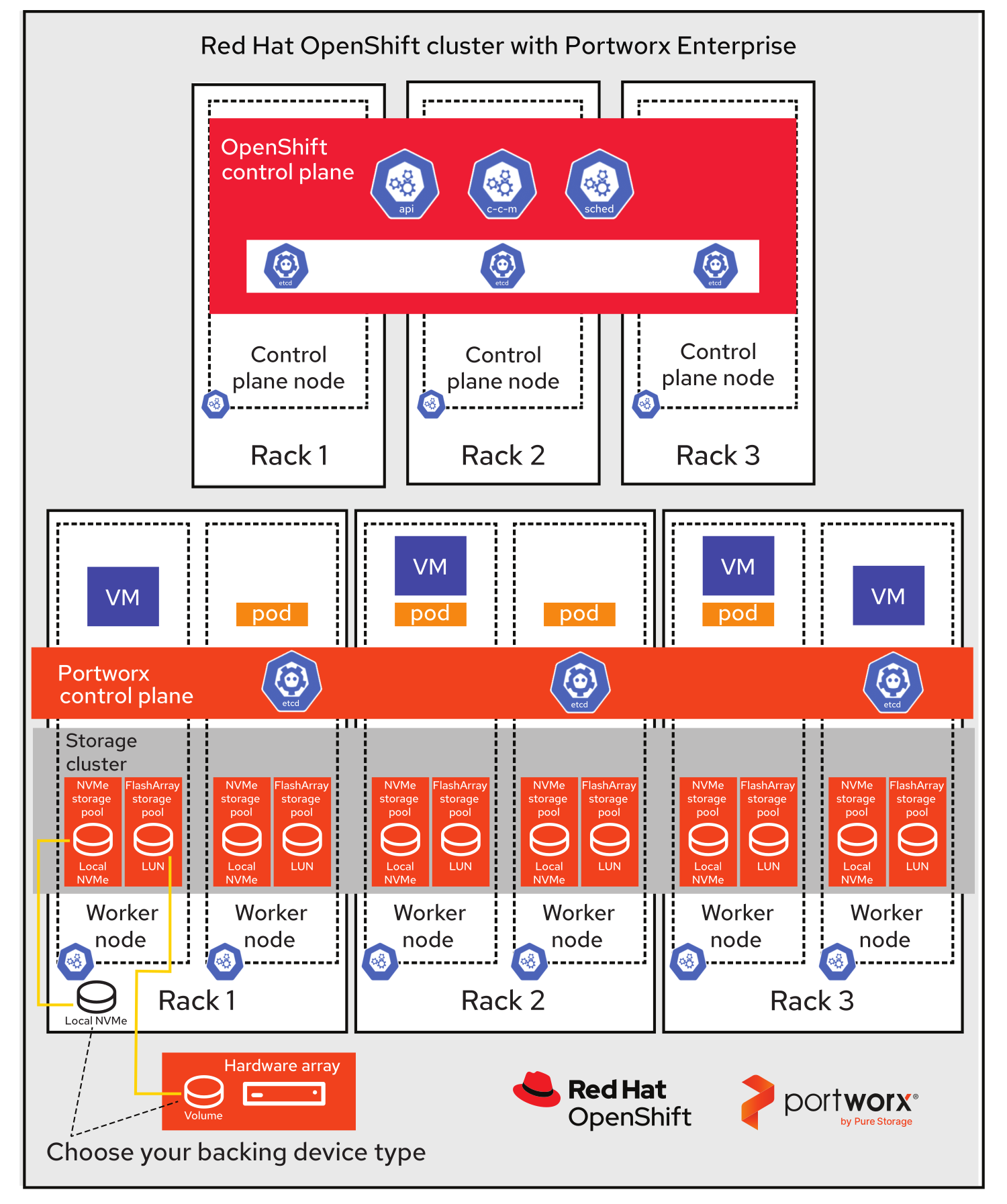
To help organizations deploy reliable solutions rapidly, Portworx provides detailed reference architectures with Red Hat OpenShift and Red Hat OpenShift Virtualization on a bare-metal deployment. Illustrated in Figure 3, the reference architectures support VMs and containers within the same Red Hat OpenShift cluster. Portworx’s advanced storage, data management, and disaster recovery capabilities run across the Red Hat OpenShift cluster in a hyper-converged architecture, ensuring high availability, performance, and scalability for both VMs and containers.

a figure displaying combined Portworx reference architectures for Red Hat OpenShift

Figure 3. Combined Portworx reference architectures for Red Hat OpenShift

By implementing the Portworx on Red Hat OpenShift Bare Metal reference architecture, a platform engineering team can automate the provisioning of a well-defined architecture for containers and virtual machines. Best practices embedded in the reference architecture include high availability, operations management, observability, business continuity, performance, and security. For bare-metal deployments on Red Hat OpenShift, Portworx strongly recommends adopting a hyper-converged architecture over a disaggregated architecture. In a hyper-converged architecture (as shown), every worker node in the Red Hat OpenShift cluster participates in provisioning storage for applications. In a disaggregated architecture, only a subset of worker nodes provide storage for the entire cluster. Hyper-converged architectures are preferable for bare-metal deployments with fixed resources, while disaggregated approaches may be more appropriate for cloud environments with relatively elastic resources.

Portworx requires a minimum of 3 storage nodes in the cluster to create a quorum and to prevent a split-brain scenario that can occur with only 2 nodes. Three nodes are also needed to provide 3 redundant copies of data for persistent volumes. For production environments, the reference architecture recommends starting with 6 nodes.

  • In a six-node cluster, losing one node affects only one-sixth of the cluster capacity.
  • A six-node cluster can also distribute I/O requests more effectively, reducing I/O latency.

The Portworx on Red Hat OpenShift Bare Metal: OpenShift Virtualization Addendum supplements the bare-metal reference architecture. It builds upon the foundational design outlined in the original base reference architecture, providing specific details and considerations for deploying and running Red Hat OpenShift on Portworx Enterprise. It offers additional design guidance that complements the official documentation, helping organizations integrate OpenShift Virtualization with Portworx in a bare-metal environment.

The OpenShift Virtualization addendum addresses key use cases for organizations looking to enhance their infrastructure by deploying OpenShift Virtualization with Portworx. Multiple use case scenarios for the addendum include modernizing traditional virtualization platforms, adopting a unified platform for containerized and virtualized workloads, and creating consistent management across workloads. The addendum gives infrastructure sizing guidance, along with considerations that include:

  • Live migration, including StorageClasses that provide RWX Access modes to enable live migration within OpenShift Virtualization, the need for similar processor types across nodes, and network considerations to improve live migration performance and application performance considerations.
  • Storage performance, including supported storage classes and storage profiles optimized for specific workload characteristics, data volume placement and scheduling across cluster resources, and network resources and configuration.
  • Upgrades, including optimally performing upgrades for VMs hosted in a Red Hat OpenShift cluster, operators and Day-2 operations, and Red Hat OpenShift storage checkup and best practices.
  • High availability, including maintaining disk-level, cluster-level, and application-level consistency and resilience, along with differences between replicas and storage device Redundant Array of Independent Disks (RAID).
  • Business continuity, including backup, recovery, and disaster recovery solutions for Red Hat OpenShift offered by Portworx.

Portworx and Red Hat OpenShift use cases

With Portworx, enterprises can build new container-based applications and run them alongside their existing VMs with high availability, reliability, and a focus on security. The joint solution supports a broad range of additional use cases, including:

  • Database platform as a service (DBPaas). Portworx Data Services on Red Hat OpenShift provides a single DBPaaS solution for developers who work with Red Hat OpenShift.
  • Container data management. Portworx Enterprise on Red Hat OpenShift offers a fully supported container data management platform with on-demand access to storage, letting organizations run containerized applications in production with performance and scalability.
  • Backup and restore. Portworx Backup on Red Hat OpenShift allows organizations to create self-service backups and restores in just a few clicks, increasing protection from ransomware attacks with object lock support, built-in role-based access control (RBAC), and end-to-end encryption for data both at rest and in flight.
  • Synchronous and asynchronous replication between clusters. Portworx business continuity and disaster recovery (BCDR) offers synchronous and asynchronous replication between Red Hat OpenShift clusters so that changes made to the primary cluster are automatically reflected in the DR cluster.

Learn more

For more information and technical details on Running Portworx on Red Hat OpenShift, see the Portworx on Red Hat OpenShift Bare Metal reference architecture and the Red Hat OpenShift Virtualization addendum. Get started in the developer sandbox, launch a trial cluster of Red Hat OpenShift Dedicated, or set up a self-managed Red Hat OpenShift Container Platform trial.

To put your knowledge to work, find out more about Portworx with Red Hat OpenShift Virtualization workshops and register for an in-person or online event. You will get access to a Red Hat OpenShift cluster with Portworx already installed and enjoy guidance from a live instructor. The lab enables participants to explore the persistent storage benefits that Portworx offers, prove data availability across a node failure, and conduct a live migration.

About Portworx

Portworx products enable you to run any cloud-native data service in any cloud or on-premise data center using any Kubernetes platform, with built-in high availability, data protection, data security, and hybrid-cloud mobility.

Tags:Virtualization

Red Hat logoLinkedInYouTubeFacebookX

Platforms

  • Red Hat AI
  • Red Hat Enterprise Linux
  • Red Hat OpenShift
  • Red Hat Ansible Automation Platform
  • See all products

Tools

  • Training and certification
  • My account
  • Customer support
  • Developer resources
  • Find a partner
  • Red Hat Ecosystem Catalog
  • Documentation

Try, buy, & sell

  • Product trial center
  • Red Hat Store
  • Buy online (Japan)
  • Console

Communicate

  • Contact sales
  • Contact customer service
  • Contact training
  • Social

About Red Hat

Red Hat is an open hybrid cloud technology leader, delivering a consistent, comprehensive foundation for transformative IT and artificial intelligence (AI) applications in the enterprise. As a trusted adviser to the Fortune 500, Red Hat offers cloud, developer, Linux, automation, and application platform technologies, as well as award-winning services.

  • Our company
  • How we work
  • Customer success stories
  • Analyst relations
  • Newsroom
  • Open source commitments
  • Our social impact
  • Jobs

Change page language

Red Hat legal and privacy links

  • About Red Hat
  • Jobs
  • Events
  • Locations
  • Contact Red Hat
  • Red Hat Blog
  • Inclusion at Red Hat
  • Cool Stuff Store
  • Red Hat Summit
© 2025 Red Hat

Red Hat legal and privacy links

  • Privacy statement
  • Terms of use
  • All policies and guidelines
  • Digital accessibility