
An Operator Lifecycle Manager (OLM) CatalogSource is a collection of operator metadata. OLM uses CatalogSources to build the list of available operators that can be installed from OperatorHub in the OpenShift web console. In OpenShift 4.3, the web console has added support for managing the out-of-the-box CatalogSources as well as adding your own custom CatalogSources.
You can create a custom CatalogSource using the OLM Operator Registry. The operator-framework/operator-registry repository has a Dockerfile to build a minimal registry server image using some example manifests and can be used to create your own custom catalog images. Run the following commands (replacing quay.io/my-organization/example-registry with your own repository) to build the example. You’ll need a repository at an image registry like quay.io for your image.
git clone https://github.com/operator-framework/operator-registry.git

cd operator-registry

docker build -t quay.io/my-organization/example-registry:latest -f upstream-example.Dockerfile .

docker push quay.io/my-organization/example-registry:latest
To add the catalog source in OpenShift console, log in as a cluster administration. Go to the Cluster Settings page under the Administration navigation section and click on the Global Configuration tab. This page lists the configuration resources for various cluster components and is a great place to explore what cluster configuration is available.
Click the OperatorHub link and then click the Sources tab to see the currently installed CatalogSources.
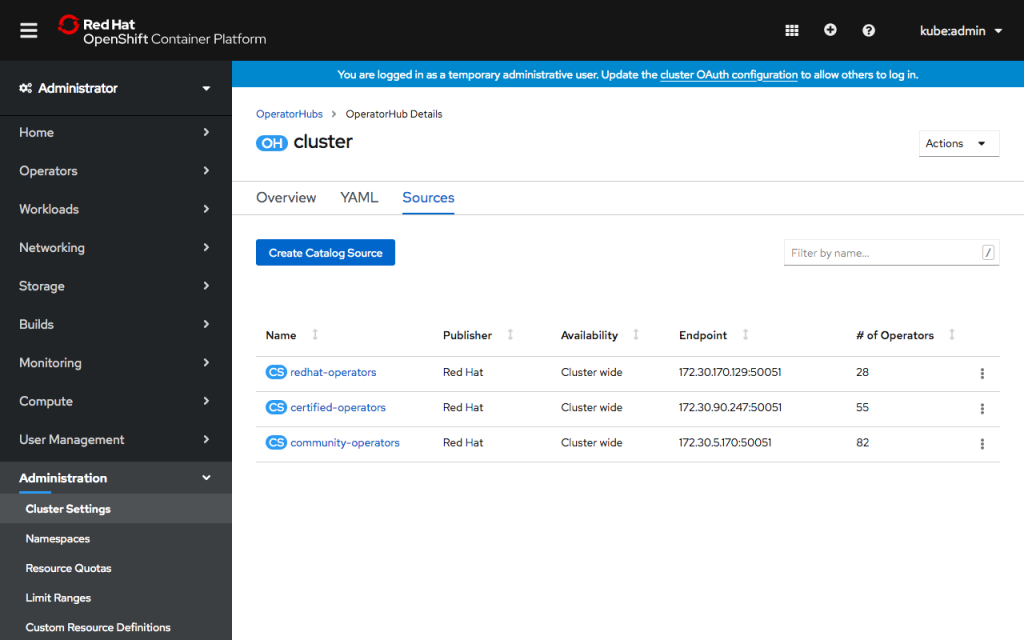
You’ll see several already present on the cluster, which populate OperatorHub with Red Hat, Certified and Community operators. These default catalog sources can now be enabled and disabled inside OpenShift console from the action menu for each table row.
To add a new CatalogSource, click Create Catalog Source. In the form, give the CatalogSource a name and optionally a display name and publisher. Enter the image name you built above. You can choose whether the CatalogSource is available for all namespaces or a single namespace.
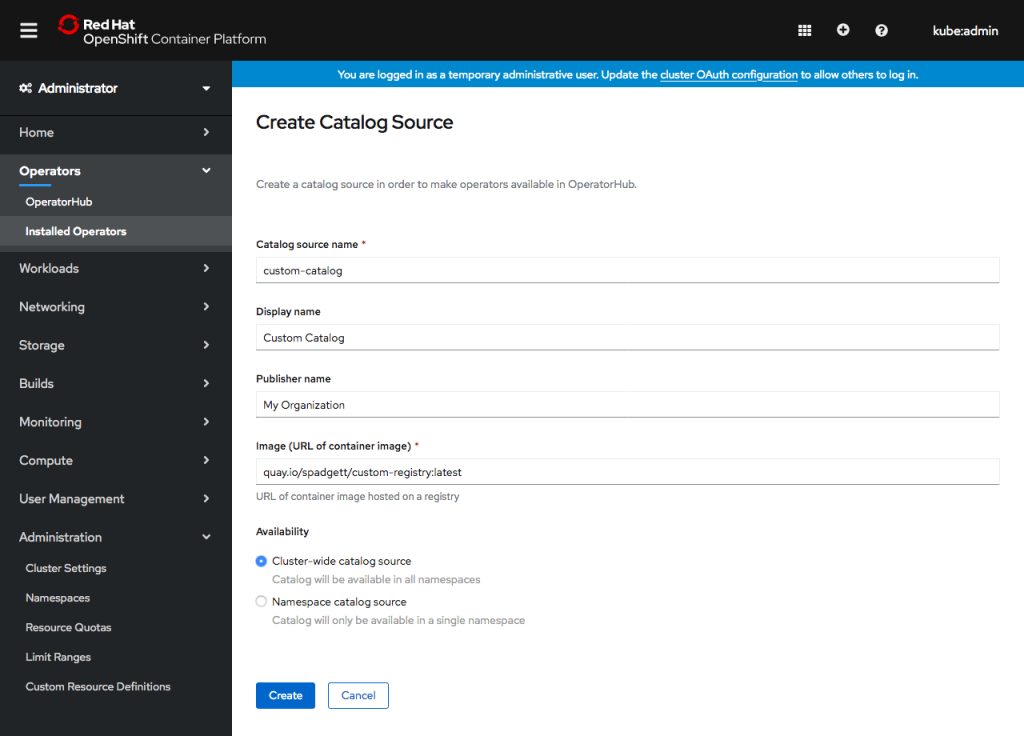
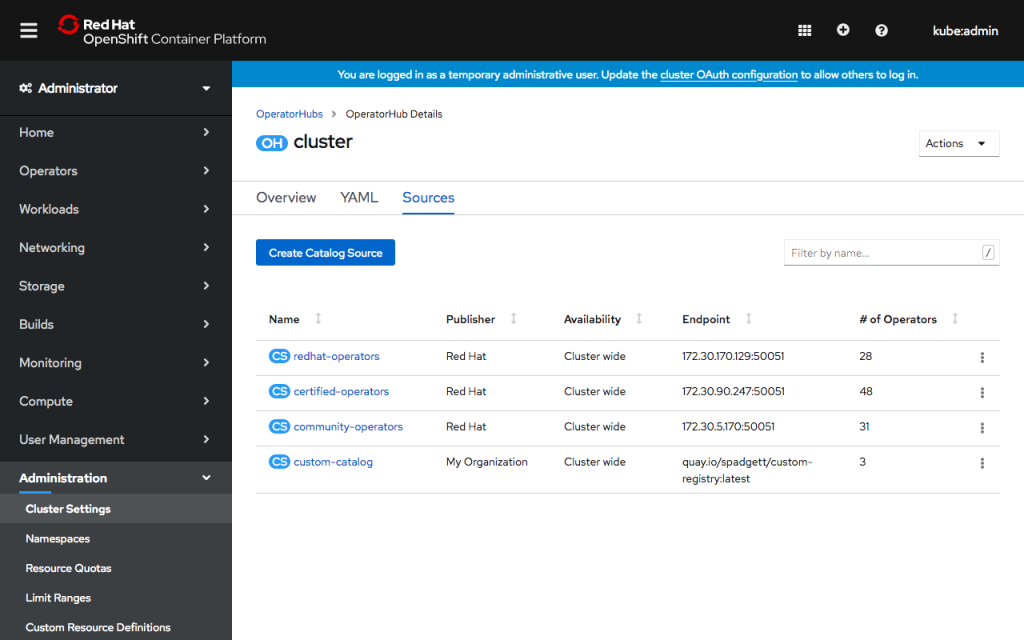
Click Create. You’ll see the new catalog source in the list. After a few minutes, OLM will load the catalog, and console will show the number of operators available.
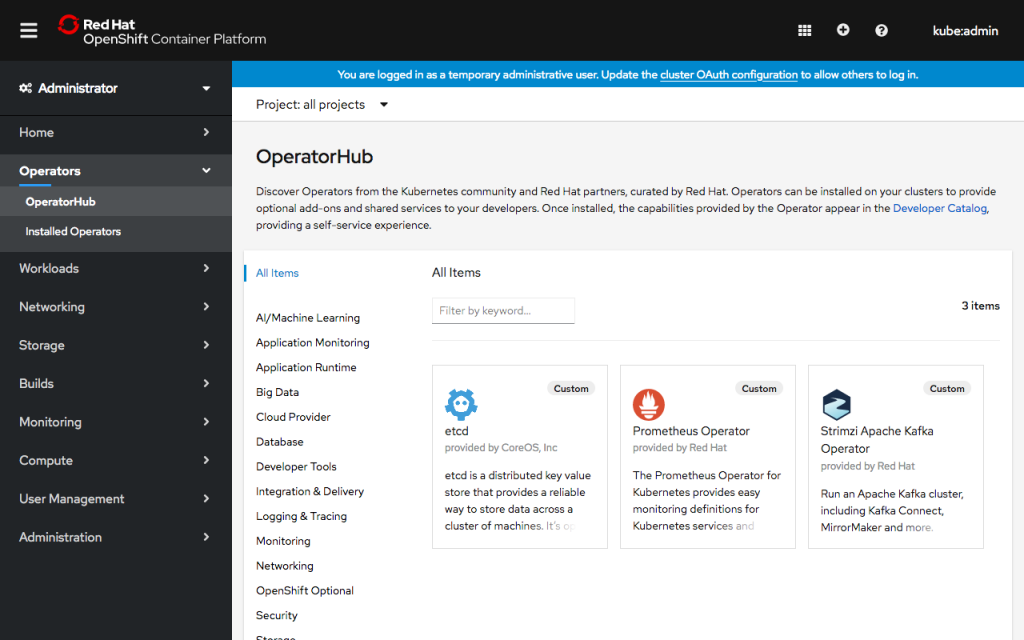
Visit the OperatorHub page under the Operators navigation section to see the new operators! Operators from a custom CatalogSource will be categorized as Provider Type “Custom,” and you can use the click the Provider Type “Custom” filter to the left of the page to see just the new operators.
If you’d like to learn more about what the OpenShift team is up to or provide feedback on any of the new 4.3 features, please take this brief 3-minute survey.
About the author
More like this
Azure Red Hat OpenShift with hosted control planes is now available in public preview
Streamlining container security: Red Hat Hardened Images now supported in AWS InspectorScan API and ECR Basic scanning
Scaling with Orchestrators | Compiler
Container Roundup | Compiler
Browse by channel

Automation
The latest on IT automation for tech, teams, and environments

Artificial intelligence
Updates on the platforms that free customers to run AI workloads anywhere

Open hybrid cloud
Explore how we build a more flexible future with hybrid cloud

Security
The latest on how we reduce risks across environments and technologies

Edge computing
Updates on the platforms that simplify operations at the edge

Infrastructure
The latest on the world’s leading enterprise Linux platform

Applications
Inside our solutions to the toughest application challenges

Virtualization
The future of enterprise virtualization for your workloads on-premise or across clouds
