
GitLab and Red Hat have been collaborative and successful technology partners for over 2 years. GitLab began their Red Hat integration and certification journey with the GitLab Runner, an open-source GitLab component used to run pipeline tasks.
Now, in collaboration with the team over at GitLab, we are announcing the certification of the GitLab Server operator to allow users to install GitLab instances directly on their OpenShift clusters. Customers can now have their DevOps lifecycle and infrastructure all on the same stack.
Please Note: The Operator is ready for development testing and feedback, but not yet recommended for production environments.
Complex deployment
The GitLab application and its operator are complex, with a large amount of required components and configurations. This gave us the opportunity to work hand in hand between Red Hat and GitLab engineering teams to enable the creation and certification of the operator and its components. We wanted to ensure the product complexity was abstracted away from the customer, which is what the operator deployment achieves.
Completing this operator certification is a significant milestone and gives customers the confidence and assurance that GitLab runs effectively, jointly supported by Red Hat, on OpenShift.
Run GitLab directly on your OpenShift cluster
With the use of the GitLab operator, you can run your self-hosted GitLab instance directly on any OpenShift or Kubernetes cluster. This enables development teams to access and work within their GitLab DevOps platform from any location, on the same trusted infrastructure used for other shared applications and services.
This operator functionality is an extension and advancement of the existing cloud native GitLab Helm chart and, as of early 2022, the Kubernetes community operator. The operator deployment model, in contrast to Helm, facilitates a simple, streamlined installation and integration for the end-user and ensures seamless upgrades of both the OpenShift clusters and GitLab components. Operators help to reduce application deployment complexity for our joint customers.
Now, with the Red Hat OpenShift certification in place, the GitLab product components run on Red Hat’s Universal Base Image (UBI) and have gone through our operator certification program to ensure successful deployment and functionality based on Red Hat policy requirements. This allows the GitLab platform on OpenShift to be supported collaboratively with Red Hat, to the benefit of current and future joint customers.
The DevSecOps Platform
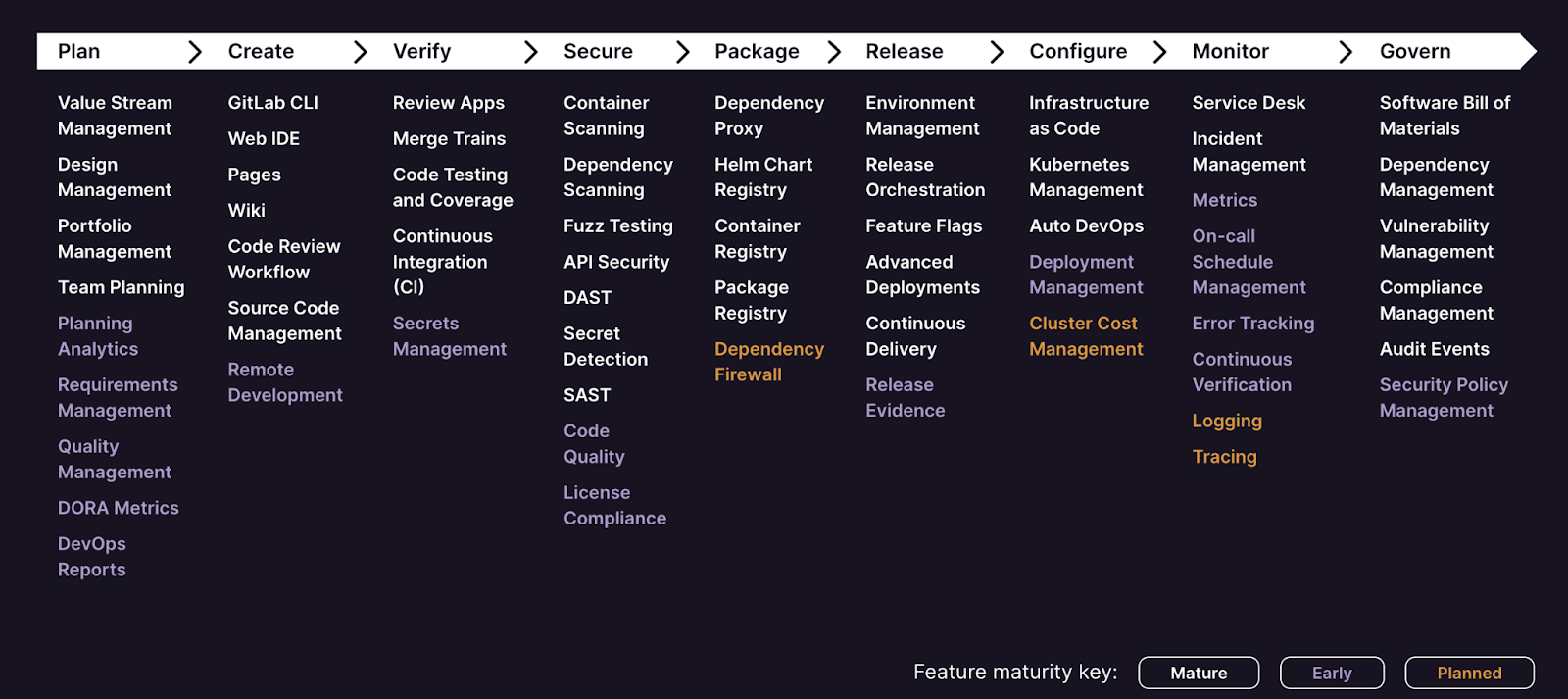
GitLab accelerates software development by streamlining version control, CI/CD, and security within a single DevSecOps platform.
Utilizing GitLab, as Red Hat internal teams and many of our customers do today, improves cycle time from weeks to minutes, reduces operational costs, speeds time to market, and delivers more secure and compliant applications.
Check out some of the platform features:
Try it out
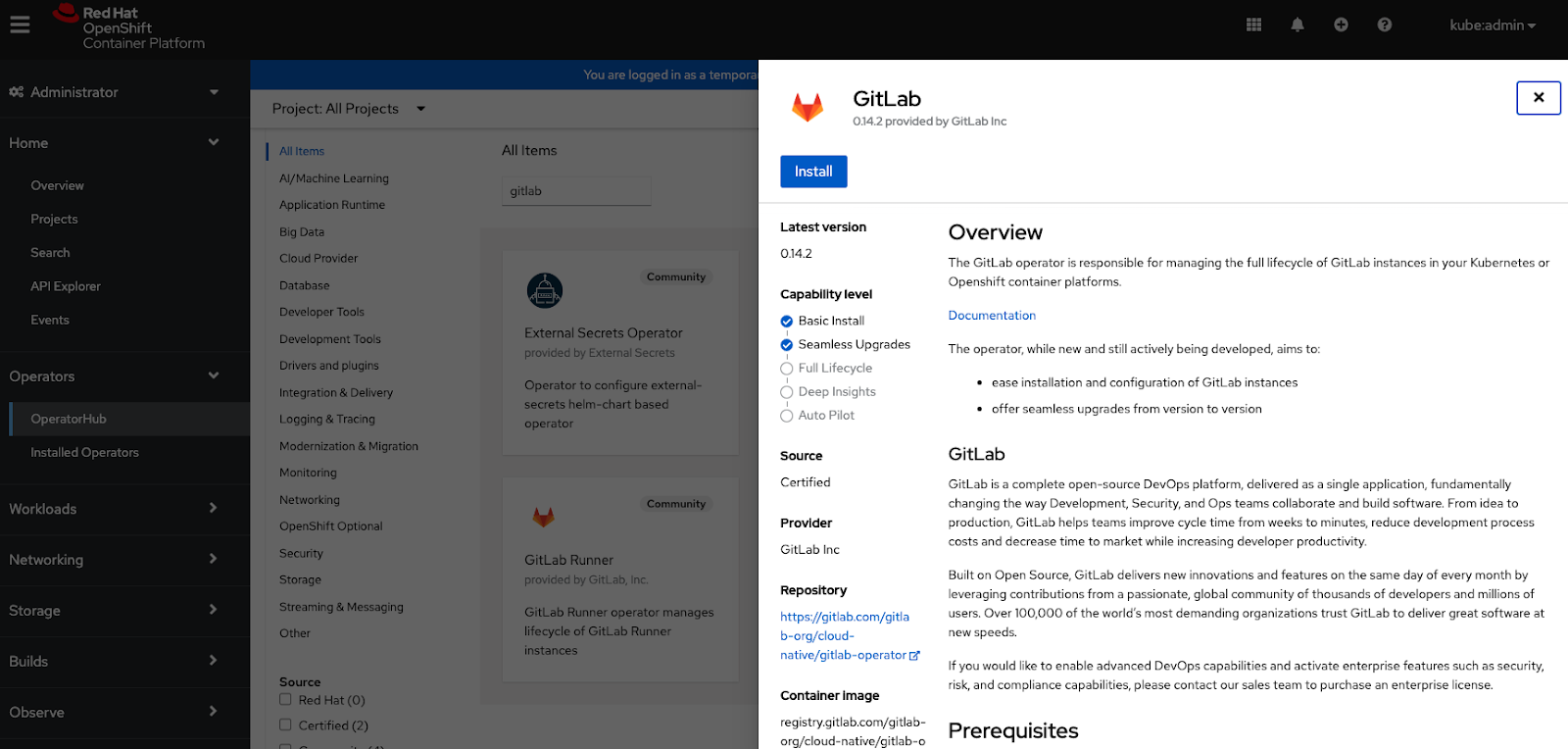
The GitLab Operator is available now in the OpenShift console via the embedded OperatorHub. Check out the catalog listing for links to documentation and installation instructions. For a self-managed free trial to host GitLab on your OpenShift cluster, submit this form.
About the author
More like this
NVIDIA BlueField security and acceleration arrive on the Red Hat AI Factory with NVIDIA and Red Hat OpenShift
Streamlining container security: Red Hat Hardened Images now supported in AWS InspectorScan API and ECR Basic scanning
Scaling with Orchestrators | Compiler
Container Roundup | Compiler
Browse by channel

Automation
The latest on IT automation for tech, teams, and environments

Artificial intelligence
Updates on the platforms that free customers to run AI workloads anywhere

Open hybrid cloud
Explore how we build a more flexible future with hybrid cloud

Security
The latest on how we reduce risks across environments and technologies

Edge computing
Updates on the platforms that simplify operations at the edge

Infrastructure
The latest on the world’s leading enterprise Linux platform

Applications
Inside our solutions to the toughest application challenges

Virtualization
The future of enterprise virtualization for your workloads on-premise or across clouds
