Red Hat OpenShift Pipelines is a cloud-native, continuous integration and continuous delivery (CI/CD) solution based on Kubernetes resources. It uses Tekton building blocks to automate deployments across multiple platforms by abstracting away the underlying implementation details. Tekton introduces a number of standard custom resource definitions (CRDs) for defining CI/CD pipelines that are portable across Kubernetes distributions.
Red Hat OpenShift Pipelines 1.8 is now Generally Available on OpenShift Container Platform 4.10, and is planned to be available on OpenShift Container Platform 4.11 and 4.12.
New Features and Enhancements:
- Red Hat OpenShift Pipelines on Arm: With this release, you can run Red Hat OpenShift Pipelines 1.8 and later on an OpenShift Container Platform cluster that is running on Arm architecture.
- Tekton Hub enhancements:
- As an administrator, you can configure Tekton Hub to use a custom database rather than the default database.
- As an administrator, if you enable Tekton Hub, it periodically updates the catalog with the current information. You can configure the length of this period.
- As an administrator, you can install Tekton Hub with minimal input because it has better default configuration settings. You can start running Tekton Hub and work with your teams to decide what customizations they need.
- Pipelines as code enhancements:
- Add Git repository via webhook: You can add your Git repository to Pipelines as Code by using the webhook mechanism. This way, you can use Pipelines as Code even if GitHub Apps is not feasible.
- Trigger multiple pipelines for one Git event: You can trigger multiple pipeline runs for one git event e.g. PR.
- Manual and third party triggers: You as a developer will be able to trigger pipelinerun directly without being tightened up to a code flow.
- Support for additional git providers like Gitlab and Bitbucket
- Bootstrapping via dev console:
- You can create a Github application from the dev console. (Figure 1)
- You can configure the git provider (GitHub, GitLab and BitBucket) by adding repositories to enable pipeline as code. (Figure 2)

Figure 1
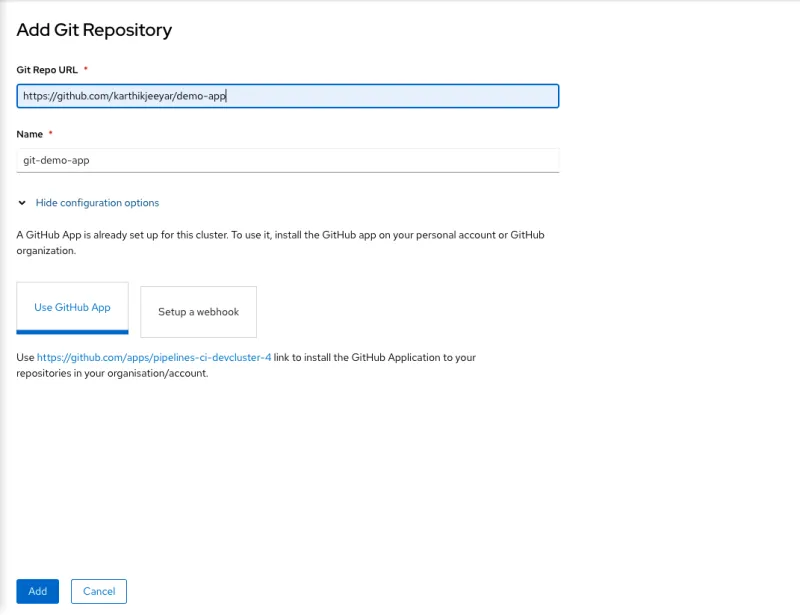 Figure 2
Apart from the features mentioned above, support for the PipelineResource custom resource (CR) and Condition custom resource (CR) have been removed as we are deprecating the tekton.dev/v1alpha1 API version.
For a full list and detailed information about each item in this release, please check out the Release Notes section of the OpenShift Documentation.
Where to next?
You can install Red Hat OpenShift Pipelines using the Operator listed in the OpenShift Container Platform OperatorHub and start using pipelines.
For more detailed understanding of Openshift Pipelines, check out Understanding OpenShift Pipelines.
About the author

More like this
Looking ahead to 2026: Red Hat’s view across the hybrid cloud
Red Hat to acquire Chatterbox Labs: Frequently Asked Questions
Crack the Cloud_Open | Command Line Heroes
What Kind of Coder Will You Become? | Command Line Heroes
Browse by channel

Automation
The latest on IT automation for tech, teams, and environments

Artificial intelligence
Updates on the platforms that free customers to run AI workloads anywhere

Open hybrid cloud
Explore how we build a more flexible future with hybrid cloud

Security
The latest on how we reduce risks across environments and technologies

Edge computing
Updates on the platforms that simplify operations at the edge

Infrastructure
The latest on the world’s leading enterprise Linux platform

Applications
Inside our solutions to the toughest application challenges

Virtualization
The future of enterprise virtualization for your workloads on-premise or across clouds
