Skip to contentRed Hat AI
  • Our approach

    • News and insights
    • Technical blog
    • Research
    • Live AI events
    • Explore AI at Red Hat
  • Our portfolio

    • Red Hat AI
    • Red Hat Enterprise Linux AI
    • Red Hat OpenShift AI
    • Red Hat AI Inference Server
  • Engage & learn

    • AI learning hub
    • AI partners
    • Services for AI
Hybrid cloud
  • Platform solutions

    • Artificial intelligence

      Build, deploy, and monitor AI models and apps.

    • Linux standardization

      Get consistency across operating environments.

    • Application development

      Simplify the way you build, deploy, and manage apps.

    • Automation

      Scale automation and unite tech, teams, and environments.

  • Use cases

    • Virtualization

      Modernize operations for virtualized and containerized workloads.

    • Digital sovereignty

      Control and protect critical infrastructure.

    • Security

      Code, build, deploy, and monitor security-focused software.

    • Edge computing

      Deploy workloads closer to the source with edge technology.

  • Explore solutions
  • Solutions by industry

    • Automotive
    • Financial services
    • Healthcare
    • Industrial sector
    • Media and entertainment
    • Public sector (Global)
    • Public sector (U.S.)
    • Telecommunications

Discover cloud technologies

Learn how to use our cloud products and solutions at your own pace in the Red Hat® Hybrid Cloud Console.

Products
  • Platforms

    • Red Hat AI

      Develop and deploy AI solutions across the hybrid cloud.

      New version
    • Red Hat Enterprise Linux

      Support hybrid cloud innovation on a flexible operating system.

    • Red Hat OpenShift

      Build, modernize, and deploy apps at scale.

    • Red Hat Ansible Automation Platform

      Implement enterprise-wide automation.

  • Featured

    • Red Hat OpenShift Virtualization Engine
    • Red Hat OpenShift Service on AWS
    • Microsoft Azure Red Hat OpenShift
    • See all products
  • Try & buy

    • Start a trial
    • Buy online
    • Integrate with major cloud providers
  • Services & support

    • Consulting
    • Product support
    • Services for AI
    • Technical Account Management
    • Explore services
Training
  • Training & certification

    • Courses and exams
    • Certifications
    • Red Hat Academy
    • Learning community
    • Learning subscription
    • Explore training
  • Featured

    • Red Hat Certified System Administrator exam
    • Red Hat System Administration I
    • Red Hat Learning Subscription trial (No cost)
    • Red Hat Certified Engineer exam
    • Red Hat Certified OpenShift Administrator exam
  • Services

    • Consulting
    • Partner training
    • Product support
    • Services for AI
    • Technical Account Management
Learn
  • Build your skills

    • Documentation
    • Hands-on labs
    • Hybrid cloud learning hub
    • Interactive learning experiences
    • Training and certification
  • More ways to learn

    • Blog
    • Events and webinars
    • Podcasts and video series
    • Red Hat TV
    • Resource library

For developers

Discover resources and tools to help you build, deliver, and manage cloud-native applications and services.

Partners
  • For customers

    • Our partners
    • Red Hat Ecosystem Catalog
    • Find a partner
  • For partners

    • Partner Connect
    • Become a partner
    • Training
    • Support
    • Access the partner portal

Build solutions powered by trusted partners

Find solutions from our collaborative community of experts and technologies in the Red Hat® Ecosystem Catalog.

Search

I'd like to:

  • Start a trial
  • Manage subscriptions
  • See Red Hat jobs
  • Explore tech topics
  • Contact sales
  • Contact customer service

Help me find:

  • Documentation
  • Developer resources
  • Skills assessments
  • Architecture center
  • Security updates
  • Support cases

I want to learn more about:

  • AI
  • Application modernization
  • Automation
  • Cloud-native applications
  • Linux
  • Virtualization
ConsoleDocsSupportNew For you

Recommended

We'll recommend resources you may like as you browse. Try these suggestions for now.

  • Product trial center
  • Courses and exams
  • All products
  • Tech topics
  • Resource library
Log in

Get more with a Red Hat account

  • Console access
  • Event registration
  • Training & trials
  • World-class support

A subscription may be required for some services.

Log in or register
Contact us
  • Home
  • Resources
  • Advance your automation maturity

Advance your automation maturity

February 24, 2025•
Resource type: E-book
Download PDF

Introduction: Automation adoption

How you automate is as important as what you automate

IT automation is a critical part of business operations and can deliver many benefits, especially during the more advanced stages of adoption. This guide can help you progress faster on your journey to enterprise-wide automation.

Red Hat® Ansible® Automation Platform is a comprehensive solution that provides everything you need to implement enterprise-wide automation, but without the right organizational strategy and behaviors, success isn’t guaranteed. While automation delivers value at every stage, the most significant benefits are generally realized when organizations reach the later stages of automation maturity. Progressing to more advanced stages of automation maturity also allows you to establish a foundation for innovation such as artificial intelligence operations (AIOps).

There is no single one-size-fits-all path to successful enterprise IT automation adoption. Each journey is unique to the organization and individual practitioners who deploy and use the technology. Even so, automation adoption initiatives should be approached from both the leadership and the practitioner levels within your organization. For example, if you’re in an IT leadership position, identify automation enthusiasts within your organization to help lead your initial pilot deployment or join your community of practice or center of excellence. If you’re an automation practitioner, find an executive or influential sponsor to help you promote automation adoption from the top down. 

Assess your automation maturity

Automation adoption at any level can deliver benefits to your teams and organization, even at the earliest stages. Even so, realistically assessing where your organization currently stands in terms of automation skills and use is essential for growing and accelerating your automation practice.

Improved operational efficiency, reduced risk, and strategic transformation are typically achieved when organizations reach the later stages of automation maturity.

Most organizations find that managing automation is difficult at the earlier stages, but becomes more straightforward as users become more familiar with the technology and your organization establishes a broader culture of automation. To help you assess your organization’s automation practice and gain insight into how to move forward, we’ve divided the automation adoption journey into 5 distinct stages:

  • Stage 1: Awareness. Individuals successfully automate day-to-day tasks. The organization has no common standards or centralized content repositories.
  • Stage 2: Standardized. One or more teams standardize how they execute their day-to-day tasks, creating and executing shared playbooks.
  • Stage 3: Proactive. Teams adopt and expand into new use cases and build a framework for testing automation. The organization establishes standards, governance, access controls, and best practices.
  • Stage 4: Institutionalized. Cross-functional teams collaborate and deploy orchestrated workflows as well as event-driven automation to support higher performance and efficiency.
  • Stage 5: Optimized. The organization develops an advanced culture of automation. Internal audits expose opportunities to save more time and further reduce risk using automation across every part of the IT organization. 

To progress to more advanced stages of automation maturity, you need to continuously look for ways to improve your approach to automation. The flexibility of both individuals and teams during this iterative process can greatly influence the speed at which you progress and, consequently, the business outcomes and benefits you achieve.

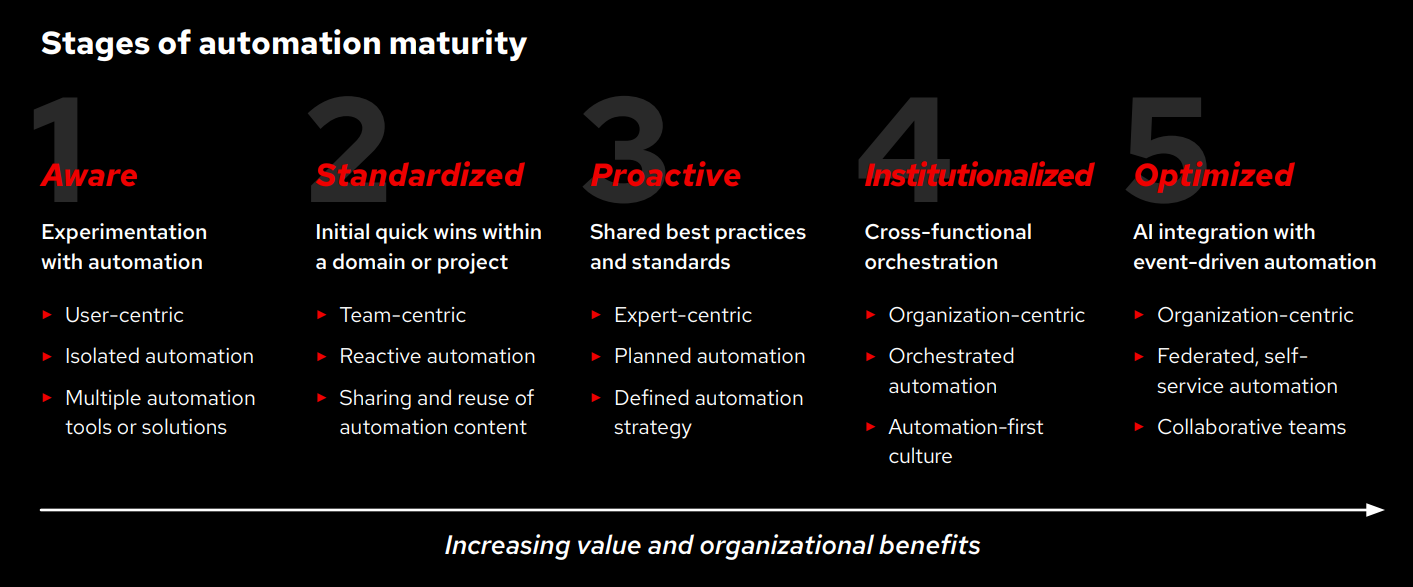
chart showing Stages of automation maturity

The following chapters explore each of the stages of automation maturity in more detail.

Stage 1: Awareness

Experimentation and exploration with automation of day-to-day tasks

Start your journey by exploring the capabilities of your automation platform and automating small tasks to gain an understanding of the potential uses and benefits. At this stage, the tangible business benefits of automation are limited, as automation efforts are generally focused on simplifying single tasks within an individual’s daily work. Organizations typically also lack standards and governance and may use untested automation code, resulting in performance and reliability issues for enterprise systems. The key to moving forward is broad participation and collaboration amongst staff and teams.

Key questions to ask 

  • How is automation used in your organization today? What has the effect on the organization been so far?
  • Which automation solutions and tools do you use? How do they integrate into your processes? Is there
    an opportunity to consolidate tools?  

Key activities

  • Explore Ansible Automation Platform features and capabilities.
  • Understand the foundations of Ansible Automation Platform.
  • Create simple automation tasks and measure results. 

Stage characteristics

  • User-centric approach
  • Isolated automation efforts
  • Multiple automation tools or solutions

Key Ansible Automation Platform features

  • Ansible Playbooks
  • YAML

Stage 2: Standardized

Initial wins within a domain or project and automation tool evaluation

In stage 2, automation projects expand to quick successes within a specific domain or project. Teams begin to evaluate their current automation tools and identify areas to consolidate and simplify. Collaboration between users and automation champions improves through knowledge-sharing and use case discussions.

Organizations often start with overly ambitious automation roadmaps and plans that may be difficult to execute at this phase of maturity. We recommend starting small and focusing on a few initial quick wins before progressing to more advanced forms of automation. Now is the time to begin working collaboratively and encouraging users to learn from each other. Teams should adopt the habit of tracking and sharing the results of their automation to promote enthusiasm and gain internal support from leadership. 

TIP: Remember to acknowledge and proactively address anxiety and concerns around automation. Emphasize the advantages users will experience, including emotional benefits like improved work-life balance, time to focus on more challenging projects, and developing their skills. 

Watch out for inertia

The tangible business value of automation—reduced risk, improved operational efficiency, and increased productivity—become far more apparent in automation maturity stages 3 and beyond. Even so, we find that most organizations, regardless of how long they’ve been automating, rate themselves at stage 2 on the automation maturity scale. Too often, the comfort of familiar team divisions and processes prevent the deployment of the cross-functional orchestration that serves as the foundation for resilient AIOps. Executive-level sponsorship and a well-articulated strategy and roadmap are essential for teams to let go of old work patterns and processes and advance to the next stage. 

Key questions to ask 

  • Which common tasks does your team perform repetitively?
  • How would you describe your staffs’ skills and knowledge related to automation?
  • To what extent does your organization’s culture support and prioritize automation initiatives?
  • Are there enthusiasts in your organization to run an initial automation pilot program within a single domain like networking or cloud operations? 

Key activities

  • Identify automation champions across teams.
  • Measure your automation performance and share the results broadly to generate enthusiasm.
  • Consolidate automation tools to improve cost efficiency and simplify training and skills development.
  • Focus on simple, beneficial use cases. 

High-impact automation use cases

Stage characteristics

  • Team-centric approach
  • Reactive automation efforts
  • Sharing and reuse of automation content

Key Ansible Automation Platform features

  • Ansible Content Collections
  • Automation analytics and
    Red Hat Lightspeed

Area

Use cases

Operating system

  • Upgrade firmware
  • Install, modify, and deploy applications
  • Automate patching and upgrades
  • Manage configurations
  • Automate compliance and remediate drift
  • Manage vulnerabilities

Cloud

  • Manage public cloud resources, virtual networks, subnets, and interfaces
  • Manage virtual machines, serverless functions, and Kubernetes clusters
  • Optimize infrastructure
  • Create and delete autoscale groups
  • Manage governance
  • Ensure business continuity

Network

  • Manage controllers, firewalls, routers, switches, load balancers, and access points
  • Update operating systems and ensure compliance from datacenter to branches
  • Deploy standard network confirmations and harden networks
  • Automate configuration backups of network equipment
  • Gather facts and create dynamic compliance reports
  • Validate network state through event-driven health checks

Application delivery

  • Manage infrastructure as code
  • Support self-service infrastructure requests
  • Automate deployment strategy
  • Roll back or forward application versions on demand
  • Manage configurations and lifecycles of on-site and off-site resources via Secure Shell (SSH), WinRM, or application programming interface (API)
  • Implement GitOps
  • Control application deployment in containers

Virtualization

  • Manage bare-metal service, containers, and high-performance computing (HPC) clusters
  • Install applications, modify settings, and deploy services
  • Manage certificates, entitlements, and packages
  • Manage system configuration validation and drift
  • Manage virtualization layer and hypervisor
  • Manage lifecycles
  • Ensure business continuity

AIOps

  • Initiate event-driven or embedded automation via AI-generated outputs
  • Perform root-cause analysis (RCA)
  • Build self-healing infrastructure
  • Identify and respond to security threats
  • Optimize costs and resources
  • Enrich support and ticket incidents

​​Stage 3: Proactive

Shared best practices and standards and expansion of automation use cases.

At this stage, the larger business benefits of automation come into sight. Organizations start to adopt best practices and standards to ensure consistency and governance within their practice. They also launch communities of practice (CoPs) to establish a culture of automation and share knowledge across teams.

CoPs are critical for defining standards and practices for the rest of your organization to follow. But a CoP that retains centralized control over time can become rigid, slow, and inflexible to the needs of automation consumers, ultimately hindering the innovation it wants to promote. Expand your CoP to include anyone who is interested in automation. Empower users to learn, create, deploy, and share automation content within their areas of responsibility. Based on these efforts, the business value of automation can grow exponentially.

Key questions to ask 

  • How do your current automation efforts support your business objectives?
  • Which automation champions can help launch your CoP and define organizational standards and governance?
  • Who will manage your automation content? How will content be shared? How will you evaluate the content that is created?
  • What is your organization’s approach to automation security and governance?
  • What is the current RACI (responsible, accountable, consulted and informed) matrix for your automation platform?
  • What are the expectations for availability for your automation platforms? Are your platforms monitored? If so, which components?
  • Do you use your automation platform logs to produce audit and performance reports?

Key activities

  • Launch an automation CoP within a team or domain.
  • Define your automation strategy and roadmap.
  • Focus on 3-5 automation use cases that will support your business outcomes.
  • Establish best practices, governance, standards, and security and access controls.
  • Continue to measure performance and share the results of prioritized use cases.
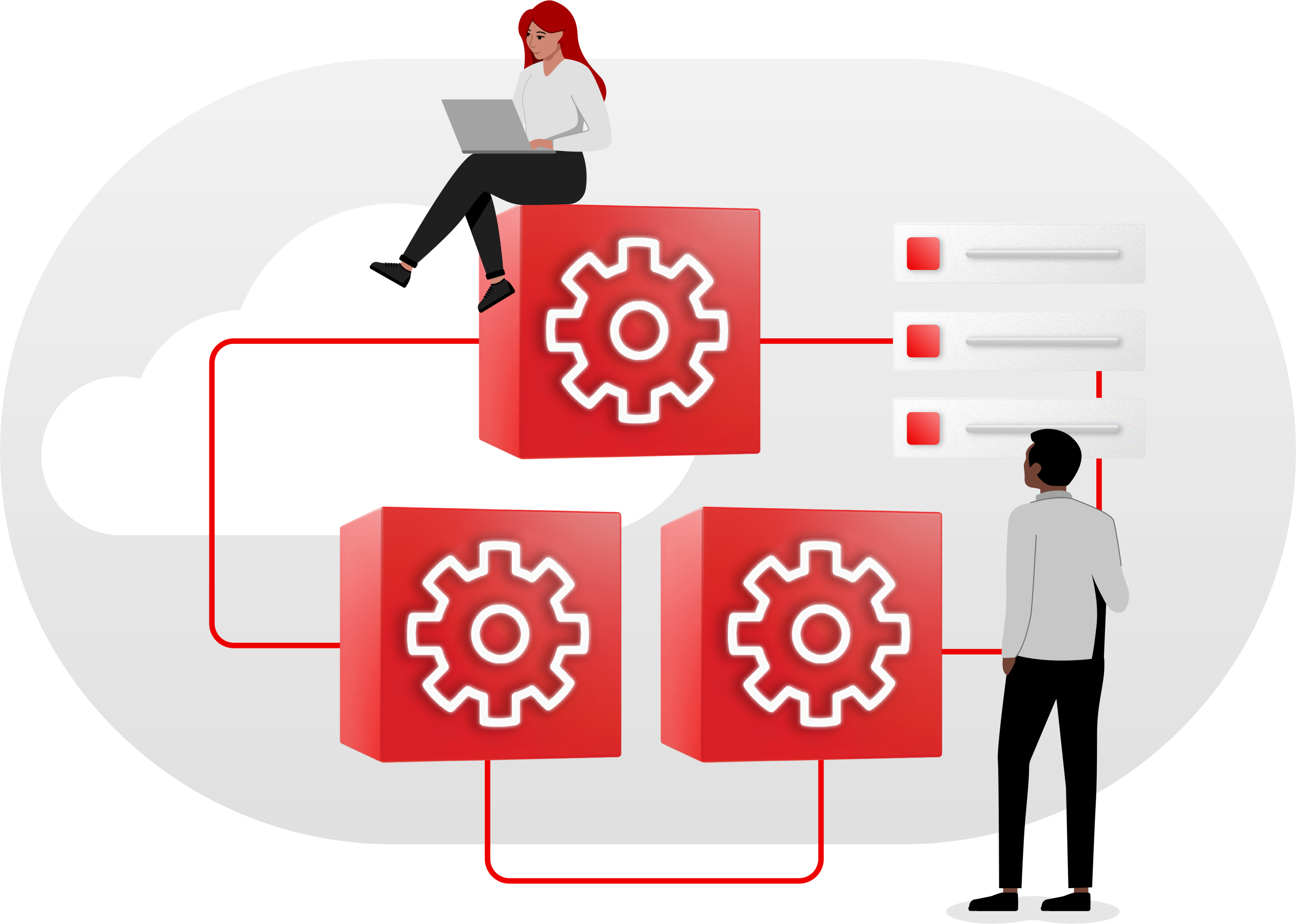
two people interacting with a technology system represented by three large red cubes with gear icons.

Stage characteristics

  • Expert-centric approach
  • Planned automation efforts
  • Defined automation strategy

Key Ansible Automation Platform features

  • Ansible automation hub
  • Ansible VS Code extension
  • Ansible development tools

Stage 4: Institutionalized

Established culture of automation with cross-functional orchestration

By this point, automation is widely embraced as a mission-critical technology throughout the organization. An established culture of automation and end-to-end orchestrated workflows increase trust, collaboration, speed, agility, and innovation. Teams identify and rework broken or inefficient processes through automation. Practitioners expand their expertise and influence while working across teams and functions to solve problems and create business value.

Because of their cross-functional nature, it takes time and patience for CoPs to thrive. Begin by defining what success looks like for your community. What is your mission or purpose? Do you want to foster innovation? Or use automation to overcome key business challenges? Starting with your desired end results in mind can make it easier to plan your automation roadmap. Be sure to create an open and collaborative environment that encourages community members to share content and ideas, while adhering to the standards established within the company framework.

TIP: Learn how to set up an automation CoP. Read the e-book.

Key questions to ask 

  • How do your teams work together to solve problems using automation?
  • Does each department have the skills needed to meet their own automation needs?
  • What is your process for onboarding users and content creators to your automation platform?
  • Is there a formal content review process? Does it interact with your change management standards?
  • What is the process for executing automation content against inventory resources?
  • Do you have a post-execution validation process, for example, inventory, content, and user permissions confirmation; variable validation; and execution approval?

Key activities

  • Expand your automation CoP to include anyone with an interest in automation.
  • Identify and create cross-functional orchestrated workflows.
  • Streamline your developer experience and tools.
  • Set up automation for ticket enrichment based on events within your IT infrastructure. 
two colleagues discussing a workflow diagram and code snippets displayed inside large speech bubbles.

Stage characteristics

  • Organization-centric approach
  • Orchestrated automation efforts
  • Automation-first culture

Key Ansible Automation Platform features

  • Automated workflows
  • Red Hat Ansible Lightspeed
  • Automated policy as code
  • Event-driven Ansible

Stage 5: Optimized

Create self-healing infrastructure through AI and event-driven automation 

In the last stage, organizations use automation to establish self-learning, self-healing, optimized infrastructure. Self-service access to automation ensures systems are configured consistently across environments to provide the performance reliability needed to support AI-based workloads. Organizations continuously examine and reassess processes and tools to further streamline and refine operations and reallocate staff time to strategic transformation.

With clearly defined automation strategies, an established automation-first culture, and technical expertise in automation technology, Red Hat customers at this stage of their automation journey are leaders amongst their peers. They are generally seen as more competitive, agile, and innovative within their industries—which is why they often present on the main stage of Red Hat Summit and AnsibleFest each year. At the same time, these organizations know that automation continues to be an ongoing journey. They engage in a continuous and adaptable process of refinement and adjustment to respond to the shifting demands of their businesses.

Key questions to ask 

  • Are there tools within your IT organization that can be further consolidated using automation?
  • Are AI and machine learning integrated into your automation efforts? Where are opportunities to create end-to-end, self-healing infrastructure?
  • Are teams working collaboratively and empowered with the automation they need to do their jobs?
  • Have you adapted your CoP as your automation practice has matured? 

Key activities

  • Reduce redundant automation tools for cost optimization and simplified user training and onboarding.
  • Audit IT teams and identify additional time savings that translate to found capacity and more budget for innovation.
  • Expand completely automated workflows with no human intervention to further reduce errors.
  • Create self-service automation templates and make them available to users through your internal developer portal (IDP) to boost productivity. 
a woman managing a technology system that connects to several completed tasks indicated by checkmarks.

Stage characteristics

  • Organization-centric approach
  • Federated, self-service automation
  • Collaborative teams

Key Ansible Automation Platform features

  • Ansible plug-ins for Red Hat Developer Hub

Ready to advance your automation journey?

No matter where your company is on the automation maturity path, Red Hat Consulting can help you advance to the next level in less time. 

Using methodologies and practices proven across organizations of every size, type, and industry, our experts work alongside your teams to assess your organization’s automation maturity and implement a roadmap that’s aligned to your strategy and goals. They can also help you create a foundation for collaboration and autonomous IT operations.

The result? Your organization can get more value from your automation investment, faster. 

Get expert guidance for establishing your automation CoP from Red Hat Consulting.
 

Get advice

See how Transunion successfully scaled automation across their entire organization.
 

Watch the video

See how other customers have planned their automation strategies and experienced success.
 

Watch the video

Tags:Automation and management

Red Hat logoLinkedInYouTubeFacebookX

Platforms

  • Red Hat AI
  • Red Hat Enterprise Linux
  • Red Hat OpenShift
  • Red Hat Ansible Automation Platform
  • See all products

Tools

  • Training and certification
  • My account
  • Customer support
  • Developer resources
  • Find a partner
  • Red Hat Ecosystem Catalog
  • Documentation

Try, buy, & sell

  • Product trial center
  • Red Hat Store
  • Buy online (Japan)
  • Console

Communicate

  • Contact sales
  • Contact customer service
  • Contact training
  • Social

About Red Hat

Red Hat is an open hybrid cloud technology leader, delivering a consistent, comprehensive foundation for transformative IT and artificial intelligence (AI) applications in the enterprise. As a trusted adviser to the Fortune 500, Red Hat offers cloud, developer, Linux, automation, and application platform technologies, as well as award-winning services.

  • Our company
  • How we work
  • Customer success stories
  • Analyst relations
  • Newsroom
  • Open source commitments
  • Our social impact
  • Jobs

Change page language

Red Hat legal and privacy links

  • About Red Hat
  • Jobs
  • Events
  • Locations
  • Contact Red Hat
  • Red Hat Blog
  • Inclusion at Red Hat
  • Cool Stuff Store
  • Red Hat Summit
© 2025 Red Hat

Red Hat legal and privacy links

  • Privacy statement
  • Terms of use
  • All policies and guidelines
  • Digital accessibility