4. Modernize your applications over time, on your schedule
While migrating monolithic or n-tier applications on VMs to containerized, microservices-based workloads can deliver major benefits, enhancing scalability, productivity, and agility, it can also require significant investments in time and resources. That’s why platforms that support mixed environments, including VMs, containers, bare metal, and even serverless workloads, are critical. They let you strategically transform applications at your own pace and according to your unique business needs.
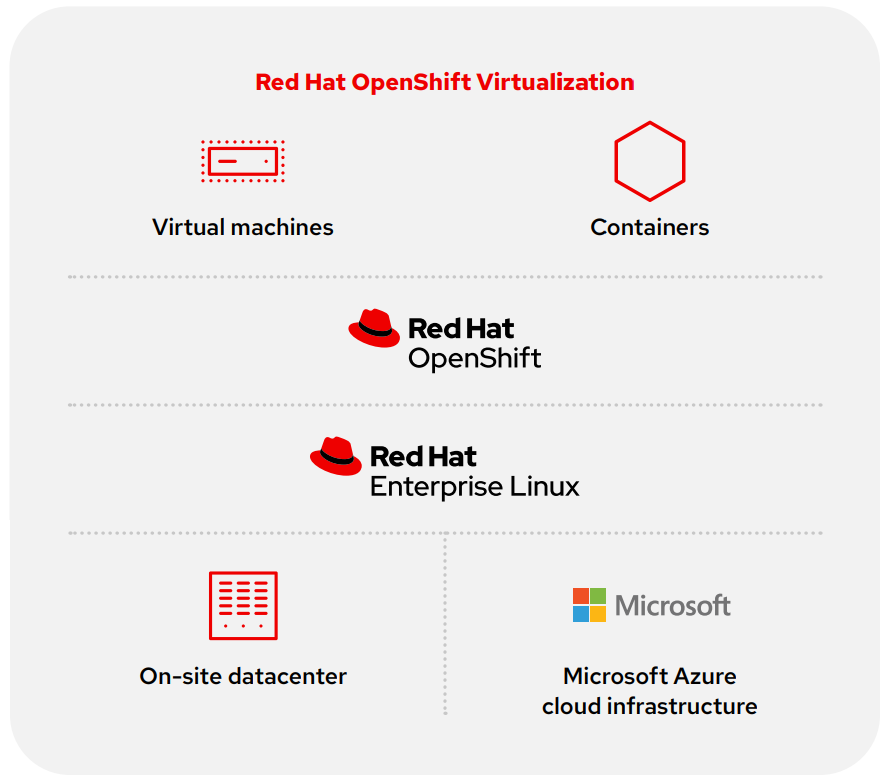
With OpenShift Virtualization on Azure Red Hat OpenShift, you gain a single, unified platform to modernize without disruption. You can run VM- and container-based workloads side by side, integrate cloud-native applications and AI workloads, and maintain operational consistency across on-premise, cloud, and edge environments. This reduces the burden of ongoing platform and resource management, freeing teams to focus on strategic innovation, upskill in emerging technologies such as gen AI, and accelerate AI-enabled application development through the combined Azure and Red Hat OpenShift ecosystems.
Because Azure Red Hat OpenShift development and operations are unified in a single environment, it can be provisioned directly from the Azure console and integrates with services such as Azure OpenAI and Azure Arc. This eliminates extra management overhead or third-party complexity while providing consistency, scalability, and a faster time to value for modern workloads.
With Azure Red Hat OpenShift, you can build an ideal software foundation for all application transformation use cases using a complete, integrated portfolio of products and cloud services that work together reliably. Directly access and integrate other Azure cloud-native services for compute, database, analytics, machine learning (ML), networking, mobile, and more, including:
- FinOps on Azure. Cloud cost management and optimization solutions.
- Azure databases. A set of fully managed, purpose-built databases.
- Azure machine learning. A comprehensive set of AI and ML services, infrastructure, and resources.
- Azure governance. A set of business management and governance control services.
- Azure Content Delivery Network. A broad set of services for running workloads and delivering content over a reliable, security-focused network.
- Azure security tools and services. A broad set of identity and access management, threat detection, compliance, and network, application, and data protection services.
- Azure storage services. A portfolio of solutions for storing, accessing, protecting, and analyzing your data.
5. Provide self-service options for deploying VMs
Manually deploying VMs is an inefficient, error-prone process that can result in inconsistent configurations, long deployment times, and an increased risk of security vulnerabilities. Self-service capabilities let users rapidly and reliably deploy preapproved, security-compliant VM configurations, when they need them and without opening an IT service ticket.
With Azure Red Hat OpenShift, users can quickly and independently provision the resources they need without manual intervention from IT operations teams. Following standard Red Hat OpenShift role-based access controls (RBAC), users can create VMs in their projects—and then grant access to other project members—to help their entire team quickly get the resources they need. VM instance types streamline self-service provisioning via predefined operating system (OS) images, workload types, and hardware requirements. You can also use templates to deploy VMs that require advanced configuration, including virtual appliances.
6. Integrate VMs into your development and deployment pipelines
Using VMs in development and deployment pipelines can increase the scalability, consistency, and speed of your application delivery processes. Integrating VMs in development pipelines lets you deploy standardized, isolated, and reproducible environments for coding, testing, and debugging to increase consistency across development teams. Using VMs in continuous integration/continuous deployment (CI/CD) pipelines provides clean, isolated environments for each stage—from build and test to release and deployment—for controlled, reliable application delivery.
With OpenShift Virtualization, you can create, manage, and run commands in VMs within development and CI/CD pipelines based on Red Hat OpenShift Pipelines to streamline infrastructure and application delivery. Azure Red Hat OpenShift also gives you access to a large library of integrated, certified tools, development environments, and self-service capabilities that let developers code at speed.
7. Take advantage of production-ready virtualization hypervisor technologies
Hypervisor performance, stability, and security posture are critical for efficient, dependable virtualization infrastructures. Adopting extensively tested and validated hypervisors that are supported by trusted vendors can help you better manage virtualized workloads at scale and increase reliability across diverse environments.
As the underlying hypervisor for OpenShift Virtualization and Red Hat Enterprise Linux, KVM is a security-focused, high-performance, open source hypervisor. First released in 2007, KVM provides a stable, efficient virtualization foundation for organizations worldwide. Today, Linux virtualization powers critical IT infrastructure for a large number of global financial services firms, airlines, manufacturers, public sector organizations, and telecommunications companies and is a popular choice for public cloud deployments.