
We’re all familiar with top, a real-time system monitor which shows usage of your Linux hardware and network resources. As a top command alternative, atop also provides sysadmins with real-time system insight, and also allows for an anatomized view of which processes are using the most CPU, memory, storage, or network.
Let’s take a look at using atop for Linux server performance analysis.
Advantages of atop
Atop is an ASCII, full-screen performance monitor which can log and report the activity of all server processes. One feature I really like is that atop stays active in the background for long-term server analysis (up to 28 days by default). Other advantages include:
- Shows resource usage of all processes, even those that are closed or completed.
- Monitors threads within processes and ignores processes that are unused.
- Accumulates resource usage for all processes and users with the same name.
- Highlights critical resources using colors (red).
- Adds or removes columns as the size of the display window changes.
- Includes disk I/O and network utilization.
- Uses the
netatopkernel module to monitor TCP, UDP, and network bandwidth.
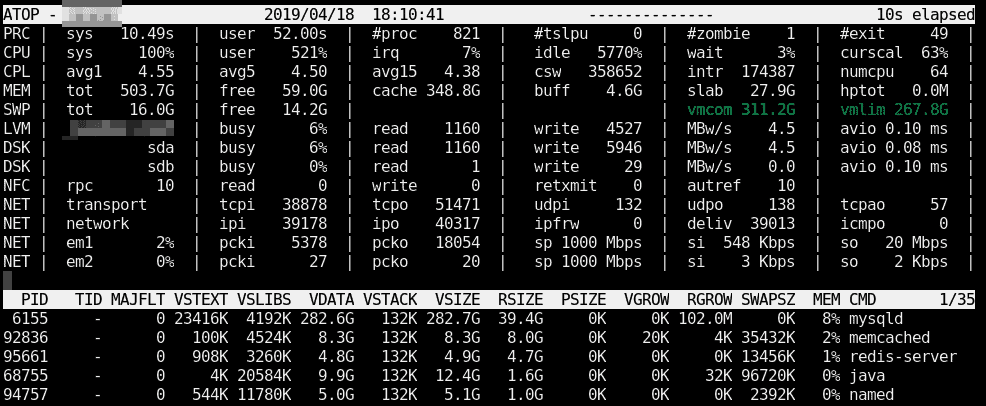
Once atop is launched, by default it shows system activity for CPU, memory, swap, disks, and network in 10-second intervals. In addition, for each process and thread, you can analyze CPU utilization, memory consumption, disk I/O, priority, username, state, and even exit codes:
Install atop on Red Hat Enterprise Linux/CentOS/Fedora Linux
[Want to try out Red Hat Enterprise Linux? Download it now for free.]
First, install and enable the Extra Packages for Enterprise Linux (EPEL) repo. See Red Hat solution #308983 if you’re not sure how to do this. Once that task is complete, you can install atop:
yum install atop
Launch it similar to top, using:
atop
Using atop
When it comes to using atop, a good place to start is to read the man pages:
man atop
Useful atop launch commands include:
| Command | Description |
|---|---|
atop -1 |
Launch with average-per-second total values. |
atop -a |
Launch with active processes only. |
atop -c |
Launch with command-line per process. |
atop -d |
Launch with disk info. |
atop -m |
Launch with memory info. |
atop -n |
Launch with network info. |
atop -s |
Launch with scheduling info. |
atop -v |
Launch with various info (e.g., PPID, user, or time). |
atop -y |
Launch with individual threads. |
Once atop is running, press the following shortcut keys to sort processes:
| Shortcut key | Description |
|---|---|
a |
Sort in order of most active resources. |
c |
Revert to sorting by CPU consumption (default). |
d |
Sort in order of disk activity. |
m |
Sort in order of memory usage. |
n |
Sort in order of network activity. |
Reading atop reports and logs
By default, after installation, the atop daemon writes snapshots to a compressed log file (e.g., /var/log/atop/atop_20140813). These log files can be read using:
atop -r </full/path/to/atop/log/file>
Once you open a log file (e.g., atop -r /var/log/atop/atop_20140813), then use t to go forward in 10-minute intervals, and T to go back. You can analyze specific times by pressing b and then entering the time. The above shortcut keys also work in this mode: a, c, d, m, and n.
You can use shortcuts with atopsar. For example, using the flag -c 30 5 with atopsar generates a report for current CPU utilization for five minutes (10 times with intervals of 30 seconds):
atopsar -c 30 5
Using the flag -A with return all available reports.
atopsar -A
But, you can limit this output to a specific time window using beginning (-b) and end (-e) flags:
atopsar -A -b 11:00 -e 11:15
Wrapping Up
There are some good advantages and unique features of atop, as listed above. Personally, I like how atop allows you to isolate and analyze CPU usage, memory consumption, storage I/O, etc., for each process and thread.
Still, some of us will continue to prefer top or htop, and they are both great tools. After reading this article, I hope more people will also add or continue to use atop as one of their go-to Linux analysis and troubleshooting tools.
執筆者紹介
Hayden James is a Linux Systems Analyst and Internet Entrepreneur from the Caribbean. He relocated to the US ten years ago, where he maintained Linux servers and sold small startups. Today, he supports clients remotely from his island home while also managing a niche web hosting venture. His web blog features Linux Sysadmin related articles: haydenjames.io.
類似検索
金融サービスにおけるポスト量子セキュリティを今すぐ始めるべき理由
Red Hat Enterprise Linux Long-Life Add-On :終了期限を設定しない RHEL への道筋
Infrastructure At The Edge | Compiler
Operating System Management | Compiler
チャンネル別に見る

自動化
テクノロジー、チームおよび環境に関する IT 自動化の最新情報

AI (人工知能)
お客様が AI ワークロードをどこでも自由に実行することを可能にするプラットフォームについてのアップデート

オープン・ハイブリッドクラウド
ハイブリッドクラウドで柔軟に未来を築く方法をご確認ください。

セキュリティ
環境やテクノロジー全体に及ぶリスクを軽減する方法に関する最新情報

エッジコンピューティング
エッジでの運用を単純化するプラットフォームのアップデート

インフラストラクチャ
世界有数のエンタープライズ向け Linux プラットフォームの最新情報

アプリケーション
アプリケーションの最も困難な課題に対する Red Hat ソリューションの詳細

仮想化
オンプレミスまたは複数クラウドでのワークロードに対応するエンタープライズ仮想化の将来についてご覧ください
