
In my previous article, I introduced Rust, explained how to install it, and created a simple Rust project. With the help of a container and OpenShift's "import from Git" functionality, you can onboard a Rust application onto OpenShift quickly.
[ Keep Rust syntax and tips on hand with this free Rust cheat sheet. ]
You can find the Rust project used in this example in my GitHub repository. The code is based on a repo created by the development team at Actix, a web framework for Rust. The most important files inside the repo include the dockerfile, Cargo.toml, and src/main.rs:
- The
dockerfilepulls the latest Rust image and runs thecargo buildcommand. - The
Cargo.tomlfile includes the Actix web dependency and package information. - The
main.rsscript contains the web server code, which displays "Hello, Openshift!" on port 8080.
Onboard Rust using OpenShift Web Console
- Log into the OpenShift Web Console.
- Click on Developer on the left sidebar at the very top.
- Click the Add button.
- Select the Import from Git option.
- Add the Git repository URL:
https://github.com/nnlama/rust_k8s_webserver - Click Create.
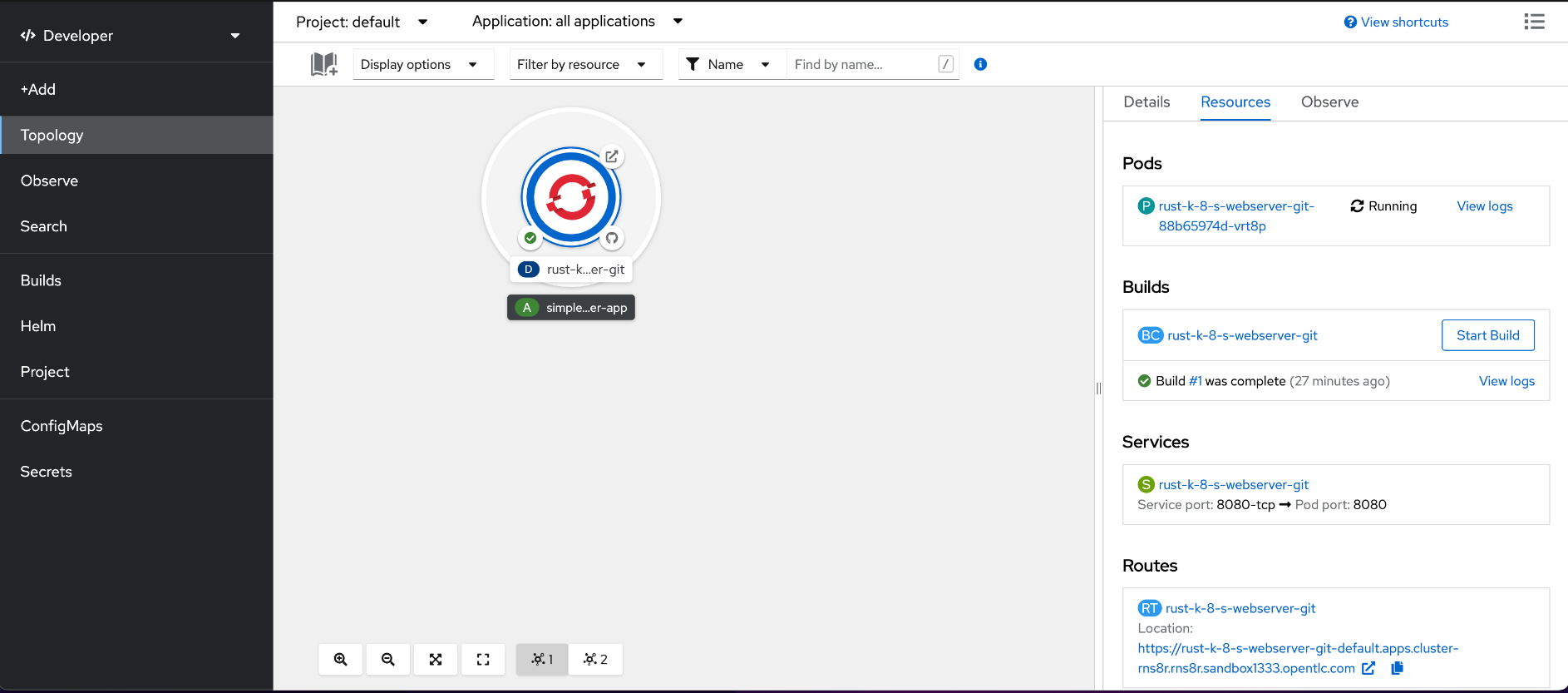
Cargo builds the project in five to 10 minutes. You must have these OpenShift resources:
- One pod in the completed stage to build the Rust application
- One pod in the running stage to run the Rust web server
- One service
- One route to expose the Rust application
Access the route to the application under the Networking tab on the OpenShift Web Console. Copy and paste the URL into your local browser to see a "Hello OpenShift!" message.

Congratulations! You have successfully onboarded your first Rust application on OpenShift. If you are interested in contributing to the Rust community, please visit the Rust Programming Language Handbook and Rustaceans.org for more information on becoming an official Rustacean.
執筆者紹介
Nicole Lama is a first-generation Panamanian-American with a bachelor's in biomedical sciences and a master's in bioinformatics and computational biology. Since 2015, she has worked with academics, tech startups, and Fortune 500 companies to help meet their data extraction, transformation, mobilization, storage, analytics, and visualization needs. She specializes in Python, machine learning, and open source technology.
チャンネル別に見る

自動化
テクノロジー、チームおよび環境に関する IT 自動化の最新情報

AI (人工知能)
お客様が AI ワークロードをどこでも自由に実行することを可能にするプラットフォームについてのアップデート

オープン・ハイブリッドクラウド
ハイブリッドクラウドで柔軟に未来を築く方法をご確認ください。

セキュリティ
環境やテクノロジー全体に及ぶリスクを軽減する方法に関する最新情報

エッジコンピューティング
エッジでの運用を単純化するプラットフォームのアップデート

インフラストラクチャ
世界有数のエンタープライズ向け Linux プラットフォームの最新情報

アプリケーション
アプリケーションの最も困難な課題に対する Red Hat ソリューションの詳細

仮想化
オンプレミスまたは複数クラウドでのワークロードに対応するエンタープライズ仮想化の将来についてご覧ください
