
Having a grasp of common architectural patterns is essential to designing software architecture at scale. Using them saves not only time but also ensures a reliable implementation of your design. There’s no need to reinvent the wheel when there’s an architectural pattern available that applies to an architecture you’re developing.
The following is a brief overview of the Saga architectural pattern.
Understanding the Saga pattern
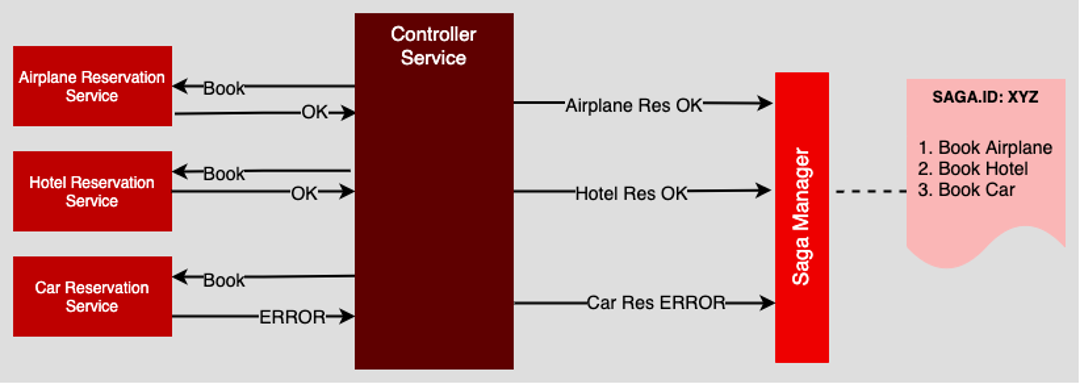
The Saga pattern is one in which the steps of a transaction are chronicled according to a set of predefined actions. This chronicle is called a saga. As each step in a transaction is executed, a controller service compares the result of the step against the saga definition. If a step is executed successfully, the next step in the saga is executed. Should a step fail, all the steps defined in the saga are set back to the last known good state.
The Saga pattern is well-suited to transactions that execute over various independent, loosely coupled services in which each service is hosted at a separate location.
Pros
- Makes transaction management in a loosely coupled, message-driven environment possible.
- Well-suited to transactions that have a small number of steps (4 -5).
Cons
- Can be complex to manage, particularly if a transaction has a large number of steps and the environment is asynchronous.
- Requires a good deal of programming, particularly to support rollback in an asynchronous, message-driven environment.
Putting it all together
Handling a transaction that occurs over a large number of loosely coupled or independent services is a difficult undertaking. It’s even more difficult when the transaction occurs in systems that use asynchronous communication. The Saga pattern addresses the issues head-on.
Basically, the pattern describes how a transaction is supposed to go. A controller will execute these steps among a variety of services. Should a step fail, the controller will restore all the services affected by the transaction back to the last known good state.
The Saga pattern can be difficult to implement, particularly in an asynchronous environment. But the safety it provides makes it worth the efforts required to implement the pattern.
執筆者紹介
Bob Reselman is a nationally known software developer, system architect, industry analyst, and technical writer/journalist. Over a career that spans 30 years, Bob has worked for companies such as Gateway, Cap Gemini, The Los Angeles Weekly, Edmunds.com and the Academy of Recording Arts and Sciences, to name a few. He has held roles with significant responsibility, including but not limited to, Platform Architect (Consumer) at Gateway, Principal Consultant with Cap Gemini and CTO at the international trade finance company, ItFex.
類似検索
Lightwell 戦略にパッチ以上のものが必要な 5 つの理由
Red Hat ラーニングサブスクリプション Course が、バーチャルトレーニングを刷新
Container Roundup | Compiler
Untangling Networks | Compiler
チャンネル別に見る

自動化
テクノロジー、チームおよび環境に関する IT 自動化の最新情報

AI (人工知能)
お客様が AI ワークロードをどこでも自由に実行することを可能にするプラットフォームについてのアップデート

オープン・ハイブリッドクラウド
ハイブリッドクラウドで柔軟に未来を築く方法をご確認ください。

セキュリティ
環境やテクノロジー全体に及ぶリスクを軽減する方法に関する最新情報

エッジコンピューティング
エッジでの運用を単純化するプラットフォームのアップデート

インフラストラクチャ
世界有数のエンタープライズ向け Linux プラットフォームの最新情報

アプリケーション
アプリケーションの最も困難な課題に対する Red Hat ソリューションの詳細

仮想化
オンプレミスまたは複数クラウドでのワークロードに対応するエンタープライズ仮想化の将来についてご覧ください
