
Ceph is often deployed with OpenStack as a back-end storage method. These two open source projects work together to make a well-integrated and robust solution for infrastructure.
OpenStack is an open source Infrastructure-as-a-Service (IaaS) platform that can provide public and private clouds in your datacenter or on the edge. OpenStack contains multiple projects; the most commonly installed are Nova (compute), Keystone (identity), Neutron (networking), Glance (image), Cinder (block storage), and Swift (object storage).
Ceph is an open source project that provides software-defined storage with unified (object, block, and file) storage. You can scale out this storage, and it is self-healing with the ability to anticipate failures.
[ Get an overview of OpenStack's history, community, and 7 of its core projects. ]
How Ceph and OpenStack work together
Ceph Storage Clusters, which are based on Reliable Autonomic Distributed Object Store (RADOS), can provide back-end storage for OpenStack. This image shows how they work together.
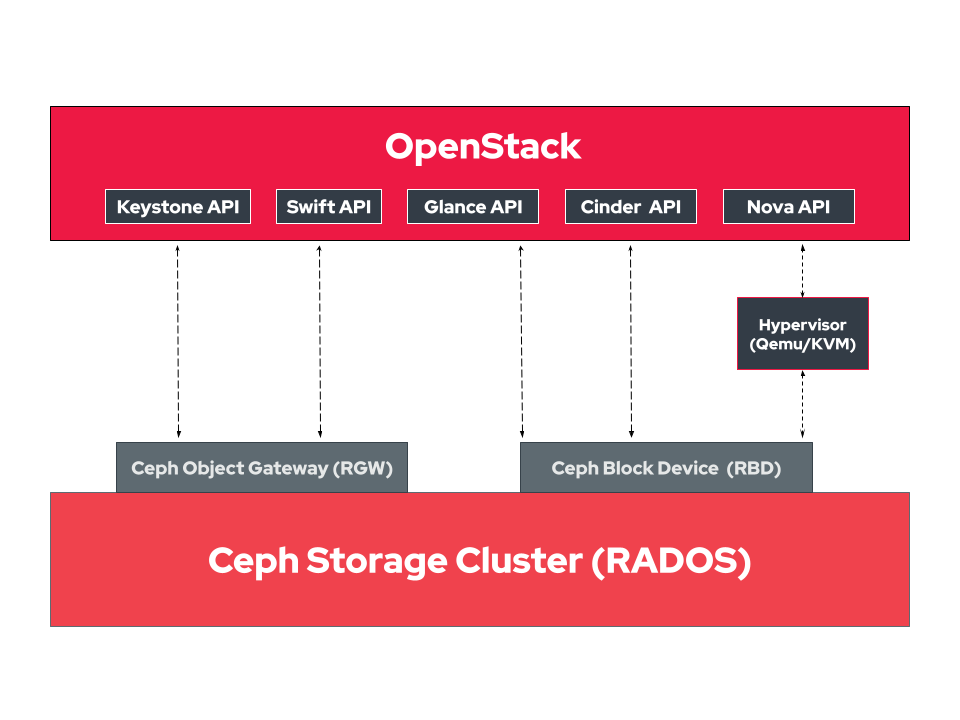
OpenStack's Keystone and Swift take advantage of Ceph by using the Ceph Object Gateway (a RADOS Rest Gateway, or RGW). This integration with Keystone allows the gateway to accept Keystone tokens for validation. This same gateway enables Swift to store its objects within Ceph.
On the other hand, Cinder, Glance, and Nova utilize Ceph block devices (RADOS block devices, or RBDs) for their back-end storage needs. Glance stores its images within Ceph, building virtual machines (VMs). Block storage devices created within Cinder for these VMs are provisioned within Ceph. And finally, Nova stores the virtual disk images of the running VMs within Ceph.
Open source makes it possible for these projects to integrate smoothly now and to maintain and improve their integration over time.
[ Download now: A system administrator's guide to IT automation. ]
Helpful resources
The following resources are a good place to start to learn more about Ceph and OpenStack:
- Getting started with RDO (community-supported version of OpenStack)
- RDO Twitter
- RDO community blog
- Ceph and OpenStack in a nutshell
- Storing containers with Kolla and Ceph
- Deploy OpenStack and Ceph on Kubernetes with Helm Charts
About the author
Amy Marrich is a Principal Technical Marketing Manager at Red Hat. She previously worked at a small open source e-assessment company in Luxembourg, where she was the Open Source Community and Global Training Manager. Previously, she was the OpenStack Instructor at Linux Academy and a Linux System Engineer on the Platform Engineering Cloud Operations team at Rackspace. She currently serves on the OpenStack Board, is an active member of the Openstack Ansible project, and was previously the chair of the OpenStack User Committee. Amy spends her free time competing in performance events (agility, FASt Cat, and dock diving) with her Dalmatians and competing in dressage with her Connemara pony.
More like this
An IT manager’s guide to leading an automation-driven culture
RHEL for NVIDIA delivers trusted foundation for next-gen AI workloads
Random Acts Of Automation | Compiler
Untangling Networks | Compiler
Browse by channel

Automation
The latest on IT automation for tech, teams, and environments

Artificial intelligence
Updates on the platforms that free customers to run AI workloads anywhere

Open hybrid cloud
Explore how we build a more flexible future with hybrid cloud

Security
The latest on how we reduce risks across environments and technologies

Edge computing
Updates on the platforms that simplify operations at the edge

Infrastructure
The latest on the world’s leading enterprise Linux platform

Applications
Inside our solutions to the toughest application challenges

Virtualization
The future of enterprise virtualization for your workloads on-premise or across clouds
