
There are many reasons you might be running a virtual machine (VM) at your organization, and you're probably also using or planning to use containers at the same time. Whether you're looking to migrate away from your current virtualization platform or you're just looking for a unified platform for both VMs and containers, Red Hat OpenShift is a centralized control center for all the services you provide to your users. Here's how to get started with OpenShift Virtualization, a feature of Red Hat OpenShift.
Install OpenShift and virtualization operators
To use OpenShift Virtualization, you must have access to a bare metal OpenShift cluster. There are several ways to install OpenShift:
- Interactive: Deploy a cluster with the web-based Assisted Installer. This provides smart and safe defaults, and performs several pre-flight validations before installing a cluster.
- Local agent: In an air-gapped or network-restricted environment, you can deploy a cluster locally with the agent-based installer.
- Automated: Deploy a cluster on infrastructure provisioned by the installer using your host's baseboard management controller (BMC).
- Full control: Deploy a cluster on your own infrastructure.
Once you've got access to an OpenShift cluster, you must ensure that the OpenShift Virtualization operators are enabled. To verify that the required operators are enabled, log in to your OpenShift account and click the perspective drop-down menu in the top left of the OpenShift web console. If Virtualization appears in the menu, then OpenShift Virtualization is ready to use.
If Virtualization is not listed in the Perspective drop-down menu, then select Administrator. In the Administrator perspective, click Ecosystem in the left navigation panel, and then click Software Catalog. Contact your cluster Administrator if you don't have an Software Catalog option available,
On the Software Catalog page, search for "virt" and install the OpenShift Virtualization operators.
Create a new VM
One of the easiest ways to start with OpenShift Virtualization is to build on the features already included.
To create a VM, select the Virtualization perspective from the drop-down menu in the top left of the OpenShift web console. For a quick start, click the Create VirtualMachine button in the Welcome to OpenShift Virtualization pop-up window.

If you've already closed that pop-up window, you can alternately click Catalog in the left column of the OpenShift web console.
1. Select a boot image
Regardless of how you got there, the catalog displays several pre-defined virtual machine images, including supported versions of Red Hat Enterprise Linux (RHEL), the latest Fedora Linux, and CentOS Stream. If you need a Windows host, a link to the latest Windows installer images is also provided under the list of virtual machines.
Select the image you want to boot, then scroll down for the next step.
2. Select an instance type
The next step after you've chosen your base image is to define the resources you want to assign to the VM being created. There are pre-defined categories, including the General Purpose U Series with shared physical CPU cores and a modest allowance for RAM.
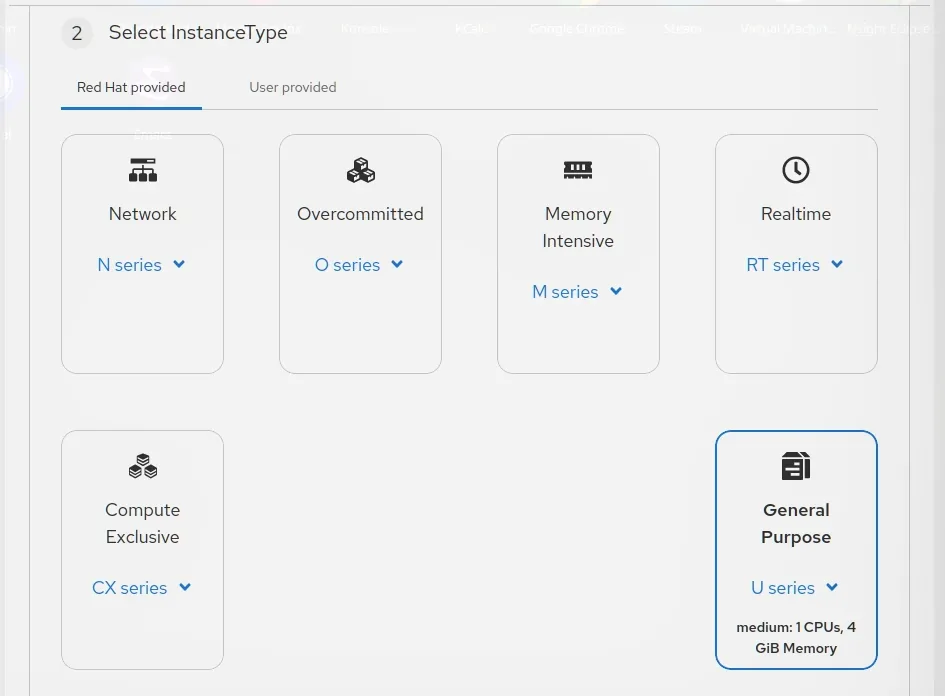
Select an InstanceType and then scroll down for the final step. Some InstanceType choices won't work without special features being enabled and configured on the cluster. If you're unsure what to choose, try General Purpose to begin with.
3. Set virtual machine details
Most attributes of the VM you're about to create are defined by the boot image and instance type you selected. However, in this final step of creating a VM you can customize your image as you see fit. You can give your VM a custom name (by default, a unique name is generated for you), the disk size, storage class, and a public SSH key so you can log in remotely without a password. Should you need to customize your VM further, click the Customize VirtualMachine button to modify configuration, including the network connection (default is the private cluster network). For convenience, you can also set the virtual machine to start immediately after creation.
Click the Create VirtualMachine button at the bottom of the window to create the VM.
You're done! You've created a VM in OpenShift.
Import your own base image
If the base image you want to use isn't already included in OpenShift, then you can import your own image using the Migration Toolkit for Virtualization (MTV). Using MTV, you can define a migration plan for an existing virtual machine image, providing an image repository or a filesystem location. The MTV web console guides you through each step of the process, so it's just a matter of knowing the locations of your source and destination data.
Migrate a VM to OpenShift Virtualization
You can use the migration toolkit for virtualization (MTV) to bring a VM from Red Hat Virtualization, VMware, Red Hat OpenStack Platform (now referred to as Red Hat OpenStack Services on OpenShift), Open Virtual Appliances (OVA), and more. Migration toolkit for virtualization is an operator, so you (or your cluster administrator) can install it from the Software Catalog of OpenShift console.
Once the migration toolkit for virtualization operator has been installed, click Migration in the left column of the Administrator perspective, and then Providers for virtualization. In the Providers window, define the current location of your virtual machines.
Once your providers have been configured, click Plans for virtualization in the left column. Click the Create Plan button at the bottom of the Plans window and follow the prompts to select the source provider and then to define the attributes of the resulting virtual machine (including storage locations and virtual machine specifications).
Once you've created your migration plan, click the Start Migration button in the top right of the Plan details window.
Time to integrate
With Red Hat OpenShift, you don't need separate infrastructure just to manage your virtual machines. Your VMs and containers are more powerful when they can be integrated into the same workflows, managed by the same policies, and automated by the same platform. Integrate your VMs into your cloud platform and get the most out of your most valuable resources. To learn more about Red Hat OpenShift Virtualization, check out our Learning Hub to learn more through featured resources and tools based on your virtualization tasks.
Product trial
Red Hat OpenShift Virtualization Engine | Product Trial
About the author
Seth Kenlon is a Linux geek, open source enthusiast, free culture advocate, and tabletop gamer. Between gigs in the film industry and the tech industry (not necessarily exclusive of one another), he likes to design games and hack on code (also not necessarily exclusive of one another).
More like this
Red Hat OpenShift Virtualization achieves NVIDIA-Certified Hypervisor status
Chaos engineering in practice: Lessons from enterprise customers
Virtualization Is (Still) King | Compiler
Crack the Cloud_Open | Command Line Heroes
Browse by channel

Automation
The latest on IT automation for tech, teams, and environments

Artificial intelligence
Updates on the platforms that free customers to run AI workloads anywhere

Open hybrid cloud
Explore how we build a more flexible future with hybrid cloud

Security
The latest on how we reduce risks across environments and technologies

Edge computing
Updates on the platforms that simplify operations at the edge

Infrastructure
The latest on the world’s leading enterprise Linux platform

Applications
Inside our solutions to the toughest application challenges

Virtualization
The future of enterprise virtualization for your workloads on-premise or across clouds
