Key concepts and technologies for modernization
Application modernization incorporates several key technologies and approaches. Some are essential for all modernization journeys, while others are needed only for certain scenarios.
Cloud-native approaches
Cloud-native technologies allow organizations to develop and run scalable applications across modern, dynamic cloud environments, including private, public, and hybrid clouds. By applying cloud-native approaches across your organization, you can more rapidly develop, deploy, improve, and scale your applications and services in response to changing business and market conditions.
Microservices
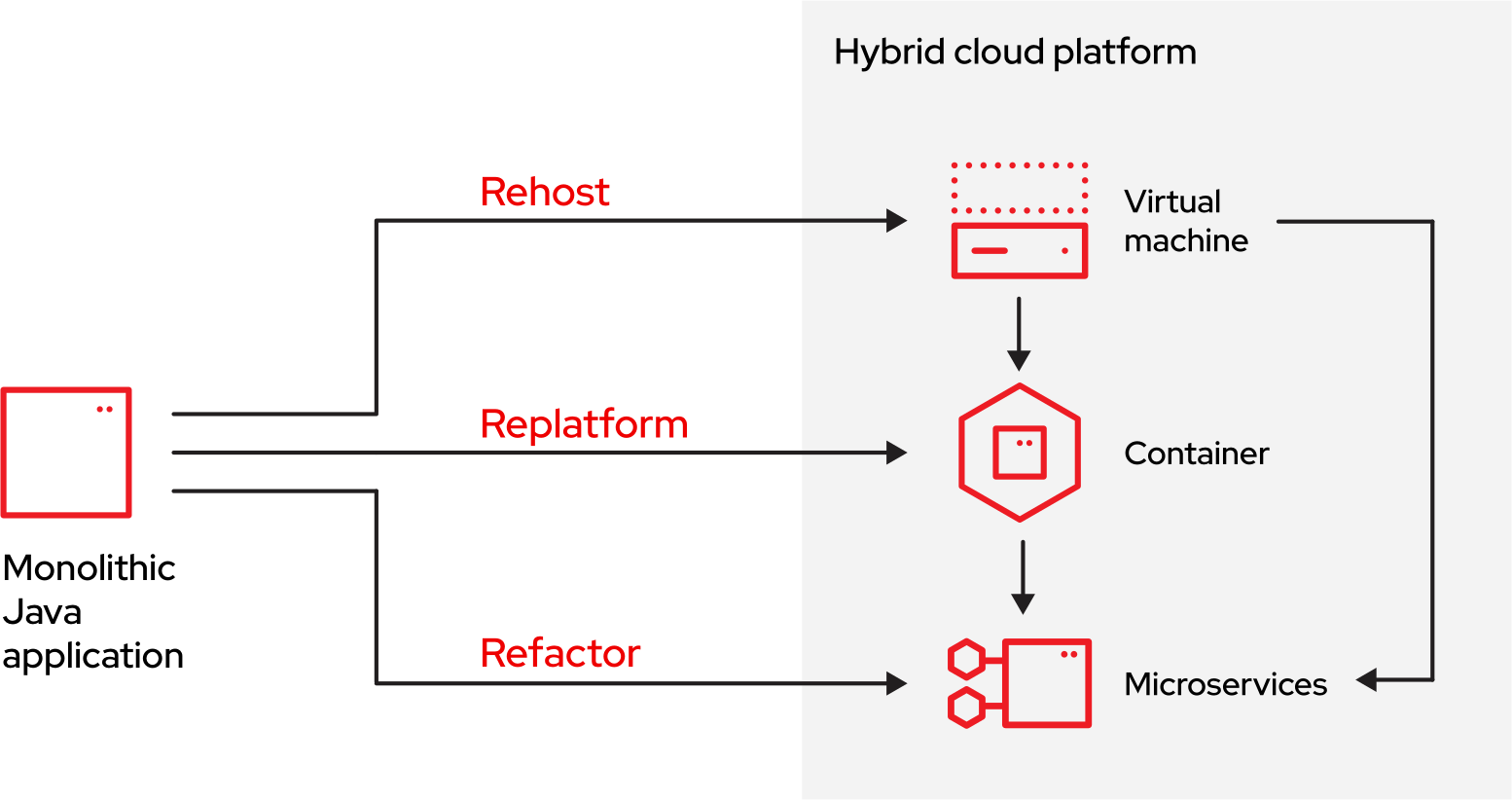
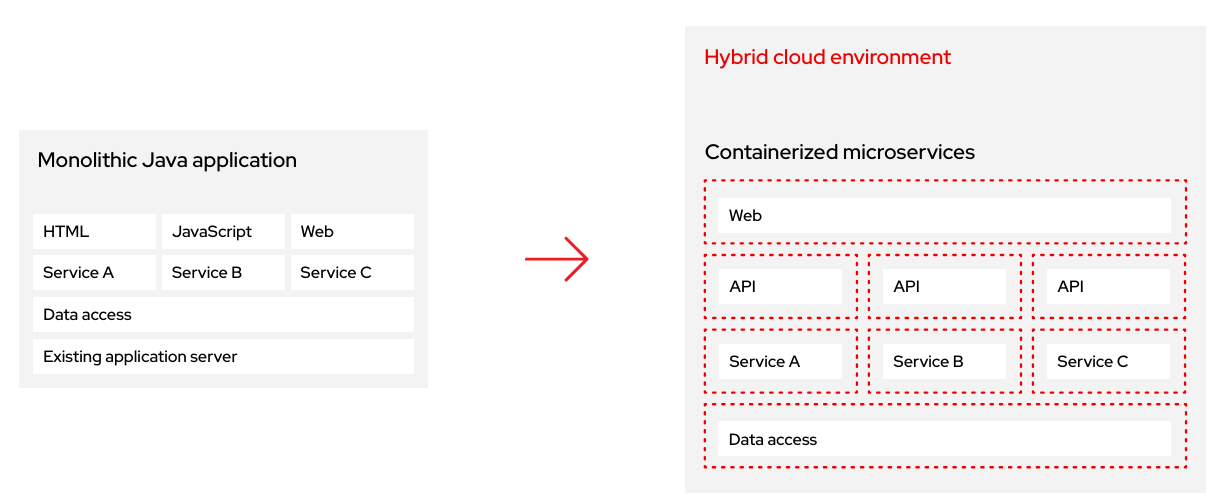
Microservices architectures break applications down into sets of functional capabilities. These functional microservices are separate from each other but work together to accomplish the same tasks as the original monolithic application. They are typically lightweight, independently scalable, and shareable across multiple applications. Microservices architectures align well with cloud-native approaches and are often adopted during application modernization initiatives.
DevSecOps
DevSecOps, or just DevOps, is an approach to culture, automation, and platform design that speeds the delivery of high-quality applications to increase business value and agility. It focuses on collaboration across teams, dynamic operations, and standardized environments to accelerate development and deployment processes. With DevSecOps, staff from security, development, and operations teams work together, sharing visibility, feedback, best practices, and insights.
Event-driven architecture
Event-driven architecture is a model for application design that is structured around the capture, communication, processing, and persistence of events, rather than requests. Event-driven applications require minimal coupling, so they work well in modern, distributed environments and architectures. Developers can create event-driven applications in any reactive programming language, giving them more flexibility and choice.
Hybrid cloud application platforms
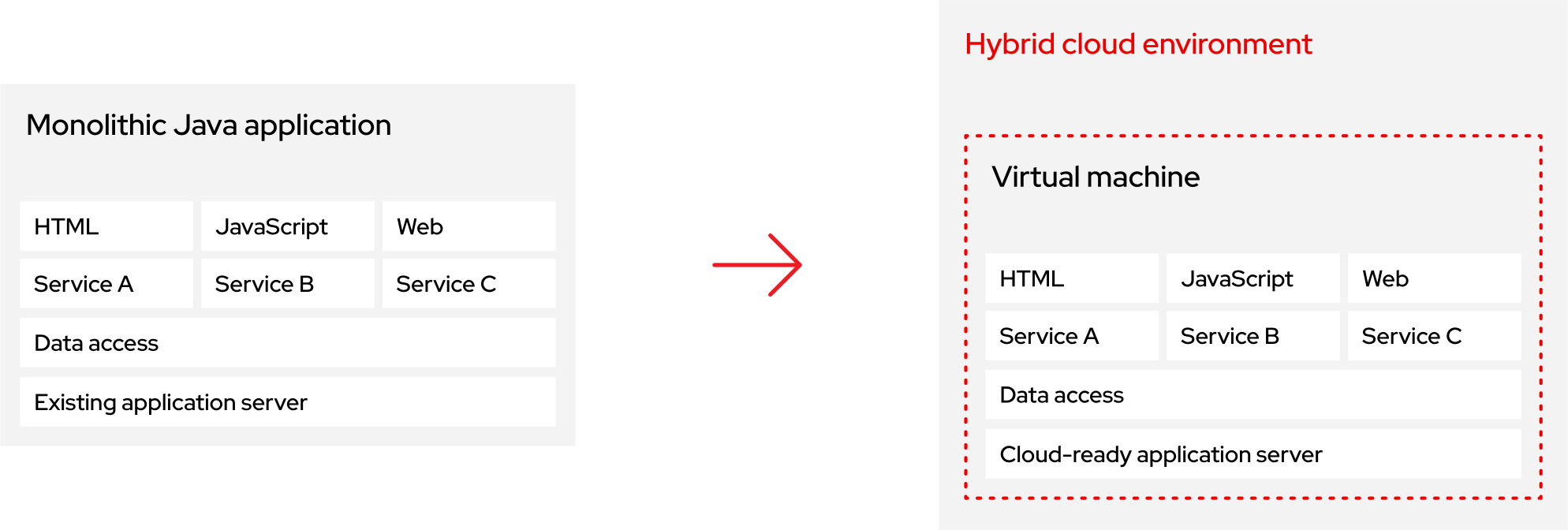
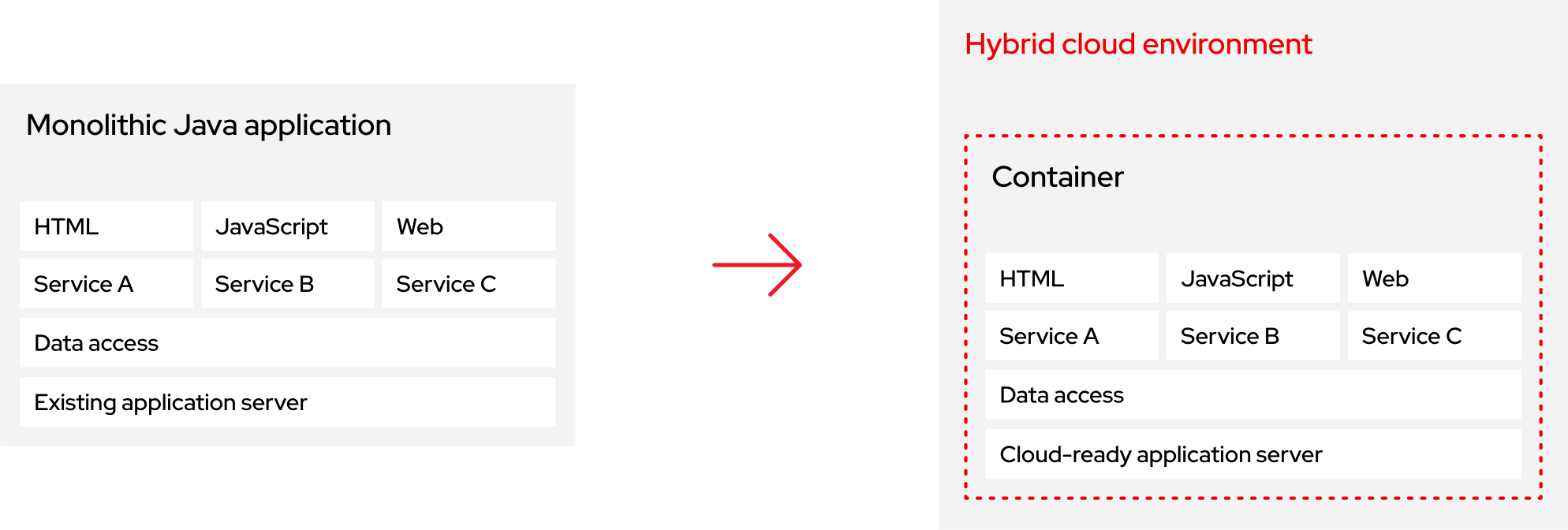
A hybrid cloud platform provides a unified software foundation for developing, deploying, and managing tools, applications, and models consistently across datacenter, edge, and cloud environments. Key features include:
- Support for traditionally virtualized, cloud-native, and containerized applications.
- IT-controlled self-service resource delivery.
- Application and workload portability across different types of cloud environments.
- Integrated DevOps and operations management capabilities.
- Application development tools.
- Integrations from third-party technology vendors and open source communities.
A comprehensive, adaptable hybrid cloud platform is essential for most application modernization journeys and can help you transform more readily at your own pace.
Modern development frameworks
Development frameworks provide pluggable and extensible patterns of code flow for developers creating applications using programming languages like Java™. Developers can use these repeatable frameworks as a base for programming applications, reducing development time and increasing consistency. For example, modern, Kubernetes-native Java development frameworks like Quarkus and Spring let you incorporate new infrastructure technologies like containers, microservices, and serverless.
Serverless models
Serverless is a cloud-native development model that allows developers to build and run applications without managing the underlying infrastructure. A cloud provider or IT operations team handles the routine work of provisioning, maintaining, and scaling servers, so developers can focus on coding. Once deployed, serverless applications automatically scale up, down, or even to zero according to demand or event triggers, freeing up valuable infrastructure resources when not in use.
Service meshes
Service meshes provide communication between microservices and add capabilities like resiliency, security, observability, routing control, and insights. They control how different parts of an application share data with one another. As a transparent, dedicated, and scalable infrastructure layer that resides outside of applications, service meshes allow developers to concentrate on creating valuable applications and features rather than rebuilding or connecting standard underlying services.
CI/CD pipelines
Continuous integration/continuous delivery (CI/CD) pipelines improve software delivery using DevOps or site reliability engineering (SRE) approaches. These pipelines apply automation to optimize application life cycle management processes like compiling code, unit testing, and code analysis. When moving to cloud-native and containerized environments, many organizations extend their CI/CD pipelines with GitOps workflows that automate delivery across hybrid cloud infrastructure.