
If you manage Red Hat Enterprise Linux (RHEL) systems connected to Red Hat Lightspeed, you're likely familiar with insights-client, the tool responsible for reading system information and reporting it to Red Hat Lightspeed's hosted services.
Starting with RHEL 9.8 and RHEL 10.2, Red Hat is changing how insights-core, one of the components of insights-client, delivers its updates. The change gives system administrators more control and predictability, with a delivery mechanism they already know and trust.
From runtime updates to RPM Package Manager (RPM) delivery
Insights-client is made up of 2 components: the insights-client package itself, which acts as the orchestrator, and insights-core, the engine that reads information from the system for analysis. When we refer to insights-client as a whole, we mean both.
Insights-client and insights-core previously followed different update paths. This model gave Red Hat the ability to ship updated analysis rules quickly, independent of the RHEL release cycle. Insights-client was always delivered as a standard RPM Package Manager (RPM). Insights-core, however, was distributed as a Python egg and updated itself automatically at runtime. This meant it downloaded the latest version available outside of your standard package management workflow.
With RHEL 9.8 and RHEL 10.2, that changes. Insights-core is now delivered as a standard RPM through the official RHEL repositories, using the same trusted content delivery pipeline used for every other RHEL package. Additionally, both components of insights-client now follow the same update model. They’re delivered through the AppStream repository, included with all standard RHEL subscriptions.
What this means for your team
Patch management that fits your workflow
Because insights-core is now an RPM, it slots directly into the update processes your team already has in place. You can apply it during your maintenance windows, test it in lower environments before promoting it, and track it in your change management system with no special handling required. It behaves like every other package on your RHEL systems.
While not mandatory, having the latest version of the package enables Red Hat Lightspeed to analyze your systems to its full potential. For teams that want insights-core to stay continuously up-to-date, automating the update with a daily cron job or systemd timer keeps analysis rules current with minimal overhead.
Updating insights-core with dnf on RHEL
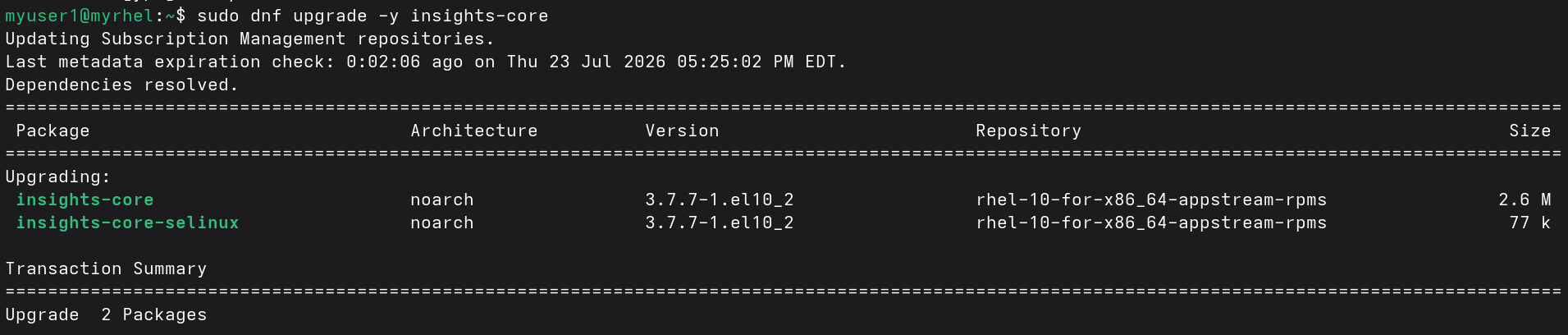
Terminal output showing the sudo dnf upgrade -y insights-core command successfully updating the insights-core package on a RHEL system
A natural fit for Red Hat Satellite
This change is particularly valuable for organizations managing RHEL through Red Hat Satellite. Previously, insights-core updated outside of Satellite's content management model. One small part of your RHEL stack was always operating on its own terms.
Now, insights-core is just another package in your content view. Sync it, promote it through your environments, and let Satellite deliver it to your managed hosts in exactly the same way you manage everything else. Simply ensure the AppStream repository is included in your content view, and insights-core will be available alongside the rest of your RHEL content. Organizations with strict change control policies gain full visibility into when and how insights-client's analysis rules change, without any additional tooling or process.
For Satellite-managed fleets, the result is a more consistent, more governable infrastructure with one less exception to manage.
No disruption, no migration
Adopting the new delivery model requires no special action. Fresh installations of RHEL 9.8 and RHEL 10.2 automatically include the new insights-core RPM. Systems upgraded from earlier versions switch to the RPM model as part of the standard upgrade process.
The Python egg update model remains in place for teams on RHEL 8, RHEL 9.0-9.7, or RHEL 10.0-10.1.
Part of a broader direction
These updates reflect our ongoing work to improve our client tools, focusing on standardization, predictability, and integration with the management platforms enterprises already use. As Red Hat continues to simplify and unify the client tools, these foundations, including standard RPM packaging, Satellite integration, and alignment with existing workflows, are what that next chapter is built on.
For full technical details, see the KBase article: Security improvements and new distribution method for insights-client (https://access.redhat.com/articles/7139622).
製品トライアル
Red Hat Enterprise Linux | 製品トライアル
執筆者紹介
Christian Marineau is a Senior Product Manager at Red Hat working on client tools for Red Hat Enterprise Linux and Red Hat Lightspeed. A former sysadmin and DevOps engineer, he focuses on improving the ways users connect their systems to Red Hat. Outside of work, he enjoys hockey, skiing, and spending time with his dogs.
類似検索
Ansible 2.7のVisual Execution Environment Builder とコンテンツ検出
Red Hat Ansible All-Stars:ネットワークおよびインフラストラクチャの自動化の未来を切り拓く
Random Acts Of Automation | Compiler
Untangling Networks | Compiler
さらに調べる
- e ブック: クラウド規模でのインフラストラクチャ管理
- e ブック: 先進的なビジネスを成功させるための効率的な IT 基盤を構築する
- トライアルを開始する:Red Hat Enterprise Linux
チャンネル別に見る

自動化
テクノロジー、チームおよび環境に関する IT 自動化の最新情報

AI (人工知能)
お客様が AI ワークロードをどこでも自由に実行することを可能にするプラットフォームについてのアップデート

オープン・ハイブリッドクラウド
ハイブリッドクラウドで柔軟に未来を築く方法をご確認ください。

セキュリティ
環境やテクノロジー全体に及ぶリスクを軽減する方法に関する最新情報

エッジコンピューティング
エッジでの運用を単純化するプラットフォームのアップデート

インフラストラクチャ
世界有数のエンタープライズ向け Linux プラットフォームの最新情報

アプリケーション
アプリケーションの最も困難な課題に対する Red Hat ソリューションの詳細

仮想化
オンプレミスまたは複数クラウドでのワークロードに対応するエンタープライズ仮想化の将来についてご覧ください
