
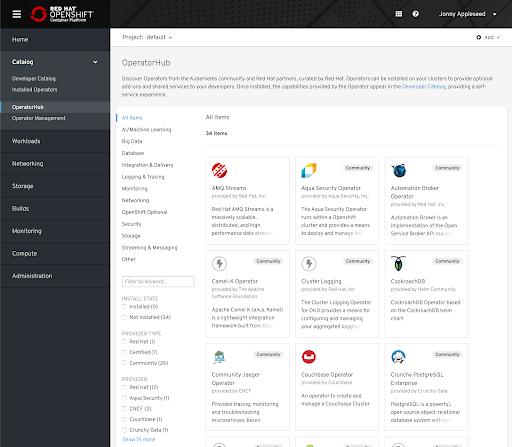
Last week at Red Hat Summit we announced Red Hat OpenShift Operator Certification. We’re excited to be able to offer an ecosystem of certified Operators for enterprise applications embedded in Red Hat OpenShift. Red Hat OpenShift Certified Operators offer consistent packaging, deployment and lifecycle management of applications across all OpenShift 4 footprints. At the time of the announcement, we had already certified 22 Operators. Here's how you can add yours.
OpenShift Certified Operator Benefits for OpenShift Users
OpenShift Certified Operators are monitored and updated to help reduce interoperability failure or security risks and are jointly supported by Red Hat and our partners. For users this can improve time-to-value, by using components that have been pre-tested on OpenShift, empowering them to deploy faster. To get started, learn how to install applications into your OpenShift 4 cluster using Operators from OperatorHub or try out one of the Operator scenarios on learn.openshift.com.
Why Certify Your Operator?
Red Hat OpenShift is the industry’s most comprehensive enterprise Kubernetes platforms with more than a thousand customers. Developers who partner with Red Hat in certifying their Operators on OpenShift can gain broader visibility for their solutions and make them more easily consumable by OpenShift users. By codifying and packaging best practices and business workflows, these partners are able to provide a consistent experience for their users across hybrid cloud platforms. Additionally, they gain access to technical and marketing benefits through the Red Hat Connect Partner Program.
How to Certify
We’re eager to work with new partners to help them through the certification process. At a high level the Operator certification steps include:
- Confirming that the application’s container images and Operator image is Red Hat certified. Certified images must be:
- Built using Red Hat Enterprise Linux or Red Hat Universal Base Image as the base layer.
- Comply with Red Hat Container Certification requirements.
- Submitted to Red Hat to verify and publish.
- Provide product information for publishing in the Red Hat Container Catalog.
- Then the Operator and Application container images are packaged and submitted through the Red Hat Partner Connect website along with additional metadata. The Operator metadata allow it to be deployed using the Operator Lifecycle Manager and to render the Operator’s detail page in OperatorHub.
- The Operator and Application images then undergo a security health check.
- Once they complete the health checks the RH team will post the Operator in the embedded OperatorHub.
For the full set of instructions, check out our detailed guide to OpenShift Operator Certification.
Learn more about Operators at KubeCon in Europe, May 20-23. The Operators in Action panel at the OpenShift Commons Gathering is not-to-miss. Check out a keynote talk from Rob Szumski and learn about the tools at your disposal to build, test and ship an Operator. The Kubernetes Hands-on Workshop at KubeCon is sold out at over 100 attendees but you can meet us at the Red Hat booth for a demo or discussion.
執筆者紹介
類似検索
パッチ適用が追いつきませんか?最後の防衛線としてのゼロトラスト
Red Hat Enterprise Linux のイメージモードを今すぐ使い始めるべき 4 つの理由
Scaling with Orchestrators | Compiler
Container Roundup | Compiler
チャンネル別に見る

自動化
テクノロジー、チームおよび環境に関する IT 自動化の最新情報

AI (人工知能)
お客様が AI ワークロードをどこでも自由に実行することを可能にするプラットフォームについてのアップデート

オープン・ハイブリッドクラウド
ハイブリッドクラウドで柔軟に未来を築く方法をご確認ください。

セキュリティ
環境やテクノロジー全体に及ぶリスクを軽減する方法に関する最新情報

エッジコンピューティング
エッジでの運用を単純化するプラットフォームのアップデート

インフラストラクチャ
世界有数のエンタープライズ向け Linux プラットフォームの最新情報

アプリケーション
アプリケーションの最も困難な課題に対する Red Hat ソリューションの詳細

仮想化
オンプレミスまたは複数クラウドでのワークロードに対応するエンタープライズ仮想化の将来についてご覧ください
