Migrate to a modern virtualization platform
Introduction
Virtualization technology and virtual machines (VMs) are key for organizations looking to deliver applications and services that streamline operations, optimize costs, and create new business opportunities.
VMs have historically allowed IT teams to efficiently use physical hardware resources, improve organizational flexibility, and enhance infrastructure performance. The introduction of more accessible public cloud technologies has brought added scalability, agility, and cost benefits to virtualization platforms.
With recent shifts in the virtualization space, many organizations are looking to migrate from their current virtualization platform to a modern solution that can support their virtualization strategy and help them prepare for future innovation.
Without the right modern, unified virtualization platform that provides the required levels of consistency, efficiency, and cost effectiveness, your organization could be left struggling to maximize the value of existing and future investments.
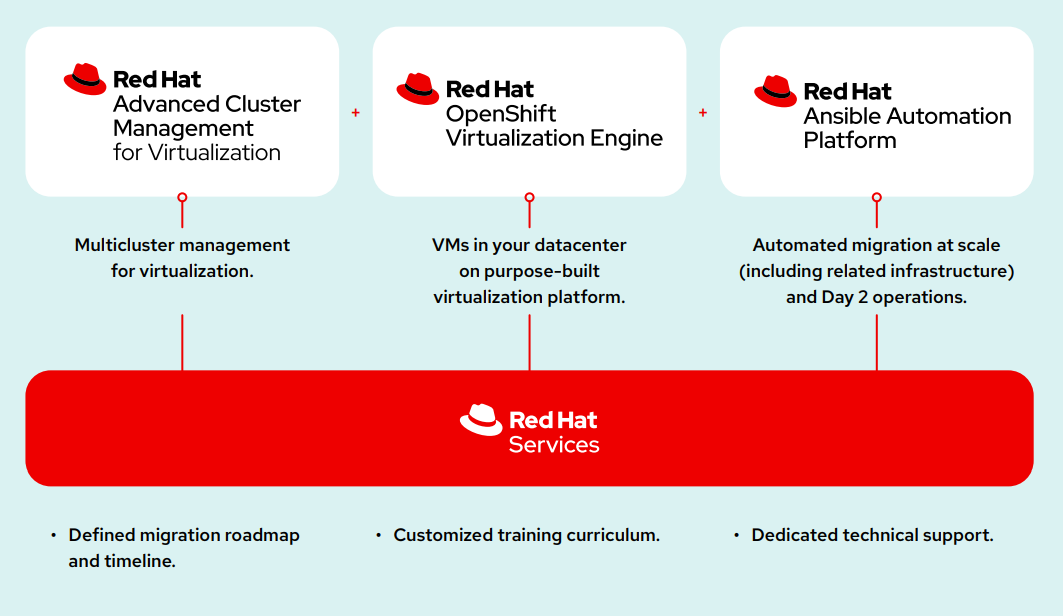
Red Hat offers modern virtualization capabilities that combine support for both traditional VMs and containerized workloads. This allows you to migrate your existing VMs onto a new platform and run them alongside containerized workloads using the same processes and tools, with the flexibility to modernize workloads at your own pace. Red Hat also offers a dedicated and streamlined virtualization platform for organizations focused on migrating their VMs onto a new platform as efficiently as possible.
While any migration is a complex process, Red Hat® Services offers engagements that directly address and help ease each step of VM migration and the modernization journey. By working collaboratively with experts from Red Hat to plan and implement your migration, you can reduce migration complexity, streamline key migration steps, and train your teams in the skills they need.
In this e-book, we will explore Red Hat’s virtualization solutions, the benefits they can provide to your organization, and how Red Hat Services can help you navigate the complete VM migration and modernization journey.
Chapter 1: Red Hat’s complete virtualization platform
As the virtualization component included in Red Hat OpenShift®, Red Hat OpenShift Virtualization provides modern virtualization capabilities that allow you to run and deploy your new and existing VM workloads at scale and with a focus on security across your enterprise.
OpenShift Virtualization streamlines migration and management of traditional VMs onto a consistent and comprehensive hybrid cloud application platform. It also helps preserve existing virtualization investments while offering modern management principles and cloud-native architecture, and provides a clear path to application and infrastructure modernization.
Key benefits of OpenShift Virtualization
Red Hat offers Red Hat OpenShift Virtualization’s capabilities through flexible and comprehensive virtualization solutions to meet immediate migration needs while also providing a clear path to application modernization, if and when needed.
The value of OpenShift Virtualization can be further compounded when used in tandem with enterprise-wide automation capabilities and centralized VM lifecycle management.
When the time comes to adopt containerization and modern application development and delivery capabilities, upgrading to editions like OpenShift Container Platform or OpenShift Platform Plus is designed to be straightforward and not disruptive. These editions of Red Hat OpenShift also allow you to use modern approaches for building and deploying applications. This includes new innovation in development and deployment pipelines, service meshes, and serverless technologies, as well as container orchestration tools and automation capabilities that streamline the lifecycle management of your applications across your entire enterprise, including hybrid cloud environments.
Chapter 2: Navigating the complete migration journey
Before undertaking a VM migration, you need to understand what the complete migration journey entails—from Day 0 planning through to Day 2 operations and beyond.
In this section, we explore key issues your organization should consider before embarking on your VM migration, and how Red Hat Services can support your organization during every stage.
Day 0: Planning stages
The planning stages of a VM migration are essential to building the strong foundation needed for future success, as well as any potential modernization efforts.
You should consider the following questions as you plan your organization’s VM migration:
- How will I architect and configure my network?
- How will I integrate my storage and backup integration?
- How quickly can I migrate to my new virtualization platform?
How can I plan for my migration?
Red Hat Consulting collaboratively conducts a Virtualization Migration Assessment with you to understand your virtualization environment, architecture, workloads, and required operational tooling and processes, and determine your migration complexity and timeline. This helps them design your target virtualization platform and your customized, integrated, and automated migration factory.
Day 1: Migration stages and deployment
With a solid migration plan in place, you can turn your focus to migrating to your new virtualization environment, including removing deployments from your previous platform and initiating them on your new platform.
Consider the following questions as you begin enacting your VM migration:
- How will I prioritize my workloads for migration?
- How will my teams maintain, scale, and automate the VM platform throughout its lifecycle?
Day 2: Ongoing maintenance and optimization
Following your VM migration, you can now address the Day 2 operations of your migrated workloads. This includes essential ongoing management and optimization, such as monitoring performance metrics, validating workload stability, overall lifecycle management of the VMs, and fine tuning resource allocations to create and maintain efficiency.
Consider the following question as you plan your Day 2 operations:
How will my teams monitor the health, performance, and compliance of my virtualization platform and virtualized workloads?
How will my teams manage VM Day 2 operations, including compliance, patching, upgrading, and configuration management of migrated workloads?
How will my teams automate the complete VM lifecycle, including virtualization deployment, redeployment, and removal of new fleets of VMs?
How will my teams efficiently deploy applications on this infrastructure or orchestrate cross-functional workflows?
How can I ensure team efficiency—as well as consistency and accuracy of change—to mitigate risk across my operations?
How can I start executing my migration?
Red Hat Consulting uses the knowledge gained from the previous assessment to advise which workloads to prioritize for migration, as well as other considerations, including network configuration, storage and backup integration, and more.
How can I prepare for Day 2 operations?
Red Hat Consulting mentors your teams on using Red Hat OpenShift, Ansible Automation Platform, and Advanced Cluster Management for Virtualization to monitor, manage, and automate your Day 2 tasks across the entire VM lifecycle.
Chapter 3: How Red Hat Services can help
Before we dive into the Red Hat Services’ engagements for VM migration and modernization, let’s take a look at what each segment of Red Hat Services does, as well as some of their proven benefits.
Red Hat Consulting | Red Hat Training and Certification | Red Hat Technical Account Management |
| Red Hat Consulting leads with a mentor-based approach, tailoring each engagement to your specific organizational needs and grounded by experience and open source processes. | Red Hat Training and Certification offers a suite of expert-created courses that equip your teams with the knowledge and expertise needed to successfully use Red Hat technology. | A Red Hat Technical Account Manager (TAM) is a technical expert who serves as a single point of contact for technical advice and ongoing support, providing specialized knowledge of Red Hat products to help you achieve your business goals. |
How this supports your VM migration:Red Hat Consulting can assess your existing virtualization environment and collaborate with your teams to build and enact a VM migration strategy that will lay a solid foundation for future success. | How this supports your VM migration:Red Hat offers role-based courses and hands-on exams for OpenShift Virtualization that help your teams develop and validate the skills and product expertise you need to successfully migrate and modernize. | How this supports your VM migration:Red Hat TAMs serve as a dedicated advisor to help mitigate and address risk, enhance productivity, and support your long term operations throughout your migration and modernization journey. |
Organizations that engaged Red Hat Consulting to deploy Red Hat OpenShift achieved:1
213% ROI return on investment in 3 years.
US $1.85 million in platform cost savings.
US $354,000 in infrastructure cost savings.
US $673,000 in IT and DevOps labor cost savings.
US $1.13 million in developer labor cost savings.
Less than 6-month payback period.
What customers say about Red Hat Consulting
Red Hat Consulting was 20% to 30% cheaper to deploy OpenShift than doing it ourselves. Bringing in experts offsets costs. It takes a lot of money, resources, and time to stand up a full system alone.1
Our journey would have been more stressful [without Red Hat Consulting]. Our goal wasn’t just to get things done, it was to build a platform team … and we got access to a team that had done this with other clients, and we could tap into that experience.1
Organizations that engaged Red Hat Training achieved:2
25-50% more efficiency in completing day-to-day IT tasks.
77% more effective new employees.
15% more effective server utilization.
20% reduction in support tickets generated.
32% reduction in time to remediate support tickets.
Organizations that engaged Red Hat Technical Account Management achieved:3
379% ROI in 3 years.
US $1.1 million in savings from reduction in system outage time.
US $3.3 million in added value from improved developer and IT productivity.
US $433,000 in savings from lower technology fees.
US $167,000 in added value from improved security and compliance.
Chapter 4: Accelerate your migration with Red Hat Consulting
Red Hat Consulting are experts at accelerating and derisking VM migrations, from planning through executing and operationalizing the platform and VMs that run your digital business.
Whether you are looking for a dedicated and streamlined virtualization platform or a platform that provides the freedom to scale and a path to modernization, Red Hat Consulting can help you successfully make the move to a platform that meets your needs.
To assist you in your journey, Red Hat Consulting offers a tailored and phased approach: the Virtualization Migration Assessment and the Virtualization Migration Factory.
Virtualization Migration Assessment
During this 2-week assessment, Red Hat experts work collaboratively with your team in an initial discovery session and a subsequent series of assessment workshops to gain a clear understanding of your existing virtualization environment and your virtualization goals. Another key objective of this engagement is to create a supportive culture to foster innovation and reduce resistance to adopting new technologies. While migration is more of a technical challenge, it also requires support from executive teams to prioritize efforts across the organization.
This includes:
- Analyzing your current VM infrastructure and designing your target VM platform.
- Discovery and mapping out of your VM workloads.
- Designing your automated, integrated migration factory.
- Gaining an understanding of your Day 2 operations needs, such as automation, configuration management, monitoring, and backups.
Following this, Red Hat Consulting will provide your organization with a tailored high-level solution design for your target virtualization environment and a customized roadmap for migrating to OpenShift Virtualization with efficiency and a focus on security. This includes strategies for management, monitoring, risk mitigation, and disaster recovery.
At the end of the this engagement, your teams will have:
- A clear and strategic roadmap for VM migration.
- A defined path to retiring your existing solution.
- Expert recommendations and strategic advice.
- Customized training opportunities.
- A clear picture of your migration costs.
- A foundation for accelerated migration.
Virtualization Migration Factory
This engagement is conducted in 2 primary phases, starting with deploying virtualization migration technology and helping your organization prepare to operate at scale, and then moving on to helping you achieve steady state migration and reduce your existing footprint.
During the 1st phase, experts from Red Hat Consulting work with you to establish your virtualization platform foundation and help you prepare to operate at scale by:
- Deploying a Red Hat OpenShift cluster in your environment.
- Validating virtualization features, workloads, and integrations.
- Migrating initial VM workloads.
- Designing your migration strategy.
- Automating your Day 2 operations.
By the end of this phase, your organization will benefit from:
- Reduced complexity on a unified platform for all workloads.
- Preservation of your existing virtualization investments.
- Production-grade VM workload consistency, reliability, and performance.
- The flexibility to modernize applications and infrastructure at your own pace.
Red Hat Consulting has been proven to help reduce migration off of traditional application and virtualization environments by 6 months.1
During the 2nd and final phase of this engagement, Red Hat Consulting helps you scale your migration and complete the migration of your remaining VM workloads, including:
- Automating the migration of batched VMs.
- Automating configuration of key components.
- Developing repeat migration patterns to migrate groups of VMs in waves.
- Validating your complete migration.
- Completing the retirement of your existing solution.
This will give your organization a migration model that:
- Reduces complexity.
- Mitigates risk.
- Maintains application quality.
- Lowers operational costs.
If we deployed OpenShift ourselves, we projected a 3-year ROI of 20% to 30%. With [Red Hat Consulting], the ROI was going to be 200%. That’s the advantage of experts who understand what we are trying to do.1
Chapter 5: Modernize your workloads with Red Hat Consulting
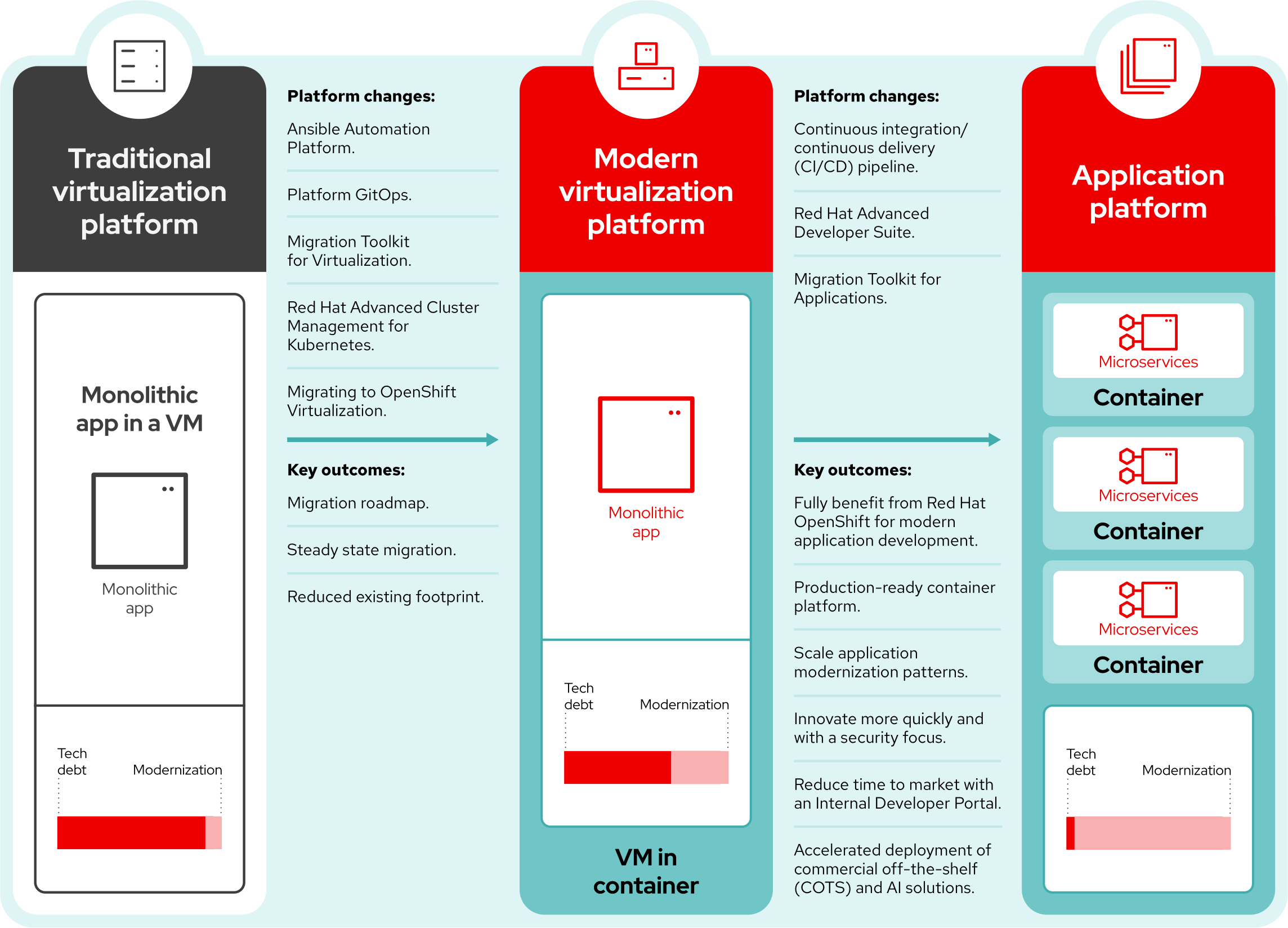
OpenShift Virtualization supports the streamlined and reliable migration of VMs to a virtualization platform where applications and workloads can be modernized when your organization is ready.
Red Hat Consulting offers expertise, including best practices and templates, that helps you continue on that modernization journey with the guided support and mentoring you need.
For those looking for a quick start path to containerized application development, Red Hat Consulting offers an Application Modernization Accelerator. For those seeking to start modernizing a subset of their traditional applications, look to the Application Portfolio Assessment. These engagements will help prepare your team and technology stack to scale application modernization patterns and focus on reducing technical debt.
Experts from Red Hat Consulting work with your team to accelerate innovation by modernizing your VM workloads to cloud-native applications, to help your organization:
Chapter 6: Build your internal skills with Red Hat Training and Certification
A key aspect of any migration is the specialized skills that your teams need to effectively operate your new platform, but it doesn’t mean that you have to navigate this without the proper resources at hand.
In tandem with mentoring and expertise from Red Hat Consulting, Red Hat Training and Certification can support your teams with holistic retraining and retooling as you navigate the migration and modernization journey and help your organization’s skill sets keep pace with the evolving landscape.
Although this might sound like a large organizational lift, Red Hat Training and Certification’s curriculum was designed to help flatten the learning curve for both those who are new to Red Hat OpenShift, as well as those who are interested in building on their foundational Red Hat OpenShift knowledge for a streamlined adoption. Red Hat offers free introductory courses to get you started and comfortable with the essentials, and then when you’re ready, you can select the more advanced training you need for each step in your journey.
Get started with Red Hat solutions
Professionals with existing VM experience are already halfway there, as they can use their existing knowledge to administer their workloads as VMs on Red Hat OpenShift. Their next step will simply be to become familiar with the fundamentals of Red Hat OpenShift and OpenShift Virtualization’s VM management capabilities.
Red Hat offers free introductory courses to help get you started and comfortable with the essentials, including foundational knowledge for Red Hat OpenShift and OpenShift Virtualization, as well as some basics for Ansible Automation Platform. This includes:
- Containers, Kubernetes, and Red Hat OpenShift technical overview (DO080).
- Red Hat OpenShift Virtualization technical overview (DO016).
- Ansible Basics: Automation technical overview (DO007).
Build your OpenShift Virtualization skills
With the fundamental knowledge and skills in place, you can look to build your skills and experience on OpenShift Virtualization.
If you wish to prioritize migration in the near term and intend to delve deeper into virtualization capabilities at a later point, Red Hat Training and Certification offers a number of courses and exams for Red Hat’s virtualization solutions that cover a range of learning content, including but not limited to:
- The basics of Red Hat OpenShift to reduce the barrier of entry.
- Migrating VMs from another hypervisor to Red Hat OpenShift Virtualization with the migration toolkit for virtualization operator and Ansible Automation Platform.
- Creating and managing VMs on Red Hat OpenShift using the Red Hat OpenShift Virtualization operator.
- Learning advanced techniques, such as sealing VM clones to create golden images, custom instance types, and custom templates, that help developers and other administrators independently create VMs from existing VMs that are tested and authorized for cloning.
- Provisioning and managing storage for VMs by learning how to apply the same established ways of working with Kubernetes to your VMs.
- Addressing security concerns by isolating traffic between VMs and nodes in different networks. This is accomplished by configuring node networking to connect VMs and nodes to networks outside of the cluster and isolating your workloads to run VMs on a separate network.
- Minimizing downtime by using high availability VMs that are resilient to failures, implementing planned maintenance, and conducting cluster upgrades by configuring Kubernetes resources.
These courses were carefully created for VM Administrators who are interested in moving virtualized workloads from traditional hypervisors, Kubernetes administrators, platform engineers, cloud administrators, system administrators who want to support virtualized workloads, and automation architects.
Learn how to streamline the complete VM lifecycle
To further support your OpenShift Virtualization skills, Red Hat Training and Certification also offers a number of courses that cover the skills you need to use Advanced Cluster Management and Ansible Automation Platform, including how to:
While these aren’t mandatory, they will be useful if you want to use Advanced Cluster Management and the OpenShift GitOps operator to deploy OpenShift Virtualization and VMs to a managed cluster or use Ansible Automation Platform to automate migration and create supporting Kubernetes resources for VMs.
When your organization is ready to modernize traditional applications, Red Hat also offers a developer’s skills path to help you learn how to build and deploy containerized applications on a Red Hat OpenShift cluster.
Red Hat Training and Certification helps you:
- Grow team capabilities.
- Speed up technology adoption and maximize your ROI.
- Accelerate innovation by addressing your organizational skills gaps.
- Boost your team performance and increase productivity.
- Advance individual competency.
- Attain greater autonomy and the ability to troubleshoot on the job.
- Follow established uses and practices to improve job performance.
- Reduce mistakes and increase efficiency.
Evaluating your organization’s training needs
During the Virtualization Migration Assessment engagement, Red Hat will analyze your team’s current skills and recommend any Red Hat Training and Certification courses that would be relevant and valuable, either during migration or afterwards. These courses can most often be completed during the Virtualization Migration Factory, but any supplementary courses can also be done after the completion of your migration journey.
You can also explore the Red Hat skill paths to gain a clearer understanding of the skills you should build in your organization to best prepare your teams to use Red Hat OpenShift and Ansible Automation Platform. These outline the recommended Red Hat Training and Certification courses for Red Hat OpenShift and Ansible Automation Platform.
Take the Red Hat Skills Assessment.
This no-cost tool tests your expertise, determines your skills gaps, and gives you recommendations for where to start with Red Hat training.
Chapter 7: Depend on a dedicated advisor with Red Hat Technical Account Management
Engaging with a Red Hat TAM during your virtualization journey provides your organization with a technical expert and dedicated advisor who serves as your single point of contact for all technical advice and ongoing support. This can be extremely valuable both during and after a migration.
By providing specialized knowledge of Red Hat products—including OpenShift Virtualization and all other components of the complete Red Hat virtualization platform—a Red Hat TAM can help you determine your migration goals, and ultimately, achieve your desired business outcomes with a modern virtualization platform.
Red Hat TAMs can help you:
- Migrate, create, and manage VMs successfully by providing specialized expertise.
- Understand complex infrastructure, to help you avoid potential issues and costly downtime.
- Build in-house skills through knowledge transfer tutorials and workshops.
- Establish plans and goals for long-term success.
Red Hat recommends 1 of 3 TAM engagements for a virtualization migration:
Dedicated Red Hat OpenShift TAM
- For migrations of more than 500 VMs.
- Dedicated to 1 account.
- Covers Red Hat OpenShift.
Enterprise TAM
- For migrations of more than 5,000 VMs.
- Dedicated to 1 account.
- Covers multiple products, including Red Hat Enterprise Linux, Red Hat OpenShift, and Ansible Automation Platform.
Shared Red Hat OpenShift TAM
- For migrations of less than 500 VMs.
- Dedicated to 4+ accounts.
- Covers Red Hat OpenShift only.
Chapter 8: Explore the added value of Red Hat’s partner ecosystem
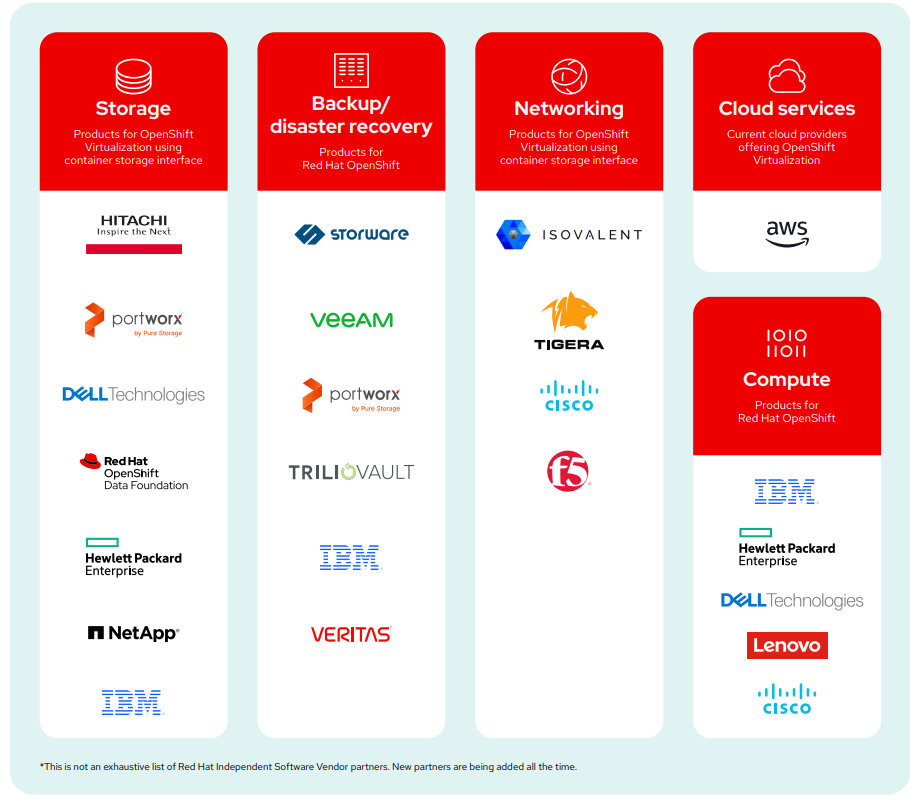
For many customers undertaking a complete VM migration, it’s essential that the virtualization platform can integrate with their existing set of technology investments. Customer environments are complex and most organizations have investments with multiple technology vendors in areas that include hardware, storage, backup, disaster recovery, networking, and more. As a result, some have discovered the need to address updates to 1 or more of their existing investments beyond just virtualization solutions.
Red Hat’s migration approach emphasizes the value of reuse whenever possible, which is achievable because:
- Red Hat OpenShift and OpenShift Virtualization run effectively on multiple hardware platforms, and integrate with many versions of networking, storage, backup, and disaster recovery solutions.
- Red Hat provides you access to a robust and diverse partner ecosystem—as well as partner solution and service recommendations—cultivated over years of successfully building relationships with innovative companies in key solution areas.
- In addition to relationships with many hardware original equipment manufacturers (OEMs) and independent software vendors (ISVs), Red Hat has deep partnerships with global, regional, and local system integrators.
By tapping into the breadth of solutions available within Red Hat’s ecosystem, your organization benefits from working with partners that are already tested and skilled in implementing Red Hat solutions, including OpenShift Virtualization, OpenShift Virtualization Engine, Ansible Automation Platform, Advanced Cluster Management, and more.
To determine which partner solutions you may need to support your VM migration and modernization journey, it is important to ask yourself the following key questions:
- Which third-party solutions are integrated into my current virtualization platform and what role will they play in my future platform?
- Do I need to incorporate advanced features such as network dynamic routing and Multiprotocol Label Switching (MPLS)?
- Will I reuse my existing storage and compute hardware or use my regular refresh cycle to accelerate my migration journey?
Chapter 9: A customer's journey through VM migration with Red Hat Services
To get a clearer picture of the value of engaging with Red Hat Services for your VM migration and modernization journey, let’s take a look at a real-world example and the significant benefits that were achieved.
Large technology company standardizes on Red Hat OpenShift with guided migration
In this story, a leading global technology company with over 100,000 employees that offers a broad range of solutions to multiple customer segments had more than 100 different departments running its IT environments, many of which used a traditional virtualization platform.
As running VMs and containers on their existing platform became too expensive, they partnered with Red Hat Services for a guided migration to Red Hat OpenShift and OpenShift Virtualization. While the project’s main focus was on OpenShift Virtualization migration, the company also had a strategic focus on application modernization.
Supporting migration pathways tailored for different users
Red Hat Consulting conducted 10 proofs of concept and worked with a variety of stakeholders to understand their needs. The Red Hat team then tailored its offering for 3 groups within the company:
The team also used Red Hat Training and Certification’s curriculum to upskill internal platform users and operators, curated assets to speed up adoption, and ongoing advice and guidance on how to run the environment post-migration.
Teams that migrated to Red Hat OpenShift attended discovery workshops and training programs with Red Hat Services. During these sessions, the teams created a navigation plan tailored to their department using proven Red Hat methodologies, documentation, and education pathways. In addition, 3 Red Hat TAMs supported the project by handling ticket escalation and proactively offering guidance to teams adopting the new platform.
Red Hat Consulting also provided mentorship and best practices throughout migration, and each group had an internal sponsor from the global technology company providing coaching to gain buy-in from their peers.
Improving competitive edge with the right technology and right support
The technology company’s project management office worked closely with Red Hat to build trust and establish open lines of communication. This helped to keep the project on track, sped up issue resolution, and fostered a culture of collaboration to achieve common goals.
The success of this guided migration with Red Hat Services resulted in a number of key operational benefits, including but not limited to:
- Harmonization of a fragmented IT environment. Migrating to a common platform gave the technology company a more standard environment—which made it easier to manage and more cost-effective—while still allowing internal departments the freedom to operate independently.
- Accelerated development and improved consistency. Red Hat OpenShift is faster and more reliable than the organization’s previous environment, which helped their developers work more efficiently, while the added stability of running containers and VMs on the same platform helped the company improve consistency.
- Reduced operational costs and increased operational efficiency. Red Hat OpenShift is not only more cost-effective than the company’s previous environment, it also brought them improved scalability, cloud elasticity, and operational efficiency, while Red Hat Services provided expertise, support, and training for a smooth transition.
Read the full case study to learn more about the tangible benefits of engaging Red Hat Services for a VM migration and modernization journey.
Start your virtualization journey with Red Hat
Are you ready to start your migration with Red Hat? Speak to a Red Hatter to discuss your organization’s virtualization needs and how Red Hat Services can help.
Forrester Consulting, commissioned by Red Hat. “The Total Economic Impact™ Of Red Hat Consulting for OpenShift,” Sept. 2024.
McAfee, Nathan. “Analyzing the Economic Impact of Red Hat Training.” Enterprise Strategy Group, Jan. 2024.
Forrester Consulting, commissioned by Red Hat. “The Total Economic Impact™ Of Red Hat Technical Account Managers executive summary,” May 2023.