
For the third consecutive year, Red Hat has been recognized as a Leader in the Gartner® Magic Quadrant™ for Cloud-Native Application Platforms. We believe this acknowledgement reflects the value of Red Hat OpenShift as a comprehensive application platform, providing the hybrid cloud consistency teams need to modernize virtual machines, run containers, and accelerate AI adoption on a single foundation.
The platform is natively integrated and available as a managed service including Red Hat OpenShift Service on AWS, Microsoft Azure Red Hat OpenShift, Red Hat OpenShift Dedicated on Google Cloud and Red Hat OpenShift on IBM Cloud, while also supporting flexible, self-managed deployments on-premises or in private clouds.
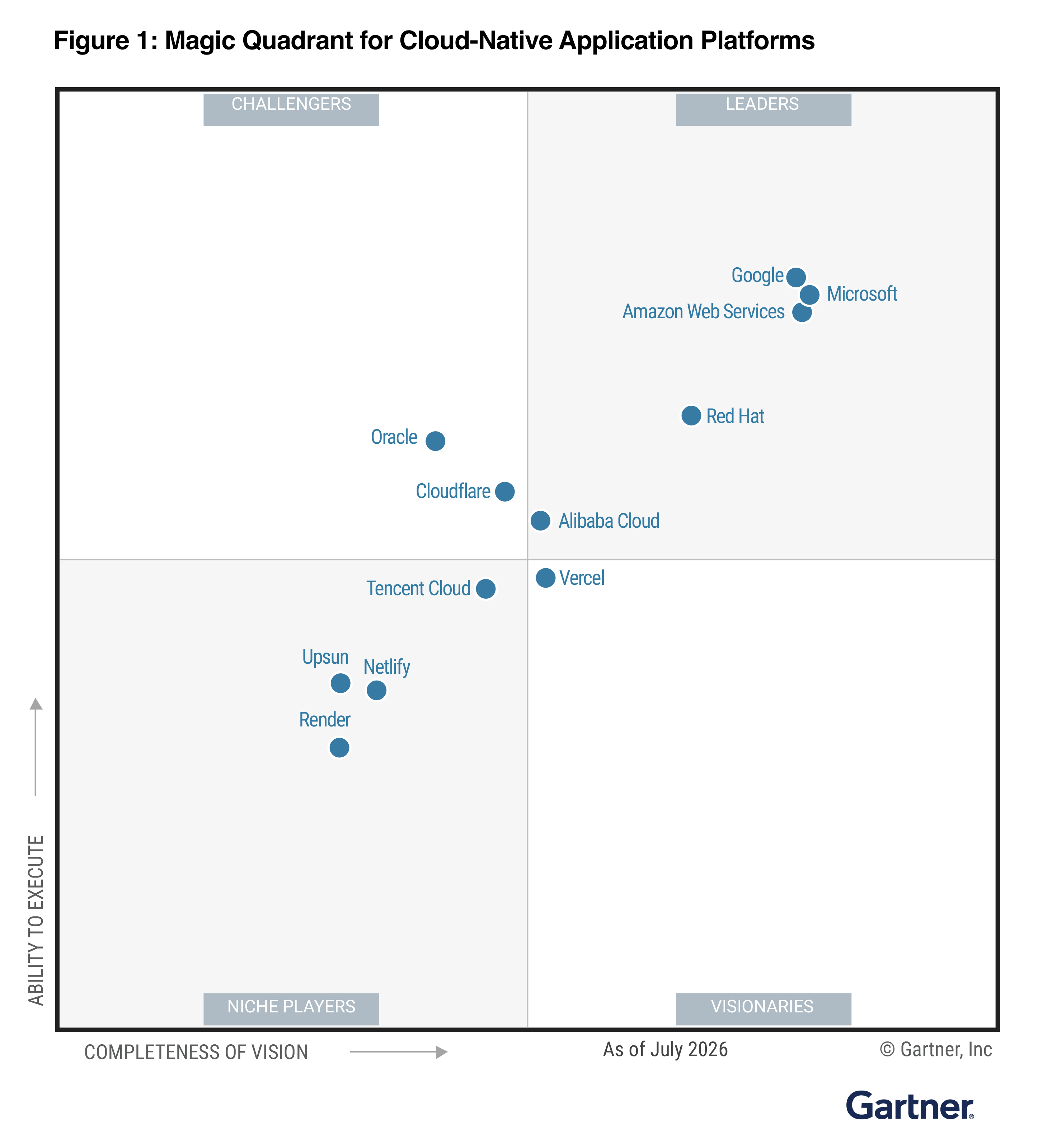
This graphic was published by Gartner, Inc. as part of a larger research document and should be evaluated in the context of the entire document. The Gartner document is available upon request from Red Hat.
Source: Gartner, “Magic Quadrant for Cloud-Native Application Platforms,” August 2026. Red Hat is positioned as a Leader in the upper-right quadrant, which we believe demonstrates strong execution and vision.
To help further explain the evaluation of the Gartner Magic Quadrant from our point of view, we’re answering some of the most frequently asked questions.
What is the Gartner Magic Quadrant?
“Magic Quadrant reports are a culmination of rigorous, fact-based research in specific markets, providing a wide-angle view of the relative positions of the providers in markets where growth is high and provider differentiation is distinct. Providers are positioned into four quadrants: Leaders, Challengers, Visionaries, and Niche Players. The research enables you to get the most from market analysis in alignment with your unique business and technology needs.”
How was this Magic Quadrant assessed? What was the criteria for inclusion?
“Gartner defines cloud-native application platforms as those that provide managed application runtime environments for applications and integrated capabilities to manage the life cycle of an application or application component in the cloud environment. They typically enable distributed application deployments and support cloud-native operations — such as elasticity, multitenancy and self-service — without requiring the development team to provision infrastructure or manage containers.
Cloud-native application platforms are designed to facilitate the deployment, runtime execution and management of modern cloud-native or cloud-optimized applications without the need to manage any underlying infrastructure.
Cloud-native application platforms provide an opinionated and structured execution environment that abstracts the complexities of underlying infrastructure and computing resources. These platforms supply vendor-supported runtimes and frameworks for commonly used languages (such as Java, .NET, Node.js, PHP, Python, Go and Ruby), reducing variability and operational overhead. By enforcing preferred configurations, automating infrastructure management and standardizing runtime environments, cloud-native application platforms help product teams deliver customer value faster and with greater consistency.
The cloud-native application platforms market reflects the consolidation of technologies across deployment, scalability, security and application observability to streamline software delivery. They are intended to be more than just a platform for running applications; they are essential for businesses aiming to achieve excellence in software engineering, productivity and market responsiveness.”
According to Gartner, the mandatory and optional features for the cloud-native application platforms market include:
- Application runtime services (including language runtime support) for multiple application types including web applications, mobile back ends, microservices, AI/ML models and analytics applications without requiring infrastructure provisioning or creating and maintaining custom container images.
- Automated deployment of cloud-native applications (e.g., integration with DevOps).
- Autoscaling (load balancing, scalability and running of multiple instances).
- Application monitoring and observability — Support for monitoring and observability to improve service-level objectives; gathering production telemetry (logs, metrics, events, traces).
- Fully managed service — Vendor (service provider) handles the maintaining, monitoring, updating and troubleshooting of the cloud-native application platform and the supported language runtimes and frameworks. This includes support, security, backups, performance optimization and infrastructure automation. It allows users to focus only on the application that can be deployed on cloud-native application platforms.
Why is this significant to us?
Gartner defines Leaders as those who execute well against their current vision and are well positioned for tomorrow. To us, being named a Leader for the third consecutive year provides powerful validation from one of the most recognized technology analyst firms in the IT space. In addition, we believe this acknowledgement underscores both the current capabilities of Red Hat OpenShift and the strength of our long-term vision to evolve the platform to meet the shifting demands of modern application development.
Learn more about Red Hat OpenShift as a Cloud-Native Application Platform
A full copy of the Gartner Magic Quadrant for Cloud-Native Application Platforms can be downloaded here.
Gartner disclaimer:
Gartner, Magic Quadrant for Cloud-Native Application Platforms, Saha Mukul, Coqueiro Alex, Prasanna Lakshmi Narasimha, Watson Richard, 3 Aug. 2026.
Gartner and Magic Quadrant are trademarks of Gartner, Inc. and/or its affiliates.
Gartner does not endorse any company, vendor, product or service depicted in its publications, and does not advise technology users to select only those vendors with the highest ratings or other designation. Gartner publications consist of the opinions of Gartner’s business and technology insights organization and should not be construed as statements of fact. Gartner disclaims all warranties, expressed or implied, with respect to this publication, including any warranties of merchantability or fitness for a particular purpose.
Product trial
Red Hat OpenShift Container Platform | Product Trial
About the author
Sara Buffington is a Product Marketing Manager at Red Hat, specializing in the marketing and positioning of Red Hat OpenShift cloud services.
More like this
Simplify hybrid cloud ops with Red Hat OpenShift Lightspeed: 5 sets of prompts to try today
Navigate AI and scale with Red Hat OpenShift 4.22
Browse by channel

Automation
The latest on IT automation for tech, teams, and environments

Artificial intelligence
Updates on the platforms that free customers to run AI workloads anywhere

Open hybrid cloud
Explore how we build a more flexible future with hybrid cloud

Security
The latest on how we reduce risks across environments and technologies

Edge computing
Updates on the platforms that simplify operations at the edge

Infrastructure
The latest on the world’s leading enterprise Linux platform

Applications
Inside our solutions to the toughest application challenges

Virtualization
The future of enterprise virtualization for your workloads on-premise or across clouds
