



As organizations embrace agentic AI for cluster operations, the central challenge shifts from whether or not AI can control a cluster to whether it can do it safely and with accountability. How do large language models (LLMs) provide meaningful context and operational capability within our clusters without compromising security or relying on brittle, script-based wrappers?
To address this challenge, Red Hat has introduced the Model Context Protocol (MCP) server for Red Hat OpenShift, available as a technology preview. MCP refers to an open source standard for connecting AI applications to external data and tools. The MCP server for Red Hat OpenShift uses the MCP to provide LLM Agents controlled access to OpenShift clusters. This helps your agents to safely and intelligently interact with your OpenShift clusters following rules you define.
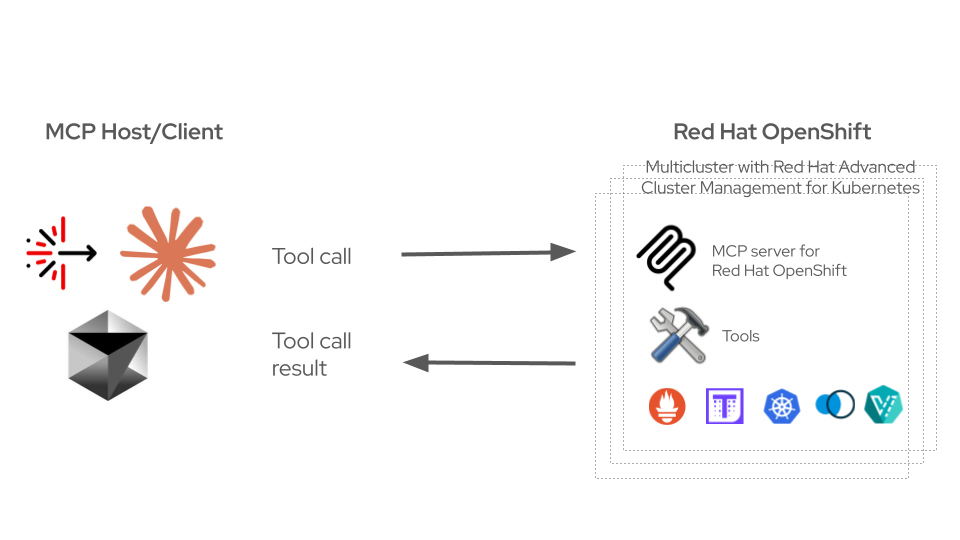
MCP server for Red Hat OpenShift
The MCP server for Red Hat OpenShift introduces a suite of capabilities designed to bring AI-driven operations to the enterprise, focusing on security, observability, and scale:
Architected for fleet-wide scale
Platform engineers rarely manage single clusters. To support fleets of OpenShift clusters, the MCP server natively supports multicluster operations. Instead of relying on static, distributed kubeconfig files, the server introduces OAuth and OIDC integration, using token exchange protocols. Currently supporting Keycloak, this architecture allows the MCP server to reside on a Red Hat Advanced Cluster Management for Kubernetes hub. Authenticated agents more safely query and act upon managed OpenShift clusters dynamically without requiring impersonation flows, maintaining strict identity verification across the fleet. Here’s a short demo showing token exchange for the MCP server for Red Hat OpenShift.
RBAC and auditability
In addition to the OAuth and OIDC integration, the MCP server for Red Hat OpenShift server does not attempt to reinvent Kubernetes security; instead, it enforces it through:
- Read-only by default: The MCP server's modular toolset architecture defaults to read-only operations. Write capabilities must be explicitly enabled, and administrators can entirely disable destructive operations via configuration flags.
- Role-based access control (RBAC) enforcement and resource denial: The MCP server respects standard Kubernetes RBAC. Additionally, administrators can explicitly block the server from interacting with sensitive resources, such as Secrets or ConfigMaps, using the denied_resources configuration block.
- Audit trail: To maintain visibility for platform teams, the server injects a specific user-agent string into Kubernetes API calls. This helps ensure that the API server audit logs clearly demarcate actions initiated by an AI agent versus a human operator.
Deep observability and telemetry
Fully integrated into the MCP server, OpenTelemetry support exposes granular metrics and distributed traces directly to OpenShift monitoring. Furthermore, the MCP server exposes powerful observability toolsets directly to the LLM.
- Thanos and Prometheus: Agents can execute both instant and range PromQL queries to analyze historical trends and real-time metrics. As this is a technology preview, comprehensive evaluations of these tools are planned but not yet available.
- Red Hat OpenShift ServiceMesh (Kiali) integration: The MCP server exposes Kiali-backed tools so agents can move from high-level mesh and namespace health to per-service and per-workload signals, including traces, metrics, and logs, plus Istio configuration when the task needs to explain or change mesh behavior
- Node-level metrics: Tools like nodes_stats_summary expose the kubelet's summary API, granting agents access to cgroup v2 Pressure Stall Information (PSI) for CPU, memory, and I/O.
Extensible infrastructure management
Beyond core Kubernetes resources, the MCP server ships with multiple toolsets and custom prompts designed for complex infrastructure management across the Red Hat OpenShift ecosystem including:
- Helm: Helm chart and release management.
- NetEdge: Troubleshooting for DNS and ingress, as well as monitoring for debugging connectivity and routing issues.
- OpenShift ServiceMesh (kiali): OpenShift ServiceMesh management tools covering mesh topology and health, Istio config management, resource and workload detail, metrics, logs, traces, plus pod performance against requests/limits..
- Red Hat OpenShift Virtualization (kubevirt): VM lifecycle management and troubleshooting. This toolset is available as a developer preview.
- Prometheus: Prometheus tools for querying cluster metrics and alerts directly. As this is a technology preview, comprehensive evaluations of these tools are planned but not yet available.
If you’ve got a fleet of MCP servers, read about the MCP gateway to see how to federate, govern, and control AI agent traffic at scale.
Evaluations
Quality evaluation has been a top concern from the very start. For tool quality, we used mcpchecker, an open source integration testing framework that validates MCP servers by running AI agents against them and verifying that tools execute across a variety of scenarios, as well as they are discoverable and usable against a suite of different LLMs and agents so that agents are able to successfully use these tools.
Try MCP server for Red Hat OpenShift today!
The technology preview is available now at Model Context Protocol (MCP) server for Kubernetes and OpenShift. Follow instructions from the MCP server for Red Hat OpenShift User Guide to get started. Connect it to your AI client of choice, and start exploring what agentic cluster operations actually feel like in practice.
MCP lifecycle operator
In addition to the MCP server for Red Hat OpenShift, we’re also making available the MCP lifecycle operator, which is available as a developer preview. The MCP lifecycle operator is an operator that makes it easy to deploy, run, and manage MCP servers in OpenShift and Kubernetes. Learn more here about how the MCP lifecycle operator will be used for handling MCP server’s full lifecycles with production-grade automation and ecosystem integrations.
We'd love your feedback—whether it's a bug, a missing tool, or an idea for what comes next.
Join the conversation in the OpenShift Commons Slack #general channel, open a GitHub issue, or send a pull request.
Product trial
Red Hat OpenShift Container Platform | Product Trial
About the authors
Calum Murray is a Software Engineer focused on Applied AI initiatives for OpenShift. He specializes in building at the intersection of AI and cloud-native infrastructure, including the MCP server for Red Hat OpenShift, MCP evaluations, and Agent Skill evaluations. Previously, he focused on developing OpenShift Serverless.
Calum is an active open source community leader, serving as a Cloud Native Computing Foundation (CNCF) Ambassador and project maintainer.
Matthias Wessendorf works on the Messaging team at Red Hat, focusing on event-driven architectures, data-streaming, and serverless workloads. He is an active contributor to the Knative project. Matthias is a regular speaker at international conferences and is a long standing member of the Apache Software Foundation.
Ju Lim works on the core Red Hat OpenShift Container Platform for hybrid and multi-cloud environments to enable customers to run Red Hat OpenShift anywhere. Ju leads the product management teams responsible for installation, updates, provider integration, and cloud infrastructure.
More like this
From data residency to digital control: Why the Middle East’s cloud future depends on the ecosystem
Smart enough, fast enough: Choosing the right models for agentic work
How Red Hat cleared IT debt for scalable AI
Standardizing the AI stack with PyTorch
Browse by channel

Automation
The latest on IT automation for tech, teams, and environments

Artificial intelligence
Updates on the platforms that free customers to run AI workloads anywhere

Open hybrid cloud
Explore how we build a more flexible future with hybrid cloud

Security
The latest on how we reduce risks across environments and technologies

Edge computing
Updates on the platforms that simplify operations at the edge

Infrastructure
The latest on the world’s leading enterprise Linux platform

Applications
Inside our solutions to the toughest application challenges

Virtualization
The future of enterprise virtualization for your workloads on-premise or across clouds
