

With the migration toolkit for virtualization 2.11 (MTV) release, users gain an improved learning experience.
A new “Tips and tricks” drawer was introduced as part of the 2.10 release and further improved in the following 2.11 release, which allows users to access contextual help, tips, and best practices directly within the interface. This feature is designed to reduce the learning curve for new users and provide immediate, in-context guidance for common and complex migration tasks, helping users learn key MTV workflows without ever leaving their current view.
Learn while doing: Interactive guidance
The "Tips and tricks" drawer is more than just a static help menu; it’s an interactive companion for your migration journey and can be accessed via the “Tips and tricks” button located on the top right of the MTV pages.
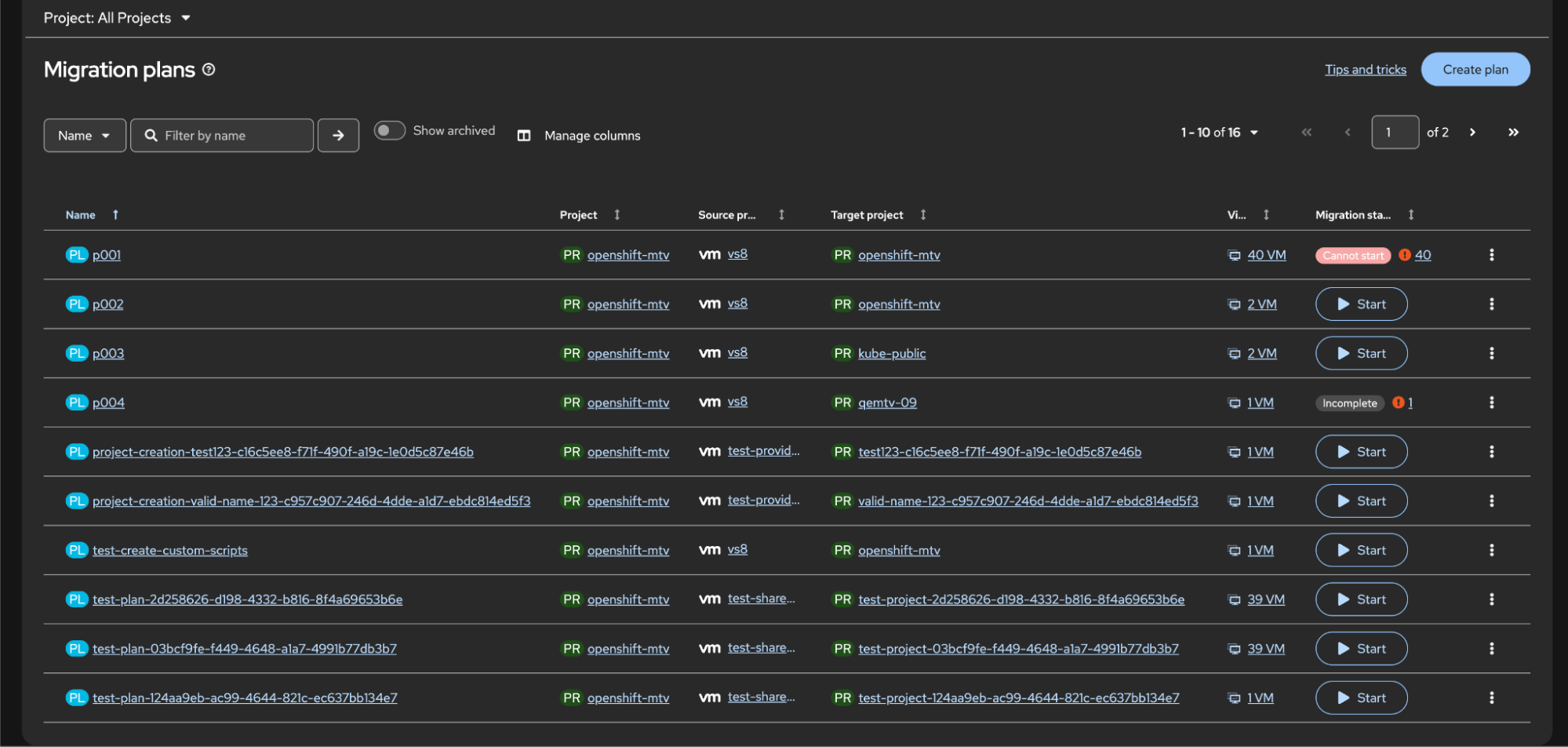
Image 1: Visual of the “Tips and tricks” drawer button on the top right of a migration for virtualization page
Its offerings include:
- Follow along in real time: You can follow the steps in the drawer and click on instructions to see the actual page change or to highlight the next action.
- Side-by-side execution: The side-by-side view ensures you never lose your place in a workflow while accessing in-depth information.
- Actionable steps: Every guide is structured to help you download, configure, or run tasks immediately, allowing you to see results at each stage.
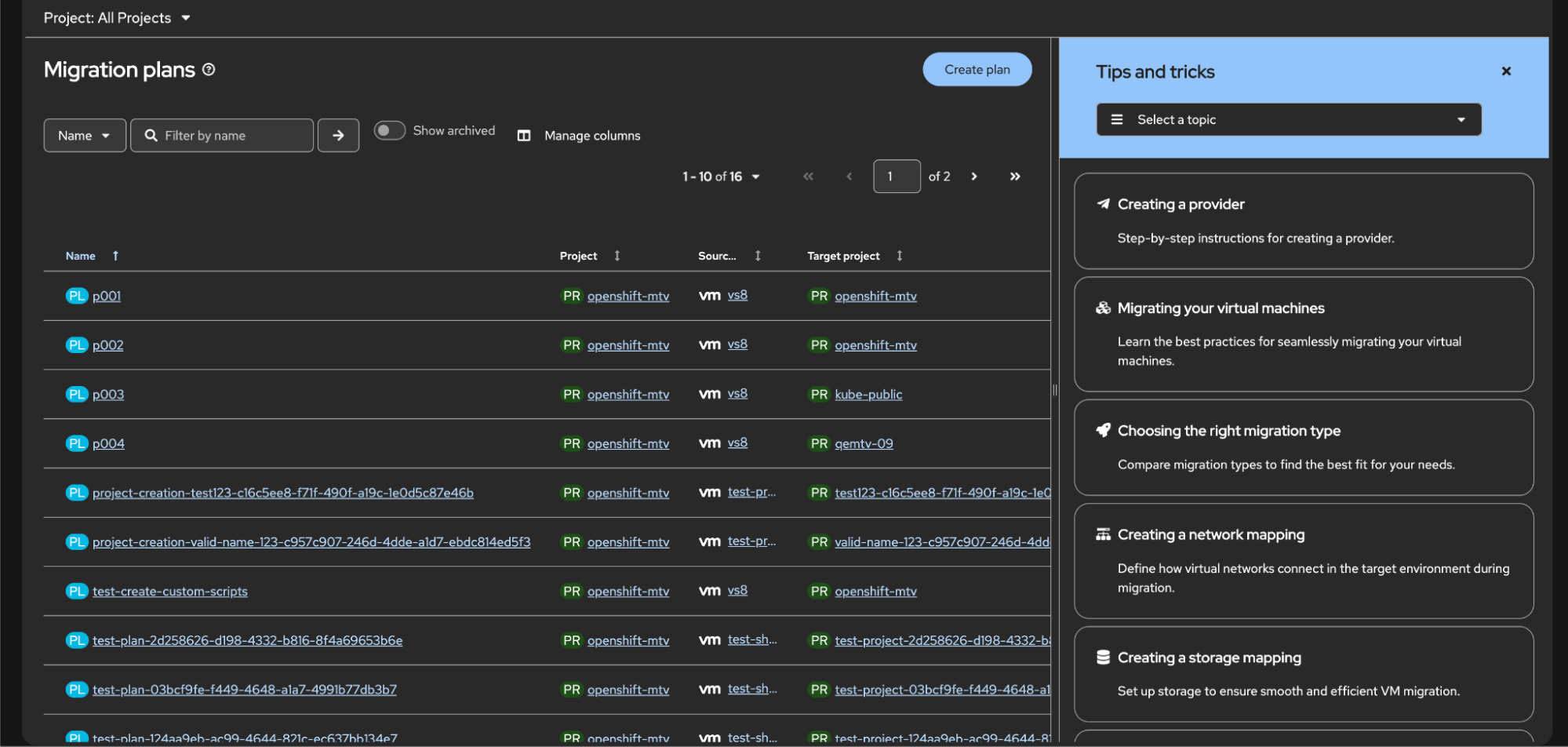
Instead of overwhelming you with everything you could know about virtualization, the drawer is organized around what you must do to be successful and includes the following advantages:
- Skip the fluff: Focus on the information you need to know regarding your current task.
- Follow the flow: The drawer allows you to click on specific instructions that update the main page, guiding you through the actual workflow in real time.
- Action over reading: Each topic is structured to get you to a result—whether that is configuring a network or running a migration—without needing to read through volumes of documents.
The why
We built this “Tips and tricks” drawer because our research strongly suggested that the way people learn is changing. We've found that users often hit a wall of text when navigating traditional documentation, which can stall progress and cause frustration.
Our investigations into the user experience revealed 3 core insights that drove this change:
- Documentation fatigue: Users prefer to stay within the product interface rather than context-switching to an external browser tab to find answers.
- The need for "just-in-time" learning: Platform engineers and sysadmins are typically looking for the answer to a specific question, not a full history of the product.
- Reducing cognitive load: By providing help directly where the task is being performed, we eliminate the need for users to memorize complex steps from a separate manual.
Better learning, better migrations
MTV 2.11's "Tips and tricks" drawer offers embedded, timely guidance, shifting to in-context learning to improve migration success. Easily navigate migration workflows and reduce cognitive load by accessing guidance directly in context. Try the new learning tool in the migration toolkit for virtualization and let us know what you think. To find out more about this version, check out the MTV 2.11 release notes.
Product trial
Red Hat OpenShift Container Platform | Product Trial
About the authors
Margot is Senior Interaction Designer on the User Experience Design team, currently working in the OpenShift Virtualization space, with a focus on MTV
Allison Wolfe is a content designer on the User Experience Design (UXD) team. She joined Red Hat in 2021 and helps translate complex concepts into clear, concise language.
More like this
How Delta Air Lines scaled AI-native development to 1,200 engineers with cloud development environments
The playbook behind Red Hat’s most successful OpenShift deployments
Python's Tale | Command Line Heroes
Who’s Afraid Of Compilers? | Compiler
Browse by channel

Automation
The latest on IT automation for tech, teams, and environments

Artificial intelligence
Updates on the platforms that free customers to run AI workloads anywhere

Open hybrid cloud
Explore how we build a more flexible future with hybrid cloud

Security
The latest on how we reduce risks across environments and technologies

Edge computing
Updates on the platforms that simplify operations at the edge

Infrastructure
The latest on the world’s leading enterprise Linux platform

Applications
Inside our solutions to the toughest application challenges

Virtualization
The future of enterprise virtualization for your workloads on-premise or across clouds
