


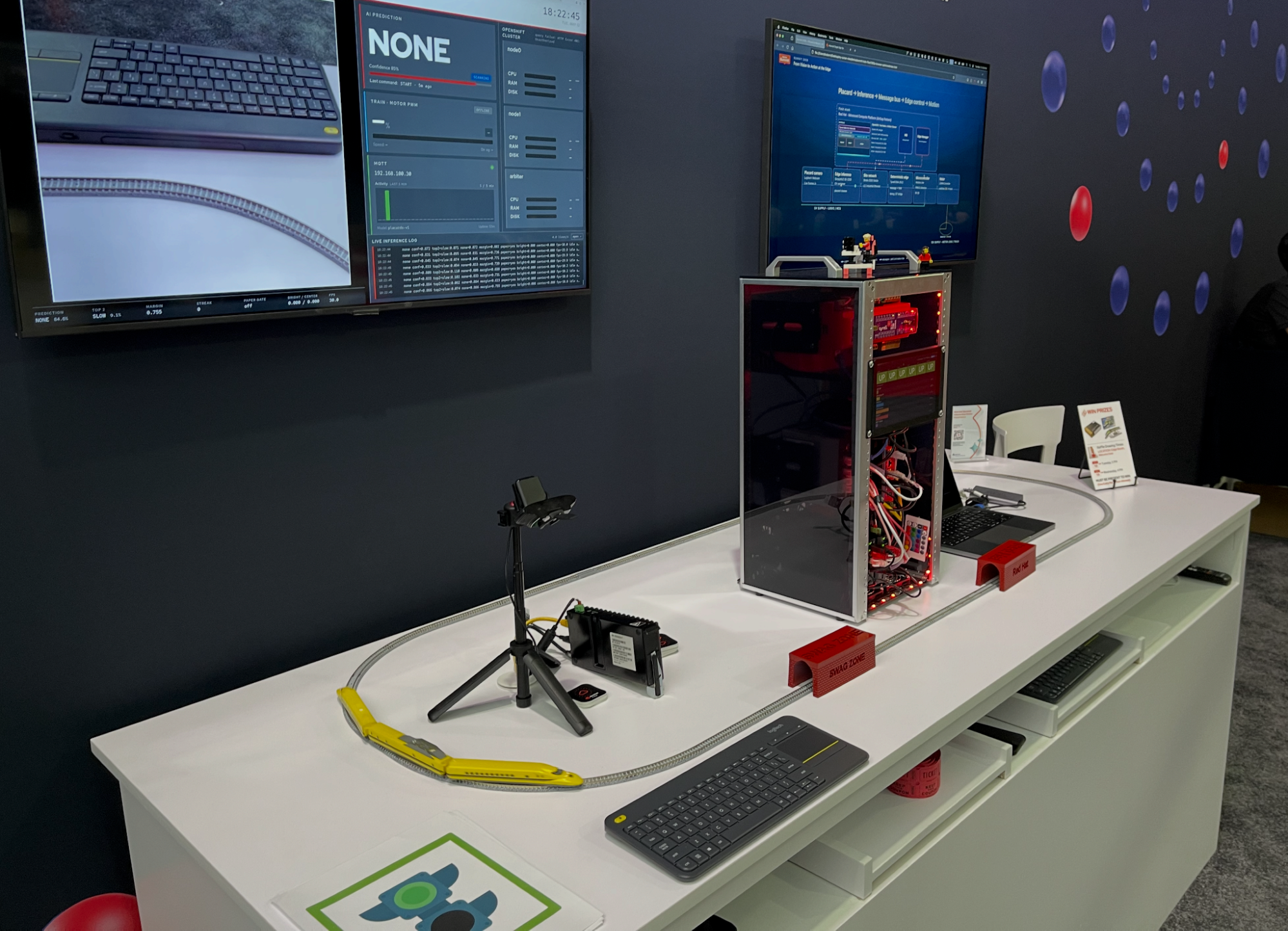
Red Hat Summit demonstration booth featuring a model train track, edge computing hardware, monitoring displays, and supporting infrastructure used to demonstrate AI-driven automation at the edge.
Many AI demos stop at detection. A dashboard highlights an object, a model produces a classification, or a graph updates in real time. Those are valuable building blocks, but operational environments often require something more immediate—systems that can react locally, autonomously, and in near time.
Using the Red Hat edge portfolio, we set out to explore what happens when AI moves beyond observation and begins driving real operational behavior.
To bring that concept to life at Red Hat Summit 2026, we built a live train demonstration that transformed visual recognition directly into physical action at the edge.
The demo became a tangible way to show how edge AI, containerized workloads, and fleet management technologies can work together in operational environments.
What visitors experienced
The booth setup was intentionally physical and interactive.
Visitors could hold up printed placards representing commands such as:




Four visual command placards labeled Start, Stop, Slow, and Reverse used by a computer vision model to control train behavior through AI-based image recognition.
A webcam connected to a managed edge gateway continuously captured video frames. Those frames were processed locally using OpenCV and passed into a MobileNetV3-based image classification model running with ONNX Runtime inside a Podman container on Red Hat Enterprise Linux image mode.
Once the model confidently identified a placard, the application published a JSON message over MQTT (Message Queuing Telemetry Transport) to an industrial control system responsible for train behavior.
The result was immediate and visible.
A placard changed. The model classified it. An MQTT message was published. The train reacted.
That entire workflow happened locally at the edge.
Figure 1. (video) A portable air-gapped infrastructure rack provided the compute, networking, management, and industrial control services required to operate the demonstration in disconnected environments
Delivering edge air gap infrastructure
To make the demo portable, self-contained, and capable of operating in disconnected environments, the entire solution was integrated into a compact air-gapped mini-rack that combined edge compute, industrial control, networking, and operational visualization.
From bottom to top, the rack contained:
- A two-node OpenShift with arbiter configuration running Red Hat Edge Manager and MQTT services.
- An industrial network switch connecting the operational and compute components.
- An Advantech UNO-148 bootstrap node running Red Hat build of MicroShift that automated deployment of the Red Hat OpenShift cluster running a pattern of Red Hat’s advanced compute platform approach while also providing critical air-gapped infrastructure services such as DNS, NTP, DHCP, and a local container registry.
- A Human-Machine Interface (HMI) touch panel displaying Grafana dashboards and the OpenShift interface for real-time operational visibility.
- A Tyrrell IOANA Programmable Logic Controller (PLC) responsible for controlling voltage distribution to the train system.
Mounted behind the rack and wired in-series were several additional hardware components that translated software-driven decisions into physical train movement:
- A breadboard containing 10k ohm resistors used to step voltage down from the IOANA controller from 10V to 5V.
- An Arduino microcontroller responsible for train speed and direction logic while converting commands into Pulse Width Modulation (PWM) signals.
- An L298N motor controller connected directly to the train track.
The train itself also contained a powered middle car that housed the motor assembly responsible for propulsion.
Red Hat’s advanced compute platform approach
Red Hat has been developing an advanced compute platform (ACP) approach to help provide a next generation compute environment for running containerized, virtualized, and AI workloads, all on the same hyperconverged platform.
Components and value:
- A highly-tuned compact ACP is deployed with specific functionality disabled to save on computing resources.
- SimplyNUC (SNUC) small form-factor hardware (EE-2200, EE-1100) with full out-of-band baseboard management controllers (BMCs) is used to host the platform, highlighting the flexibility of deployment size of an ACP, and the power of SNUC’s EE line.
- Portworx from EverPure is used as the storage layer on the two-node OpenShift with arbiter cluster, providing software-defined storage for workloads on the ACP to consume, even in the absence of a full-power third node. This also highlights our ongoing collaboration with EverPure.
- Red Hat Edge Manager runs on the platform, and is used to manage the distributed control nodes (DCN’s) throughout the system. In addition to standard agent <> back-end Edge Manager communication (providing desired state configuration management and CPU, memory and disk pressure monitoring), the new software catalog feature of version 1.1 is used to enable self-service catalog deployment of the AI Inference Application to the Computer Vision Edge Gateway device.
- Red Hat OpenShift GitOps is used for deployment and management of Red Hat Edge Manager and the MQTT broker.
- MetalLB is used to expose the MQTT broker directly onto the network via a standard L3 IP address.
- NMState is used to configure the secondary interfaces on the nodes, creating a dedicated storage network for increased throughput.
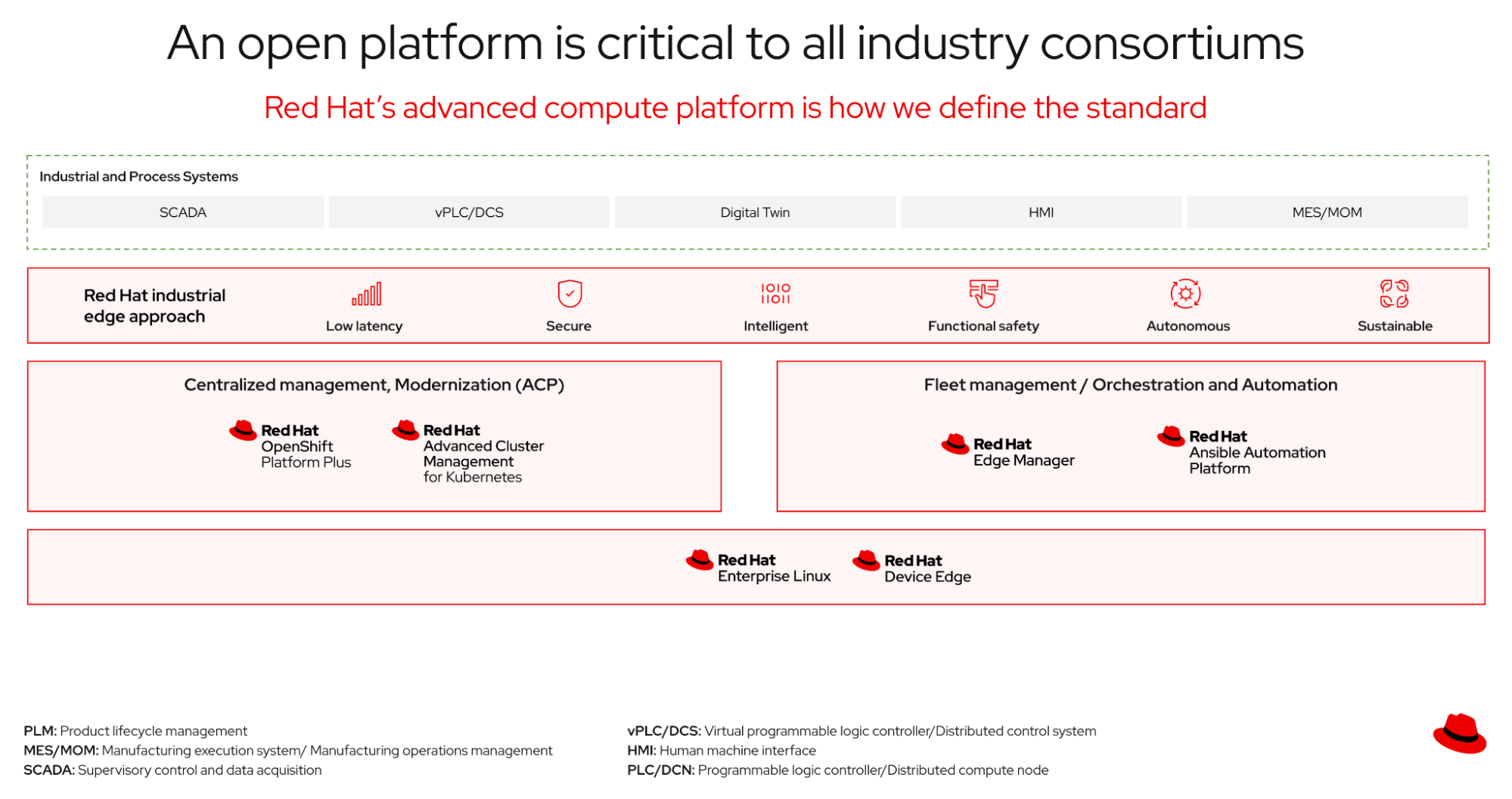
Figure 2. Red Hat's industrial edge architecture combines centralized management, automation, and edge computing technologies to support modern industrial workloads.
Bootstrap automation for consistency and repeatability
The bootstrap device allowed for the offline installation and operation of the advanced compute platform, as well as the other devices within the system. It stored the required content for the installation and operation of the ACP as well as providing the network services (NAT, DNS, DHCP) to support operations in challenging network locations (such as a tradeshow).

Figure 3. The bootstrap platform automates deployment of a two-node OpenShift with arbiter cluster while providing essential services such as DNS, DHCP, NTP, and container registry capabilities.
This type of setup highlights the customizability of an image mode bootc image, and attempts to solve some of the complexity in setting up offline installations of ACPs in a highly automated fashion.
Components and value:
- Advantech UNO-148: Advantech is a longtime hardware partner, and provides edge-focused passively-cooled hardware options that retain high core/memory count, along with multiple slots for storage devices.
- Image-mode RHEL: Image mode for Red Hat Enterprise Linux (RHEL) provides greater resiliency for edge operating environments than traditional RPM-mode RHEL, and allows for easier customization through the build process, simplifying the deployment and operation of the system.
- MicroShift: MicroShift provides a clean way to assemble software "appliance-style", so the various components are automatically started on first boot. This helps provide a consistent, repeatable deployment pattern within a set bootc image.
Device edge management
Red Hat Edge Manager enables desired state configuration management and device monitoring.
- Operational state monitoring: Continuous health and status telemetry provides near-time visibility into device, application, and infrastructure conditions on the edge gateway, improving operational consistency while quickly identifying workload, connectivity, or system-level issues.
- Software catalog application deployment: Used to deploy the containerized AI inference application on-demand, resulting in the underlying device specification being created automatically (avoiding any errors introduced through manual configuration).
- Desired state configuration management: An agent on managed devices "phones home" every 60 seconds, comparing current device state to managed state. If a drift is detected, this is automatically fixed without having to allocate resources for on-site remediation.
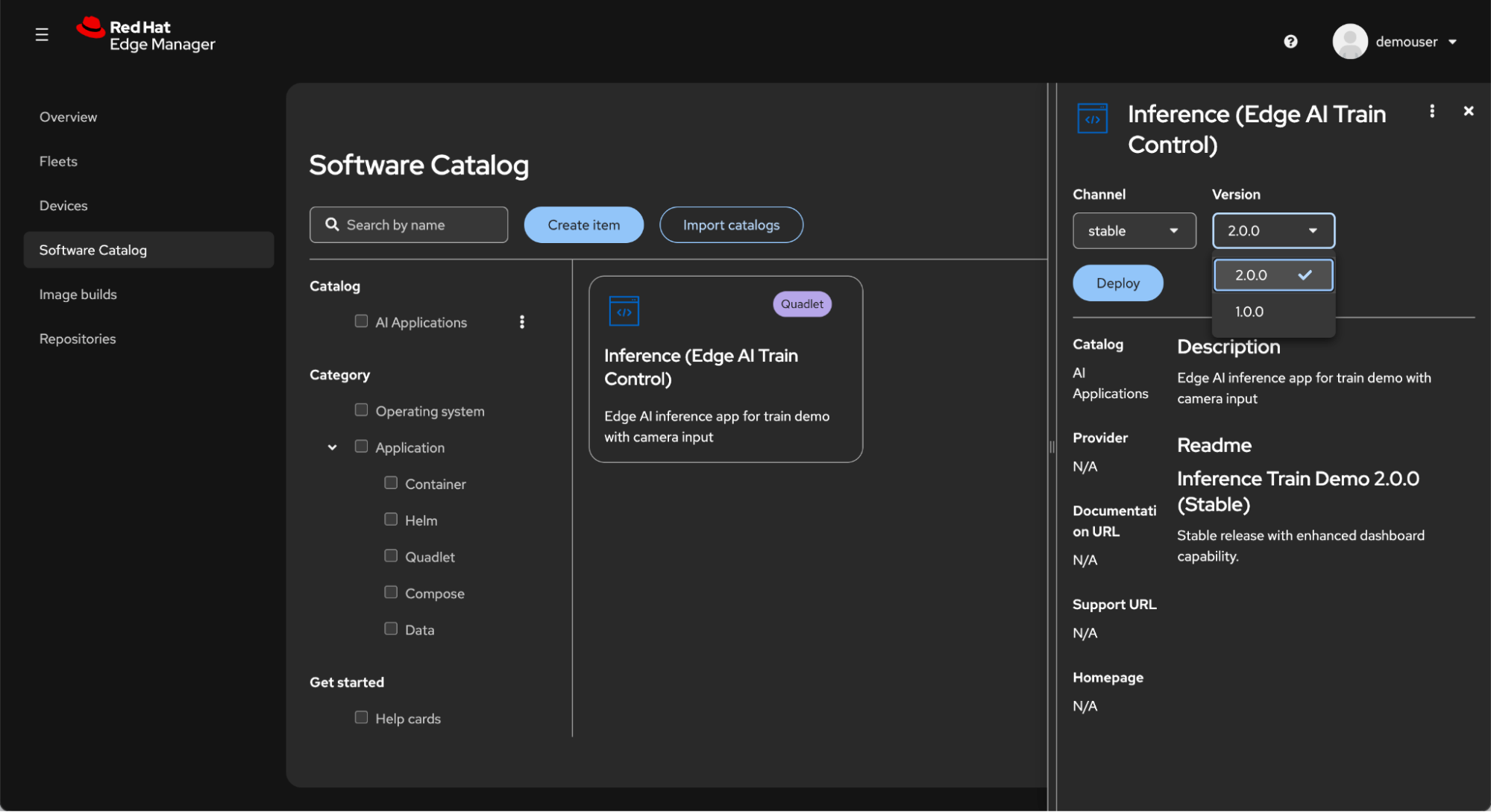
Figure 4. Red Hat Edge Manager Software Catalog was used to deploy the AI inference application to the edge gateway through a self-service workflow.
Final thoughts: Building reliable infrastructure at the edge
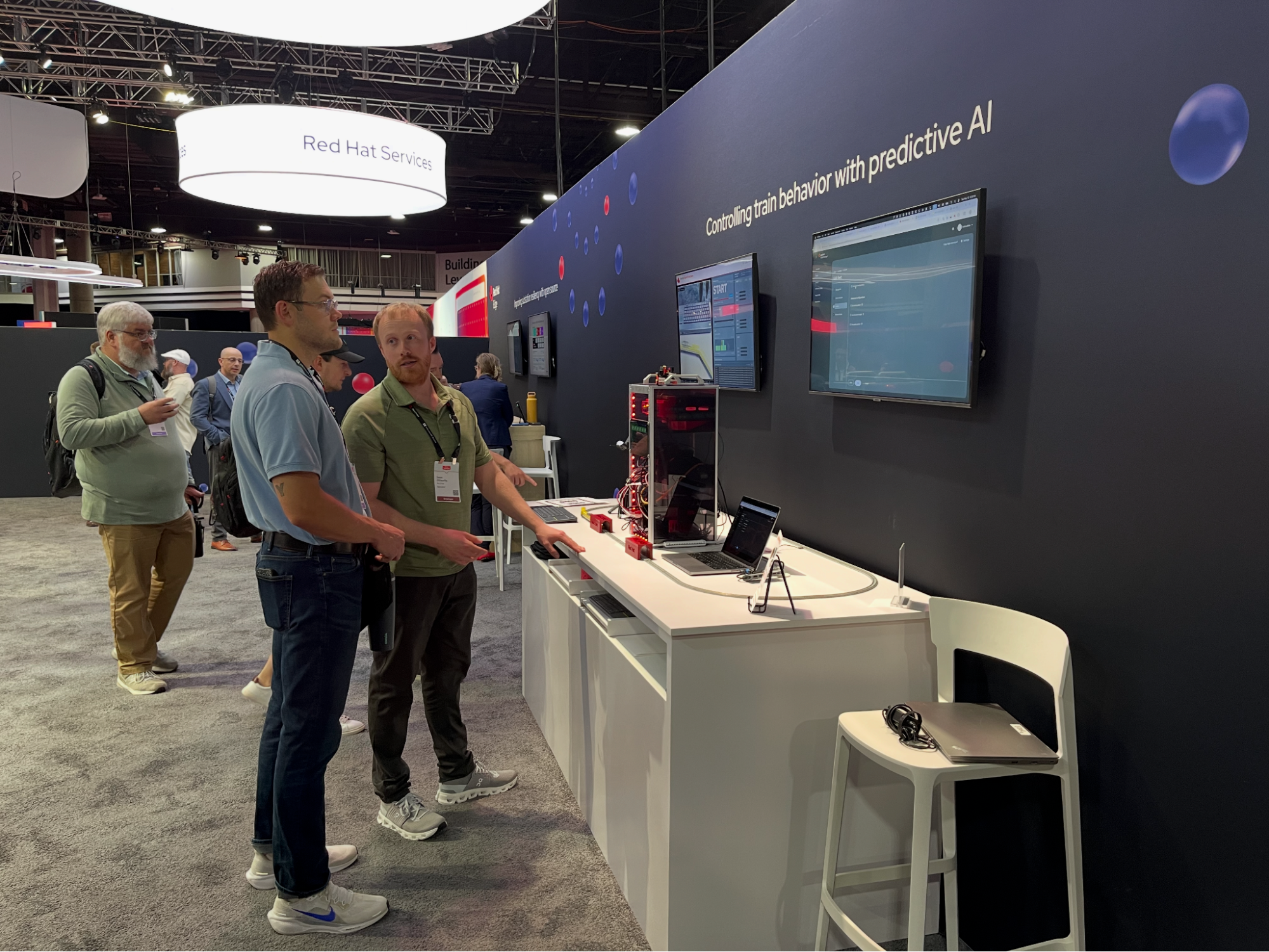
Conference attendees interacting with the Red Hat Summit train demonstration while observing AI-powered edge automation, monitoring dashboards, and supporting infrastructure.
Like most live demonstrations, much of the real engineering effort happened behind the scenes.
While visitors experienced a simple workflow (showing a placard and watching the train react), maintaining that experience reliably over multiple days in a busy conference environment required careful operational planning and repeatable deployment processes.
One of the most important goals for the project was making sure that the environment could be rebuilt consistently and predictably. Rather than relying on manual configuration steps, we focused heavily on creating a repeatable bootstrap methodology that could reliably stand up the infrastructure, deploy platform services, and provision the edge workloads in a known-good state.
That included automating bringing up the OpenShift environment, deploying supporting air-gapped services, managing containerized applications through Red Hat Edge Manager workflows, and maintaining consistent operating system and application configurations across the stack.
Operational resiliency also became a key consideration. Conference demos run continuously for long periods under unpredictable conditions, so application stability mattered just as much as functionality. Workload monitoring played an important role in keeping the environment operational throughout the event.
In many ways, those operational lessons reinforced the central message of the demo itself:
Successful edge AI solutions are not defined solely by the model. They are defined by the reliability, manageability, and operational consistency of the entire system surrounding it.
Ready to get started?
Please visit the Red Hat Device Edge product page to learn more about Red Hat edge technologies and how the Red Hat Edge portfolio can help support your edge deployment scenarios. Contact your Red Hat representative to get started.
Download the How to unite modern and traditional at the industrial edge e-book.
Product trial
Red Hat Device Edge | Product Trial
About the authors
Ken Osborn is a Principal Technical Marketing Manager at Red Hat focused on edge technologies. With more than 20 years of experience in the IT industry, Ken has held roles spanning pre-sales engineering, product and technical marketing, with a strong emphasis on helping organizations bridge traditional infrastructure with modern cloud-native platforms.
Josh is Red Hat’s industrial edge architect on the global edge architecture team, focused on the industrial edge. He’s worked on the floor of manufacturing plants and built industrial control systems before moving over into enterprise architecture to handle IT/OT convergence. While at Red Hat, he’s worked with large automotive companies, the oil and gas supermajors, and major manufacturing companies on their approach to next generation compute at the industrial edge.
Stephen is a Senior Specialist Solution Architect for Edge Computing at Red Hat, focused on running AI and infrastructure workloads at the far edge, on disconnected, air-gapped, and bandwidth-constrained networks where the cloud isn't always an option. He came up the hands-on way, architecting and securing servers, firewalls, and storage in data centers for banks, mutual fund firms, and pharmacies long before "cloud" was a job title. That foundation led him to co-found Linux Academy, the training platform that taught Linux, OpenStack, and cloud skills to tens of thousands of engineers worldwide. From there he moved into enterprise architecture and led cloud and infrastructure teams supporting critical services. At Red Hat, Stephen works with customers across defense, public safety, energy, and critical infrastructure. An open source die-hard at heart, he's happiest with his hands on the technology and a problem nobody else wants to touch. Away from the keyboard, you'll find him running N-scale model trains or building and painting miniatures at his hobby bench.
More like this
MLOps at the edge: Running AI models at the edge
MLOps at the edge: Running AI models at the edge
Infrastructure At The Edge | Compiler
Rethinking Networks in Telecommunications | Code Comments
Keep exploring
- Boost security, flexibility, and scale at the edge with Red Hat Enterprise LinuxE-book
- Red Hat and Cisco: Extending network automation at the edge
Video - Samsung propels 5G and edge networks with Red Hat OpenShift
Case study
Browse by channel

Automation
The latest on IT automation for tech, teams, and environments

Artificial intelligence
Updates on the platforms that free customers to run AI workloads anywhere

Open hybrid cloud
Explore how we build a more flexible future with hybrid cloud

Security
The latest on how we reduce risks across environments and technologies

Edge computing
Updates on the platforms that simplify operations at the edge

Infrastructure
The latest on the world’s leading enterprise Linux platform

Applications
Inside our solutions to the toughest application challenges

Virtualization
The future of enterprise virtualization for your workloads on-premise or across clouds
