
Organizations can no longer rely on static operating models. AI capabilities expand daily, reshaping what humans and machines can do together. To capture that potential safely and at speed, companies need a new organizational capability: frontier operations.
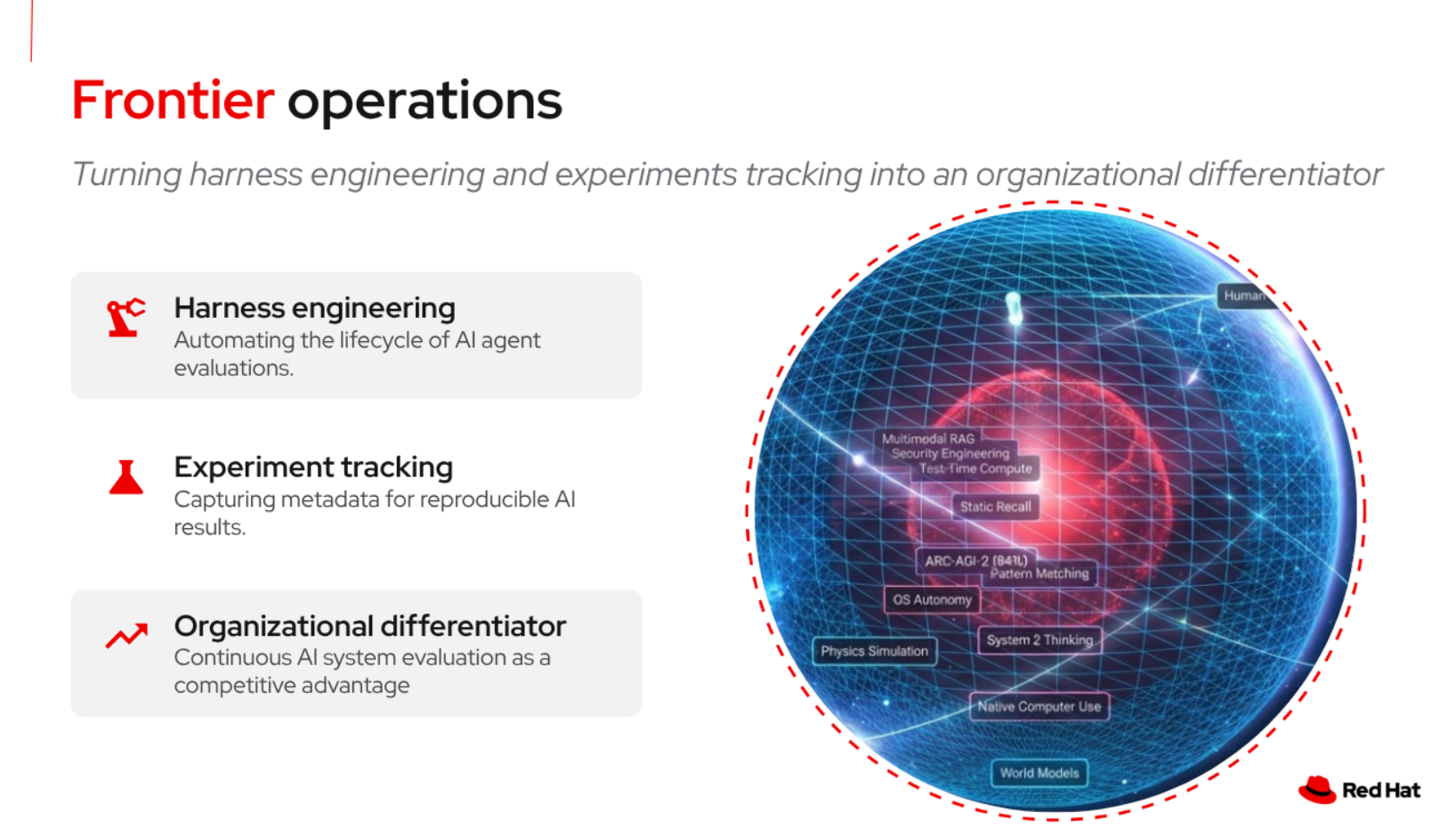
Frontier operations as an organizational differentiator and its connection with harness engineering and experiment tracking
What is frontier operations?
Frontier operations is the practice of continuously aligning evolving AI capabilities with business strategy through the adjusting of people, processes, and technology. It turns integration from a one-time project into an ongoing discipline—one that supports risk reduction, cost efficiency, and revenue growth as capabilities change.
The shift to frontier operations
In a technology operating model, the goal is no longer to hit a fixed skill level or complete a static training curriculum. Continual learning and the integration of that new knowledge is the practice. Teams must design for where the human-in-the-loop (HIL) meets hands-off execution to decide when agents can run autonomously, while preserving clear judgment about where agents fail and where humans create the most value.
Embedding frontier operations requires 5 persistent skills:
- Boundary sensing: Maintain an accurate, current map of what humans should own versus what agents can reliably handle. Boundaries move quickly, and the map must move with them.
- Seam design: Structure work so handoffs between humans and agents are clean, verifiable, and easy to audit. Seams should be redesigned as capabilities shift, not treated as permanent architecture.
- Failure model maintenance: Understand how agents fail in your context. Failure patterns are not static facts to memorize; they evolve with models, prompts, data, and use cases.
- Capability forecasting: Make disciplined short-term efforts to predict where AI capabilities are heading, so teams can prepare workflows before change arrives.
- Leverage calibration: Decide where human attention creates the highest return: review thresholds, escalation paths, supervision ratios, and approval gates.
From prompt engineering to harness engineering
Frontier operations pushes teams beyond basic prompt engineering toward intention engineering: defining desired outcomes, constraints, and verification criteria upfront in ways that are practical, assessable, and repeatable.
The organizational differentiator is harness engineering—automating the full lifecycle of agent evaluation:
- Experiment tracking: Capture metadata, inputs, and context so results are reproducible and comparable over time.
- Continuous evaluation: Treat evaluation as an always-on capability, not a pre-release checkpoint. Teams that evaluate continuously learn faster and deploy more confidently.
Together, intention engineering and harness engineering turn AI adoption from artisanal trial-and-error into a managed capability.
Building an antifragile mindset
A modern technology operating model cannot merely resist change to reduce risk. It must absorb change to increase innovation velocity. As described in Technology Operating Models for Cloud and Edge, antifragile systems grow stronger under stress and uncertainty—not weaker.
Frontier operations supports that mindset. Instead of reacting to each new model release, organizations build the muscle to sense boundaries, redesign seams, update failure models, forecast capability shifts, and recalibrate human leverage in a continuous cycle.
Red Hat AI: The practical starting point for frontier operations
Frontier operations itself is a capability, not a slide deck. It needs a platform that supports continuous change with operational control. Red Hat AI is the strongest place to start because it implements the technical substrate of frontier operations—governance, evaluation, observability, and hybrid-cloud and edge consistency—in one metal-to-agent stack.
Most organizations stall between AI pilots and production because the tooling is fragmented and the resulting workflows are inconsistent. Having one stack for inference, another for prompts, another for agents, and little shared visibility for operators leads ultimately to a lack of trust because AI safety and security are hard to reproduce. Red Hat AI closes that gap by unifying inference, data-to-model workflows, and agent operations on the same hybrid cloud foundation teams already use for enterprise applications—Red Hat OpenShift, Red Hat Enterprise Linux (RHEL), and validated open source components such as vLLM, MLflow, and llm-d.
Mapping frontier operations to Red Hat AI
Frontier operations skill | How Red Hat AI enables it |
Boundary sensing | Model-as-a-Service (MaaS) gives operators a governed interface to curate which models developers can use, track consumption, and enforce policy. MCP gateway and MCP catalog control which tools agents can reach. SPIFFE/SPIRE-based agent identity ties actions to verified entities under least-privilege access. |
Seam design | Governed prompt management (prompt lab, registry, MLflow-backed versioning) makes human-authored intent a managed handoff point into agent behavior. Agent traceability records every LLM call, tool execution, and reasoning step so human review and escalation paths are auditable, not assumed. |
Failure model maintenance | EvalHub provides a framework-agnostic evaluation control plane for models, applications, and agents—replacing ad hoc testing with reproducible benchmarks. AI safety and red teaming (including NVIDIA Garak-based scanning) surfaces jailbreaks, injection, and bias risks before production. Failures become data, not anecdotes. |
Capability forecasting | A model catalog and interchangeable inference layer let teams swap or add models through MaaS without rebuilding applications. Distributed inference with llm-d and hardware flexibility (GPU, CPU, NPU) make it practical to test “what becomes possible next” on the same platform you run today. |
Leverage calibration | Usage tracking, showback, request prioritization, and autoscaling help operators tune cost and human oversight against real load—not theoretical ratios. Centralized metrics and agent execution traces show where automation holds and where humans must intervene. |
Harness engineering, built in
Red Hat AI isn't just a platform for running models, it's a platform for running the evaluation loop:
- MLflow integration provides agent tracing, logs parameters, metrics, and artifacts for reproducible comparison across generative and predictive workloads.
- EvalHub scales benchmarking from developer laptops to production pipelines via a unified API, dashboard, and Kubernetes-native controller.
- AgentOps embeds tracing, observability, and evaluation into the agent lifecycle—from prototype to production—regardless of agent framework.
That is harness engineering in product form: the platform automates what frontier operations teams would otherwise bolt together manually.
Why start here?
Three properties make Red Hat AI especially well suited as a frontier operations foundation:
- Operational continuity: The same hybrid cloud patterns that govern traditional applications extend to AI inference and agents. Operators aren't learning a parallel universe or increasing cognitive load, they're extending an existing operating model.
- Open, portable stack: Support for any model, any accelerator, any agent framework, and deployment across on-prem, edge, and public cloud reduces cost and makes capability forecasting actionable. When the frontier moves, you change models and policies—not your entire architecture.
- AI builder– IT operator bridge: Developers get self-service APIs and prototyping tools; platform teams get governance, identity, safety scanning, and observability. Operators can focus on stability, control, auditability, security. Builders move with the speed of business (innovation, features, fixes). Frontier operations requires both sides, and Red Hat AI is explicitly designed for that split.
And if you host your models locally you get all of the above without the “drive-adoption versus keep-the-cost-per-token-down” friction.
A practical first 90 days
You don't need a full agentic transformation on day one. A credible frontier operations program can start incrementally on Red Hat AI:
- Stand up governed inference: Deploy MaaS with curated models and use policies. Establish the first boundary: which models, which teams, which environments.
- Instrument before you scale: Enable MLflow experiment tracking and EvalHub for one high-value use case. Replace subjective “it seems better” with benchmarked, repeatable results.
- Run one agent with full traceability: Pilot a single agentic workflow with AgentOps tracing, prompt versioning, and MCP-governed tool access. Document failure modes and human escalation triggers. Recalibrate on a cadence—review traces, eval results, cost metrics, and safety scans monthly. Redesign seams and supervision ratios as capabilities shift.
- Evaluate against your desired outcomes.
This sequence builds the organizational muscle of frontier operations while delivering production value at each step.
Final thoughts
Frontier operations gives organizations, its managers, and individual contributors shared principles and guardrails for working with evolving AI. By treating AI model capability integration as a dynamic practice and evaluation as a continuous discipline, organizations can adopt new AI capabilities safely without surrendering control, accountability, or strategic alignment.
Red Hat AI turns those principles into practice. It provides the metal-to-agent platform—MaaS, EvalHub, AgentOps, governed prompts, and hybrid-cloud consistency—that makes boundary sensing, seam design, failure model maintenance, capability forecasting, and leveraged calibration operational rather than aspirational.
For teams ready to move from AI experimentation to governed, antifragile operations, Red Hat AI is the most direct path to getting frontier operations ready for production.
Visit Red Hat AI learning hub to learn more and start your trial today.
Resource
The adaptable enterprise: Why AI readiness is disruption readiness
About the author
Andreas is leading the MRT (Manufacturing, Retail, Transport) vertical related topics for Red Hat across Asia Pacific. His hands-on experience in startups as well as large scale enterprise transformation programs has given Andreas a solid understanding of business drivers and value creation. Andreas has worked on a wide range of initiatives across different industries in Europe, North America and APAC including full-scale automotive JIT/JIS production systems modernisation, ERP migrations, HR, finance and accounting, supply chain logistics transformations and scalable core banking strategies to support regional business growth strategies.
More like this
Beyond the model: Architecting production-grade enterprise AI systems
Open telco AI: Training a model for an industry
Standardizing the AI stack with PyTorch
Technically Speaking | Defining sovereign AI with open source
Browse by channel

Automation
The latest on IT automation for tech, teams, and environments

Artificial intelligence
Updates on the platforms that free customers to run AI workloads anywhere

Open hybrid cloud
Explore how we build a more flexible future with hybrid cloud

Security
The latest on how we reduce risks across environments and technologies

Edge computing
Updates on the platforms that simplify operations at the edge

Infrastructure
The latest on the world’s leading enterprise Linux platform

Applications
Inside our solutions to the toughest application challenges

Virtualization
The future of enterprise virtualization for your workloads on-premise or across clouds
