
Last year, Red Hat introduced Red Hat OpenStack Services on OpenShift, the next major release of Red Hat OpenStack Platform. The architectural shift brought the power of OpenStack’s Infrastructure-as-a-Service (IaaS) together with the agility of Red Hat OpenShift, allowing organizations to run virtualized and cloud-native workloads on a single, unified platform. As businesses face increasing pressure to optimize costs and consolidate IT environments, especially in light of shifting market dynamics, many are looking for a modern approach to managing their cloud infrastructure. To address that challenge, Red Hat is introducing Red Hat OpenStack VMware migration toolkit (based on the os-migrate VMware toolkit upstream project) to support the adoption of OpenStack Services on OpenShift.
This new migration toolkit is designed to simplify and accelerate your journey to Red Hat OpenStack Services on OpenShift. It's designed to address the real-world challenges of migrating mission critical workloads from VMware, giving you a streamlined and efficient path forward. With this toolkit, users can:
- Seamlessly move workloads: The tool provides a direct and automated pathway to migrate an existing virtual machine (VM) with minimal disruption.
- Leverage automation: Integrate the migration process into your existing Red Hat Ansible Automation Platform workflows.
- Scale migration efforts: This tool is designed to handle large-scale migrations, enabling you to move VMs efficiently over a short period.
- Unify management: The migration toolkit simplifies the experience of bringing your legacy virtualized workloads into a singular control plane, where they can coexist with your new cloud-native, containerized applications.
- Warm migration: A specialized Ansible collection aims to simplify and automate the migration process from VMWare environments into Red Hat OpenStack Services on OpenShift.
What the toolkit can do for you
The Red Hat OpenStack VMware migration toolkit is delivered as an Ansible collection. It comes with a powerful set of features designed to streamline and scale your migration efforts.
- Discovery mode: Automatically gathers metadata from VMware vCenter, including VM definitions, network configurations, and storage details.
- Network mapping: Supports mapping of source networks and ports to target OpenStack Services on OpenShift networks, including MAC address preservation.
- Flavor mapping and flavor creation: Enables mapping VMware hardware profiles to OpenStack flavors, or dynamically creates matching flavors during migration.
- Multi-disk and multi-NIC support: Fully supports VM with complex storage and networking setups, helping ensure consistent and complete migration.
- Operating system compatibility: Supports a broad range of guest operating systems compatible with virt-v2v and certified for use with Red Hat OpenStack Services on OpenShift.
Overview of the migration process
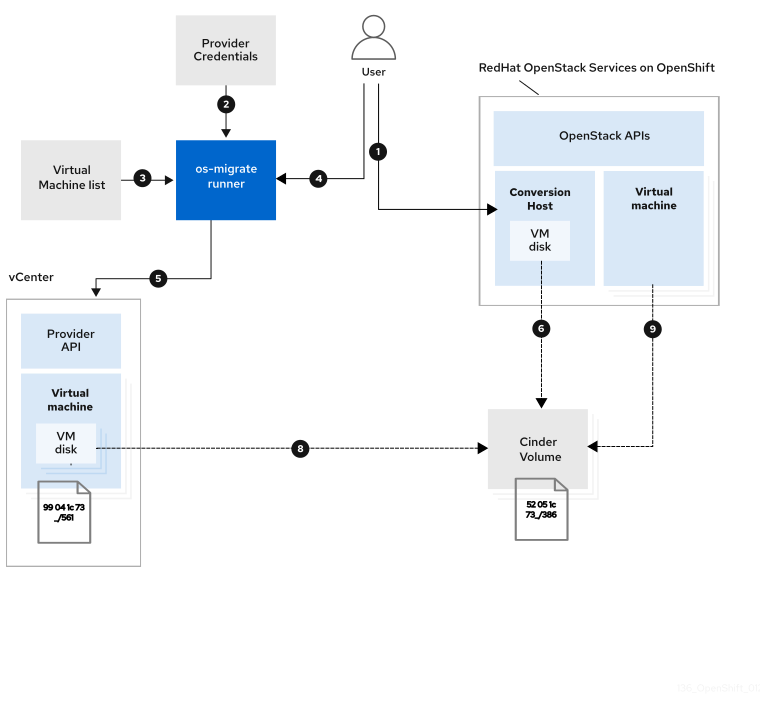
The migration process begins with deploying and configuring a conversion host and defining authentication credentials and migration parameters. Once these initial steps are complete, the migration playbook is executed from Ansible Automation Platform. The toolkit gathers comprehensive VM metadata, including configuration details and disk information, to ensure a smooth transition.
A Cinder volume is provisioned and attached to the conversion host, and a snapshot of the VM's disks is created in the source VMware environment.
The migration leverages changed block tracking (CBT) for efficient disk transfer, copying the virtual machine disk to the Cinder volume through the conversion host. The toolkit retrieves and assigns the CBT ID to the volume metadata. For subsequent transfers, it performs an incremental sync of divergent blocks by detecting whether the CBT ID has changed. This ensures that only modified data is synchronized, significantly reducing network and storage overhead.
After the data transfer is complete, the VM is created in OpenStack, configured with the gathered metadata, and the synchronized Cinder volume is attached. The VM is then started in the Red Hat OpenStack Services on OpenShift environment with minimal downtime.
While Red Hat OpenStack VMware migration toolkit provides a powerful, automated path for customers to take control of their migration journey, we understand that for many organizations, a partner-led approach is the most effective. This is especially true for large-scale, complex migrations where deep expertise and a proven methodology are essential.
Red Hat's certified partners (such as Trilio, Hystax, and Cloudbase) are positioned to help with this transition to cater to the unique needs of your environment. They have extensive experience in cloud environments and are trained on the new OpenStack Services on OpenShift architecture
A certified partner can accelerate your timeline by helping you develop and execute a comprehensive migration plan, ensuring your project stays on track and within budget. It also helps mitigate risk, as a certified partner brings a wealth of experience in managing complex IT projects. They can help you avoid common pitfalls and ensure a smooth migration of your workloads. Certified partners also offer data protection and disaster recovery to ensure your workloads are secure and resilient.
Join the migration
Have more questions? Join us at OpenInfra Summit Europe to dive deeper into the technical details and get a firsthand look at these new capabilities. Stop by the Red Hat booth or attend one of our sessions and hands-on labs to learn more and see these new features in action.
The OpenStack Word Mark is either a registered trademark/service mark or trademark/service mark of the OpenStack Foundation, in the United States and other countries, and is used with the OpenStack Foundation's permission. Red Hat is not affiliated with, endorsed or sponsored by the OpenStack Foundation, or the OpenStack community.
Resource
The adaptable enterprise: Why AI readiness is disruption readiness
About the author
Sean Cohen is the Director of Product Management in the Hybrid Platforms organization at Red Hat, a leading provider of open-source technologies and hybrid cloud solutions. He oversees the infrastructure and observability business, including strategy and delivery for Red Hat OpenShift and OpenStack Platforms. With over 15 years of experience, Sean has a robust background in senior product management and delivery across enterprise and telco markets, driving cloud infrastructure strategy, product lifecycle management, and leading high-performance cross-functional teams.
More like this
Chaos engineering in practice: Lessons from enterprise customers
Scale enterprise analytics by running Cloudera Data Platform with OpenShift Virtualization
Virtualization Is (Still) King | Compiler
Browse by channel

Automation
The latest on IT automation for tech, teams, and environments

Artificial intelligence
Updates on the platforms that free customers to run AI workloads anywhere

Open hybrid cloud
Explore how we build a more flexible future with hybrid cloud

Security
The latest on how we reduce risks across environments and technologies

Edge computing
Updates on the platforms that simplify operations at the edge

Infrastructure
The latest on the world’s leading enterprise Linux platform

Applications
Inside our solutions to the toughest application challenges

Virtualization
The future of enterprise virtualization for your workloads on-premise or across clouds
