
Modernizing your infrastructure often involves optimizing resources. One such approach is to converge virtualization and container platforms. Red Hat OpenShift Virtualization provides a powerful solution, allowing you to run virtual machines (VM) and containers side by side while enabling you to easily migrate to modern platforms at your own pace.
Migrating traditional VM workloads demands a well planned approach. This is where the synergy of Red Hat OpenShift Virtualization, Red Hat Ansible Automation Platform, and Red Hat Consulting, or your preferred partner services, is key to success.
OpenShift Virtualization is an attractive solution for organizations pursuing cost optimization, modernization of applications, and unified workflows. But migration must be streamlined. And once migrated, you must manage the ongoing Day 2 needs, including the VM lifecycle and the related infrastructure.
Red Hat Ansible Automation Platform is a powerful automation solution that helps you in three key areas:
- Migration at-scale for VMs and related infrastructure
- Ongoing management of these resources, once moved
- Lifecycle management of VMs remaining on other existing platforms, or any virtualization platform
Ansible Automation Platform includes content collections for more than 200 technologies designed to jumpstart your use of automation and these can be helpful in managing infrastructure related to your VM-based operations. New collections are continuously available, and in particular there are two new content collections for migrating to OpenShift Virtualization, and for Day 2 management of them. This article introduces you to both.
OpenShift Virtualization migration content collection
Considerations when migrating from a traditional hypervisor to OpenShift Virtualization include:
- Understanding VM dependencies: Discovering and managing interconnected VM configurations
- Encrypted disks and storage compatibility: Ensuring data security and storage interoperability
- Minimizing downtime: Executing migrations with minimal disruption to critical services
- Robust rollback planning: Developing and testing strategies for seamless recovery
- Integration with modern CI/CD pipelines: Incorporating migrated VMs into automated development and release workflows
Both Ansible Automation Platform and OpenShift Virtualization help you meet these challenges. OpenShift Virtualization includes the migration toolkit for virtualization (MTV), which analyses VM environments for factors such as network and storage mapping and helps create a plan for migration. In essence, MTV helps you understand what to do to migrate, and it can even migrate individual VMs.
But what happens when you have a large number of VMs to migrate? Well, that's when you can use Ansible Automation Platform to orchestrate and migrate groups of VMs at scale (including the related applications and infrastructure). Ansible Automation Platform can also perform tasks in addition to the list above, such as creating backups and restores, rollback planning, enrolling or re-enrolling VMs into security tooling, redeploying applications, and more. By using these solutions together, you can consistently and seamlessly migrate groups of VMs at scale.
Your teams can use Ansible Automation Platform to:
- Automate discovery and inventory: Efficiently identify and catalog existing VM infrastructure
- Orchestrate the migrations: Execute VM migrations from VMware with precision
- Manage complex configurations: Handle encrypted disks, network settings, and storage configurations programmatically
- Implement validation and rollback: Automate post-migration checks and define rollback procedures
- Integrate with CI/CD pipelines: Incorporate migration steps into your automated deployment workflows for repeatable and reliable processes
Check out this new content collection (infra.openshift_virtualization_migration) to learn more about how it can jumpstart a series of tasks in an automated migration workflow. This image provides a handful of the functions and automation capabilities in this collection:

OpenShift Virtualization operations content collection
Great, now you have migrated. It's Day 2 and you can use Ansible Automation Platform once again to manage the VM lifecycle (and apps and related infrastructure, of course). With automation, you can manage the full lifecycle, from initial provisioning to ongoing management and even final sunsetting. Because VMs interact with related infrastructure, automation workflows can seamlessly manage cross-functional needs.
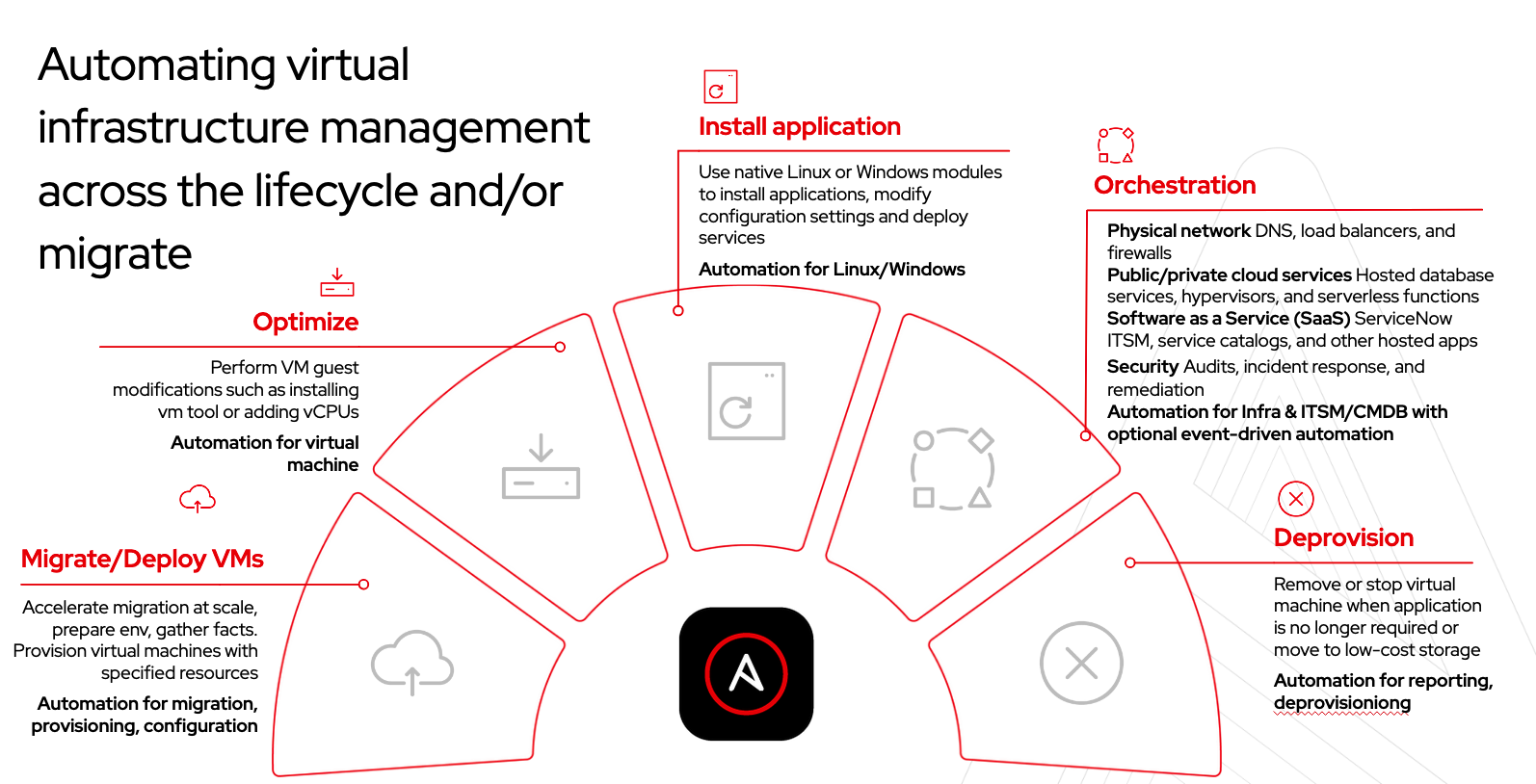
For example, in a provisioning workflow for a new VM, your workflow can:
- Provision the VM or invoke your preferred tool for provisioning
- Enroll it in security monitoring tools
- Add it to your load balancer
- Create a backup or snapshot
- Add or adjust memory or storage, and more
We all know there are ongoing issues you need to respond to, including security threats, performance degradation, an outage, or certificate renewal. Ansible Automation Platform's included Event-Driven Ansible lets you respond automatically, in your desired way, to specific alerts as they occur, at any hour of the day or night. This helps improve resilience, and it lowers the impact of an issue. You can also use event-driven automation to enrich tickets for faster resolution or create notification scenarios.
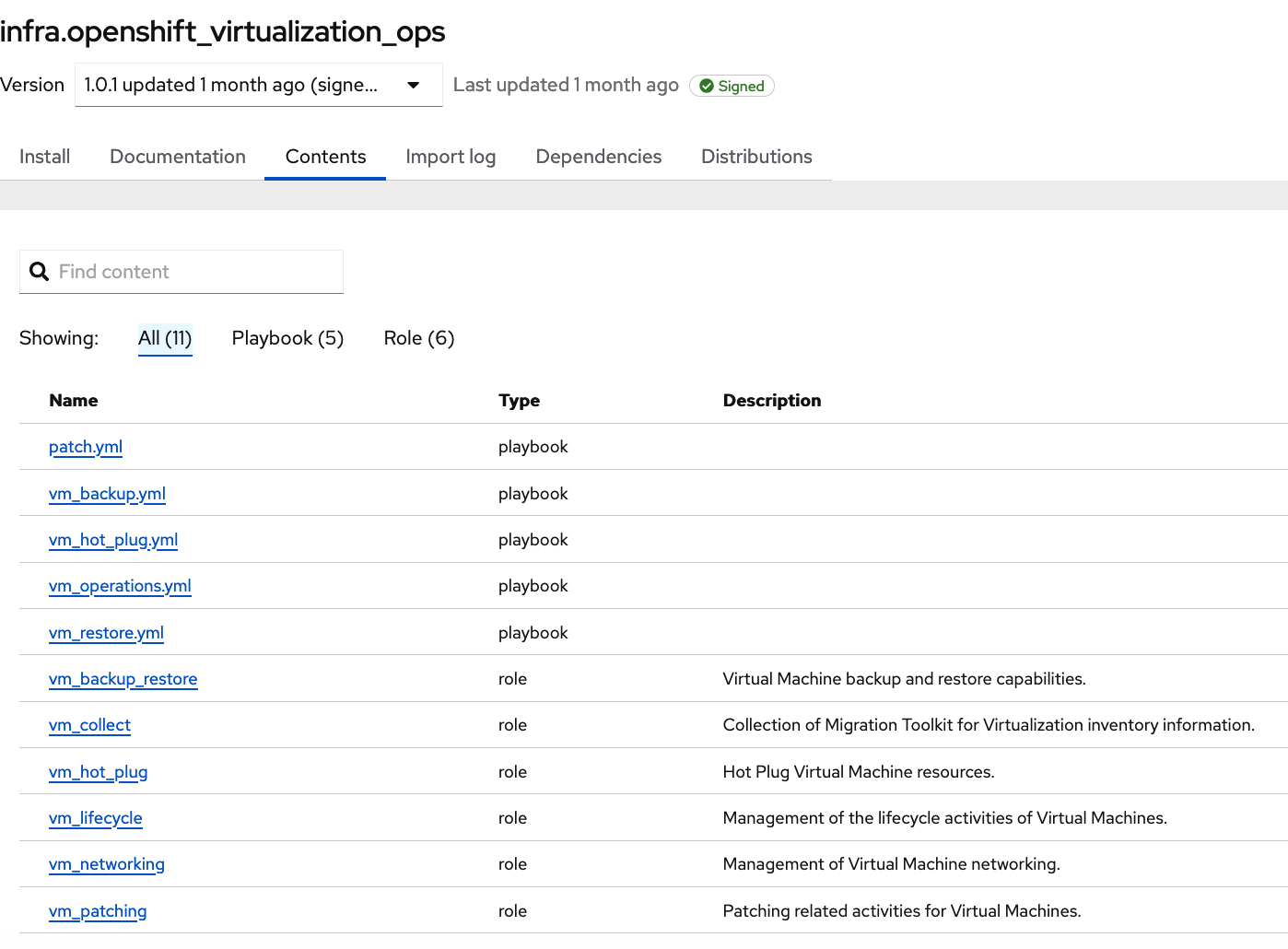
This new content collection (infra.openshift_virtualization_ops) aids with these use cases.
With over 200 content collections, there's sure to be a collection to help automate the ongoing management of multi-vendor infrastructure related to your VMs. Regardless of your virtualization platform, Ansible Automation Platform can help you gain fast, consistent, and automated action for both migration and ongoing operations. Automation empowers rapid and consistent provisioning of virtual machines and virtual networks, while also streamlining the entire lifecycle management of virtualized workloads on OpenShift Virtualization.
Here's a sampling of the type of content in this collection:
Supplement your migration journey with Red Hat and partner services
Red Hat's suite of services offerings provide valuable guidance to help streamline your migration journey, and ranges from consulting, training and certification, and technical account management.
Red Hat Consulting can help you:
- Reduce the complexity of migrating VMs by collaboratively planning and implementing your move from a traditional virtualization platform
- Assess your current environment: Thoroughly analyze your virtualization landscape and identify migration requirements
- Design and test migration strategies: Develop tailored migration plans and conduct rigorous testing
- Build custom automation pipelines: Create automation workflows specifically designed for your unique environment
- Empower teams: Provide comprehensive training and certifications for both OpenShift Virtualization and Ansible Automation Platform
- Enable ongoing support and governance: Establish best practices, and provide continuous day-to-day support with Red Hat Technical Account Managers
Engaging with Red Hat Services accelerates your time to value and significantly reduces risk, particularly for large-scale or highly regulated deployments. Similar services may also be available through Red Hat partners, so you can work with your trusted partners and those who know your IT operation.
Take the next step
The combined power of OpenShift Virtualization, Ansible Automation Platform, Red Hat, and partner services deliver significant advantages:
- Consistent and repeatable migrations: Enable standardized and reliable migration processes
- Knowledge transfer and enablement: Equip your teams with the necessary skills and expertise
- Secure handling of VM data: Maintain the security and integrity of your VM data and encryption
- Future-proofing for hybrid and multicloud deployments: Establish a foundation for flexible and scalable hybrid and multicloud strategies
If you're exploring a transition to OpenShift Virtualization, or actively planning to migrate, now is the optimal time to engage. Leverage Red Hat's ecosystem and the robust capabilities of Ansible Automation Platform to embark on a smoother, more intelligent migration journey.
If you are a partner and would like to learn more about jumpstarting migration service delivery, contact your Partner representative or Red Hat Consulting.
Resources
Product trial
Red Hat OpenShift Virtualization Engine | Product Trial
About the author
Stephen Fulmer is a Product Manager at Red Hat, leading Ansible content strategy. With a background in virtualization and IT operations, he works closely with customers, partners, and engineering teams to deliver trusted, scalable automation content for platforms like OpenShift, Windows, and public cloud. Stephen is passionate about enabling organizations to simplify complex workflows and accelerate their automation journeys with Red Hat Ansible Automation Platform.
More like this
Red Hat OpenShift Platform Plus bundle available on hyperscaler marketplaces
Breathing life into corporate innovation with IdeaBot
Can agentic AI patch the internet?
Random Acts Of Automation | Compiler
Browse by channel

Automation
The latest on IT automation for tech, teams, and environments

Artificial intelligence
Updates on the platforms that free customers to run AI workloads anywhere

Open hybrid cloud
Explore how we build a more flexible future with hybrid cloud

Security
The latest on how we reduce risks across environments and technologies

Edge computing
Updates on the platforms that simplify operations at the edge

Infrastructure
The latest on the world’s leading enterprise Linux platform

Applications
Inside our solutions to the toughest application challenges

Virtualization
The future of enterprise virtualization for your workloads on-premise or across clouds
