
If you're an AI or machine learning engineer, you've seen the classic demo: ingest a clean PDF into a prototype, build a vector database index using standard tutorial code, and submit a simple question. The model returns a pristine answer, everyone nods, and the project gets greenlit.
Then it meets enterprise reality.
Six months into production, as your knowledge base expands to thousands of multicolumn technical manuals, tabular financial reports, scanned legal contracts, and shifting internal policies, retrieval accuracy collapses. Users start screenshotting subtle hallucinations, answers skip critical technical constraints, and rising infrastructure costs trigger alarm bells for your platform engineering team.
Under pressure to fix accuracy drops, engineering teams often reach for the easiest knob: widening the retrieval net. They double chunk sizes, pull 20 candidate chunks, and swap compact models for expensive frontier large language models (LLMs), hoping sheer scale will solve the problem.
The system doesn't get noticeably smarter. Instead, latency jumps, GPU memory use spikes, and model accuracy drops. This trap, balancing accuracy against escalating compute costs, is the primary bottleneck in enterprise retrieval-augmented generation (RAG).
To fix RAG degradation, you need empirical testing across your indexing and retrieval architecture. In this guide, we'll examine why enterprise RAG performance breaks down and how bloated context windows inflate GPU bills. Then, we'll look at how automated pipeline optimization with AutoRAG in Red Hat OpenShift AI helps you improve target accuracy without overspending on compute.
If you want to explore the underlying code and architectural blueprints, check out our technical e-book, Engineering RAG for the enterprise.
The enterprise data reality vs. the demo illusion
Standard tutorials assume a simple, linear flow:

Figure 1: Flowchart illustrating document ingestion, vector embedding, and prompt generation in a basic linear RAG pipeline
This assumes data is clean, answers live within single text blocks, and more context equals better answers. Enterprise data breaks all 3 assumptions:
- Complex document layouts: Basic parsers flatten multicolumn layouts into jumbled text. Multipage tables lose row and column associations, while scanned pages lack text layers entirely.
- Context fragmentation: Answers rarely sit in a single chunk. Resolving a single query often requires assembling facts from an HR onboarding guide, a legal memo, and a technical spec.
- Rapidly changing knowledge: Enterprise data updates continuously. Static embeddings and unmanaged vector stores quickly surface outdated or conflicting details.
Why context widening destroys quality and budget
When pipelines fail, widening the context window triggers 2 major failure modes:
Attention degradation
LLMs process tokens via attention mechanisms. Flooding context windows with oversized, loosely relevant chunks introduces contextual noise. Models suffer from positional bias, performing better when key information sits at the start or end of a prompt rather than buried in the middle.
While recent long-context models handle simple fact lookup better, positional bias still hurts performance when an answer requires combining several facts scattered across the window, a phenomenon confirmed by verifiable research from Databricks showing RAG accuracy degrades across most models as context expands beyond ideal thresholds.
Liu et al. found models with extended context windows didn't use those windows more robustly than their shorter counterparts. Subsequent multineedle retrieval work has shown current frontier models handle single-fact lookup in long context far better, while degradation persists when an answer requires combining several facts scattered across the window.
Financial and latency impact (key-value (KV) cache economics)
Models process every prompt token before generating output, inflating time-to-first-token (TTFT). Expanding context from 384 to 16,000 tokens consumes massive KV cache memory on the GPU, shrinking available cache space and forcing teams to provision larger multi-GPU clusters to maintain basic concurrency.
As highlighted in Anthropic's research post, Introducing Contextual Retrieval, brute-forcing context window expansion significantly increases query costs and latency without guaranteeing better retrieval accuracy. Keeping prompt contexts tight and using targeted chunk optimization maximizes request throughput per GPU, dropping inferencing costs significantly.
Decoupled RAG pipeline architecture: 3-pipeline design
To prevent compute waste and quality decay, separate RAG into 3 distinct pipelines:
- Indexing pipeline (bulk / scheduled): Parses raw files, extracts metadata, normalizes layout, chunks content, generates embeddings, and populates the vector store. Uses Docling to convert complex layouts into structured Markdown.
- Retrieval pipeline (continuous / real-time): Executes query-time hybrid search (dense vector and sparse keyword), reranks candidate results, enforces role-based access control (RBAC), constructs prompts, and runs model generation. Built on vLLM, llm-d (for distributed KV-cache-aware inference routing), and AI guardrails.
- Maintenance pipeline (event-driven / continuous): Operates continuously in the background to handle updates, deletions, right-to-be-forgotten (RTBF) requests, re-embedding, and corpus drift detection using MLflow.
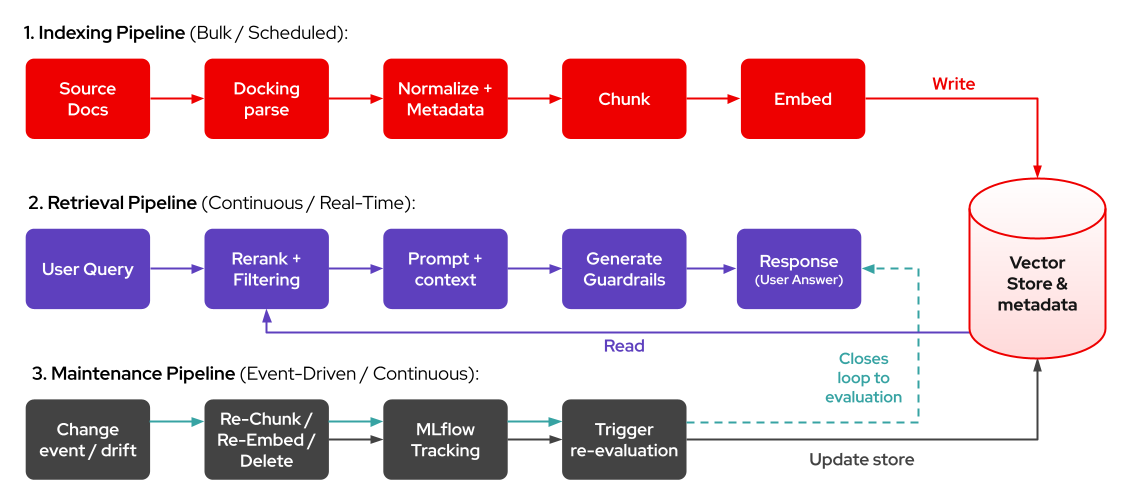
Figure 2: Architecture diagram of Red Hat's decoupled indexing, retrieval, and maintenance RAG pipelines.
Measuring RAG evaluation metrics
Evaluating enterprise RAG gets tricky fast. Spot-checking a few sample prompts won't scale—you need objective, reproducible datasets to measure real progress. Gen AI studio in Red Hat AI uses AutoRAG to automate quality measurement across 3 core production metrics:
- Context correctness: Measures whether retrieved chunks contain necessary facts without excessive noise. Low scores point to indexing issues like layout parsing failures, suboptimal chunk sizes, or mismatched embedding models.
- Answer faithfulness: Measures whether generated output is grounded strictly in retrieved context without hallucination. Low scores alongside high context correctness indicate issues with prompt construction or model reasoning capacity.
- Answer correctness: Measures whether the output directly addresses user intent and aligns accurately with ground-truth facts.
Because metrics like faithfulness and correctness rely on an LLM as a judge, selecting an appropriate model and monitoring for judge drift are critical operational tasks. Red Hat AI integrates EvalHub (evaluation control plane), LM-Eval (benchmark framework), and SDG Hub (synthetic data generation (SDG)) to standardize these measurements across runs.
Empirical optimization with AutoRAG
Tuning a pipeline manually across parsing styles, chunk sizes, embedding models, hybrid ratios, reranking candidates, and LLMs creates hundreds of unique permutations. Testing them by hand takes months, forcing many teams to ship unoptimized defaults.
AutoRAG in Red Hat OpenShift AI 3.5 (via gen AI studio) automates this workflow.
AutoRAG execution steps
- Upload data: Upload representative documents and an evaluation data set (manually created or generated via SDG Hub). The result of this process forms your ground-truth baseline for future testing and validation.
- Define constraints: Select candidate foundation models, embedding options, and target latency or cost limits. This step establishes your key operational boundary conditions for balancing performance, speed, and budget.
- Automated search: AutoRAG tests combinations across parsing, chunking, embeddings, hybrid search, reranking, and generation settings. This automated search generates rich multicandidate performance data to highlight optimal configurations across your metrics.
- Pareto frontier analysis: Displays a comparative leaderboard mapping accuracy against compute cost and latency. Using this ranked visual helps engineers to make data-driven architecture trade-offs more quickly.
Evaluating pipeline trade-offs without the guesswork
When reviewing candidate configurations on the Pareto frontier, low-cost options deserve careful inspection. A pipeline configuration might show high answer faithfulness at a fraction of the compute cost, which seems attractive on paper. However, answer faithfulness only measures whether the output is grounded in the context the retriever supplied; it doesn't measure whether that context contained the correct facts.
When high answer faithfulness is paired with low context correctness, the system suffers a silent retrieval failure: the retriever surfaces the wrong passages, and the model faithfully generates an answer based on those flawed passages. The output reads well, appears well-grounded, but is ultimately wrong. This is the failure mode most likely to escape initial detection, which is why answer correctness must be evaluated alongside faithfulness to catch hallucinated or incorrect conclusions.
The dynamics of query economics
In enterprise deployments, query costs depend on total compute consumption across the inference lifecycle:
- GPU compute hours (self-managed): Hardware resources required on OpenShift AI to host the embedding model, cross-encoder reranker, and generation foundation model.
- Context token volume: Oversized chunks process thousands of additional prompt tokens per request. This inflates KV cache memory usage, reduces request concurrency, and requires significantly more GPU processing time per query.
Configurations that combine precise, smaller chunks with a cross-encoder reranker consistently deliver more optimal cost profiles. By filtering out irrelevant context before it hits the primary LLM, these pipelines dramatically reduce input token volume, reducing the GPU memory footprint and latency while improving overall answer quality and driving down the cost per response.
Model customization with RAFT and agentic workflows
When context correctness is high, but answer faithfulness remains low, the LLM has the right facts in front of it. It just lacks the domain logic to interpret them, meaning model customization is required once prompt engineering hits its limit.
Retrieval-augmented fine-tuning (RAFT) trains models using queries alongside relevant chunks and intentional distractor chunks. The model learns to extract relevant facts and ignore irrelevant noise, improving reasoning accuracy over the retrieved context. This workflow uses SDG Hub (data synthesis), Training Hub (distributed fine-tuning or low-rank adaptation (LoRA)), and EvalHub (pre-promotion evaluation).
In autonomous agentic RAG workflows using patterns like ReAct (Think, Act, Observe), context window efficiency becomes even more critical. Each retrieved observation appends to the prompt history. An agent making 5 consecutive retrieval calls reprocesses an ever-expanding prompt history on every turn. Without prefix caching, your prefill compute costs explode with each step. AutoRAG helps each retrieval call deliver compact, high-precision context, keeping context growth under control.
To make these decoupled architectures operational, enterprise teams typically split responsibilities across 3 key roles:
- Platform engineers (AI Hub): Manage GPU allocation, distributed serving with llm-d, RBAC, and Open Container Initiative (OCI) audit artifacts.
- AI engineers (gen AI studio): Connect enterprise data, construct parsing pipelines with Docling, and run AutoRAG optimizations.
- Machine learning engineers: Automate and scale pipelines into production, track experiment runs in MLflow, enforce safety policies with AI guardrails, and monitor corpus and model drift.
Next steps
Production-grade enterprise AI requires moving past manual guesswork and bloated context windows. Adopting a decoupled 3-pipeline architecture, establishing continuous empirical evaluation, and automating pipeline configuration via AutoRAG in Red Hat OpenShift AI 3.5 lets you deliver high-precision answers while keeping compute costs under control.
Looking for hard-learned practical lessons before you launch? Check out Hope, Crash, Iterate: One PM's Journey through AutoRAG (Part 1) for an excellent first-hand account of the pitfalls to avoid and real-world takeaways from building AutoRAG workflows.
To start benchmarking context tradeoffs and building decoupled RAG pipelines, explore the interactive AutoRAG demo in gen AI studio. For a complete technical blueprint covering layout-aware parsing with Docling, metric-driven evaluation harnesses, RAFT model fine-tuning, and step-by-step AutoRAG optimization, download our e-book, Engineering RAG for the Enterprise.
Resource
The adaptable enterprise: Why AI readiness is disruption readiness
About the author
Matt is on the Product Marketing team for the AI Business Unit at Red Hat, where he shapes technical narratives through creative marketing visualisation. He drives field communications and serves as the strategist for Red Hat’s AI blog footprint and newsletters, translating complex AI capabilities into clear, engaging visual content.
Prior to Red Hat, Matt led marketing, UX, and design at Chatterbox Labs through its acquisition by Red Hat in December 2025. He specialises in bridging design and story to make enterprise AI intuitive and accessible.
More like this
Breaking the AI productivity paradox: an intelligent migration factory to modernize infrastructure and applications
Beyond OCR: Achieving 98% billing accuracy with GroundX and Red Hat OpenShift AI
How Red Hat cleared IT debt for scalable AI
Standardizing the AI stack with PyTorch
Browse by channel

Automation
The latest on IT automation for tech, teams, and environments

Artificial intelligence
Updates on the platforms that free customers to run AI workloads anywhere

Open hybrid cloud
Explore how we build a more flexible future with hybrid cloud

Security
The latest on how we reduce risks across environments and technologies

Edge computing
Updates on the platforms that simplify operations at the edge

Infrastructure
The latest on the world’s leading enterprise Linux platform

Applications
Inside our solutions to the toughest application challenges

Virtualization
The future of enterprise virtualization for your workloads on-premise or across clouds
