
NOTE: This blog has been updated to announce support for additional supported third-party model providers for the Red Hat Ansible Lightspeed intelligent assistant. Additional testing and validation of new model providers is ongoing. For the most recent list of supported model providers, please refer to Red Hat's official documentation.
Earlier this year, we released the Red Hat Ansible Lightspeed intelligent assistant, a generative AI service which delivers an intuitive chat assistant embedded within Ansible Automation Platform. The Ansible Lightspeed intelligent assistant is like having an Ansible subject matter expert right at your keyboard. The service integrates documentation directly into the Ansible administrative and operations experience for faster troubleshooting and onboarding, as well as support for the day-to-day management of your automation itself.
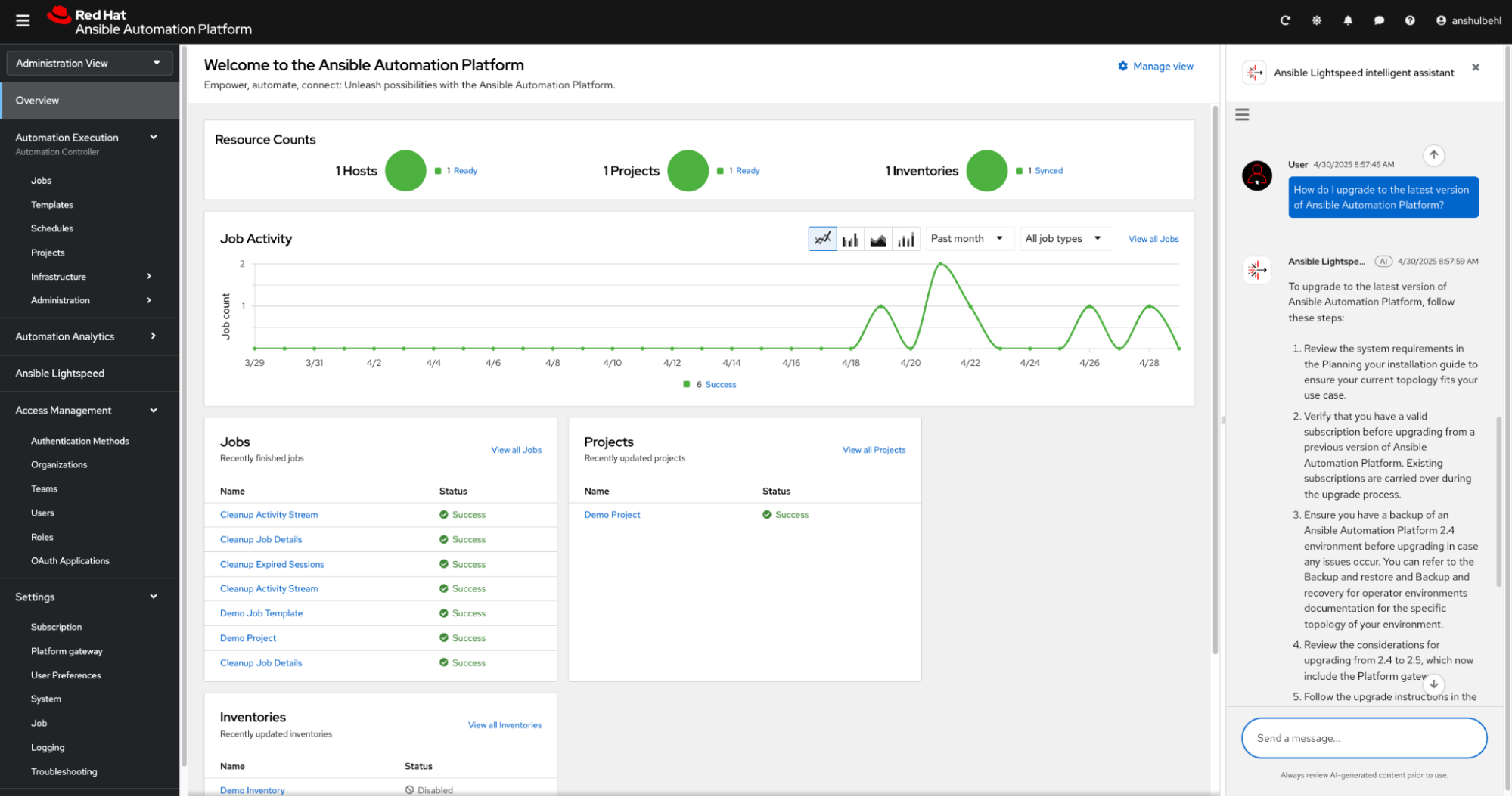
Ansible Lightspeed intelligent assistant within Ansible Automation Platform
This generative AI service is a result of a concerted effort by our product and engineering teams to improve the overall platform user experience for both automation administrators and IT operators. Examples of this include a simplified and unified UI, the release of self-service automation to empower more users, a new on-premise analytics dashboard to measure performance, a fleet of new collections for managing the platform, and more.
Expanding generative AI within the Ansible Automation Platform user experience
When we initially launched Red Hat Ansible Lightspeed with IBM watsonx Code Assistant in 2023, its purpose was to provide a robust coding assistant designed to help boost engineering and developer productivity during the creation of Ansible content, including playbooks, roles or tasks. We later embedded features such as content explanation and content source matching for greater transparency and context for model responses as well as prompt refinement. Tapping into IBM's Granite code models and trained on Ansible-specific data sources, the coding assistant democratizes access to automation and helps onboard new users as they familiarize themselves with the Ansible language and syntax.
With the intelligent assistant, we bring similar value to Ansible Automation Platform administrators and operators by reducing friction and swivel-chair operations, allowing these users to remain within the platform experience to research, troubleshoot, and resolve common questions and issues.
The intelligent assistant can respond to prompts like:
- "What is an execution environment?"
- "How do I manage user access to Ansible Automation Platform?"
- "Explain the "ERROR! couldn’t resolve module/action” error message?"
- "How do I configure Event-Driven Ansible?"
Using a retrieval augmented generation (RAG) pipeline connected to Red Hat documentation and other resources, the intelligent assistant also provides referenced links to additional documentation to help you explore a given topic in more detail.
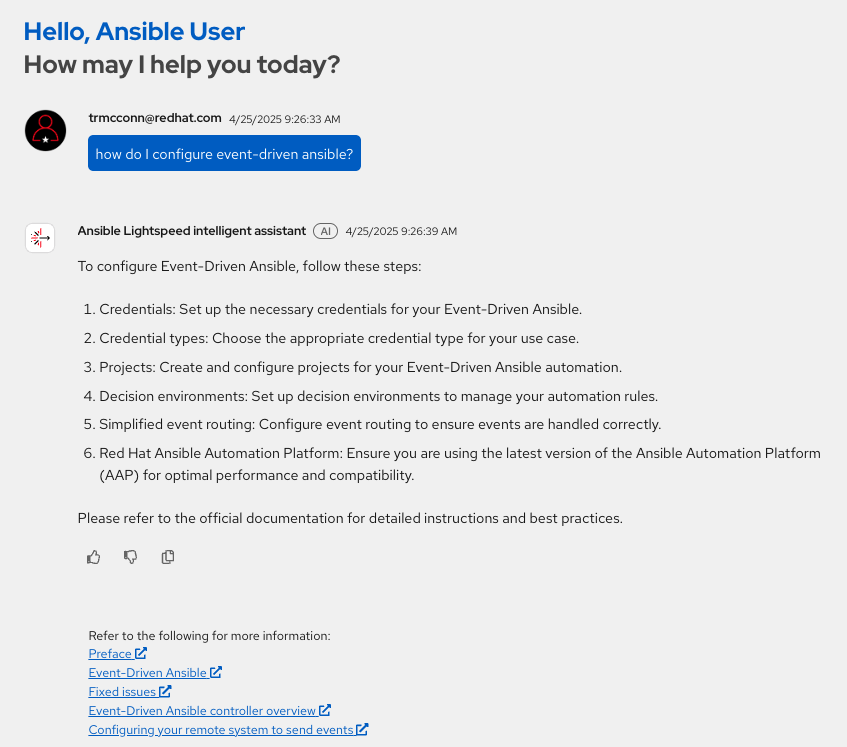
Ansible Lightspeed intelligent assistant prompt, response, and referenced resources
Additional roadmap items for the intelligent assistant include expanding data sources to provide visibility into the health and performance of your automation itself. For instance, you will be able to get assistance with prompts such as:
- "Why did my automation 'VM-migration' job fail?"
- "Show me all inventories that are included in my Ansible Automation Platform deployment."
- "What is the status of all jobs currently running and their progress?"
Getting started with Ansible Lightspeed intelligent assistant
To configure the Ansible Lightspeed intelligent assistant for your users, you will need:
- An active subscription to Ansible Automation Platform
- Deployment of an LLM served on a Red Hat AI or by bringing-your-own model using any currently supported configurations listed in Red Hat documentation.)

For more information on installing and configuring Ansible Lightspeed intelligent assistant, please refer to our documentation.
Additional resources
Product trial
Red Hat Ansible Automation Platform | Product Trial
About the author
Tricia McConnell is Principal Product Marketing Manager, Red Hat Ansible Automation Platform. She brings more than twenty years of experience marketing technical solutions to enterprise IT audiences.
More like this
Using on-premise Red Hat Lightspeed capabilities to monitor vulnerabilities and apply advisor remediations
Red Hat is named a Leader in IDC MarketScape: Worldwide Private and Hybrid Cloud Management with Automation
Random Acts Of Automation | Compiler
Untangling Networks | Compiler
Keep exploring
- The automated enterprise
E-book - Try Red Hat Ansible Automation Platform with self-paced, hands-on labsInteractive lab
- Red Hat Ansible Automation Platform: A beginner’s guide
E-book
Browse by channel

Automation
The latest on IT automation for tech, teams, and environments

Artificial intelligence
Updates on the platforms that free customers to run AI workloads anywhere

Open hybrid cloud
Explore how we build a more flexible future with hybrid cloud

Security
The latest on how we reduce risks across environments and technologies

Edge computing
Updates on the platforms that simplify operations at the edge

Infrastructure
The latest on the world’s leading enterprise Linux platform

Applications
Inside our solutions to the toughest application challenges

Virtualization
The future of enterprise virtualization for your workloads on-premise or across clouds
