
Today, we’re making the Azure Service Operator available on OperatorHub.io to enable users to connect OpenShift clusters to Azure services, including EventHub, Azure SQL, CosmosDB, Storage Accounts, and more.
The Azure Service Operator is an operator created and maintained by Microsoft (open source project here). It allows users to easily spin up and manage Azure resources, allowing developers to self-provision infrastructure, or even include Azure Service Operator in deployment pipelines. The project is made of two parts - a set of custom resource definitions and a controller manager.
For OpenShift customers, whether you’re working in hybrid, multi-cloud, or on-prem environments, Azure Service Operator abstracts away Azure-specific knowledge, allowing you to deploy in a Kubernetes native way, and by simplifying the deployment of Azure resources to Kubernetes YAML.
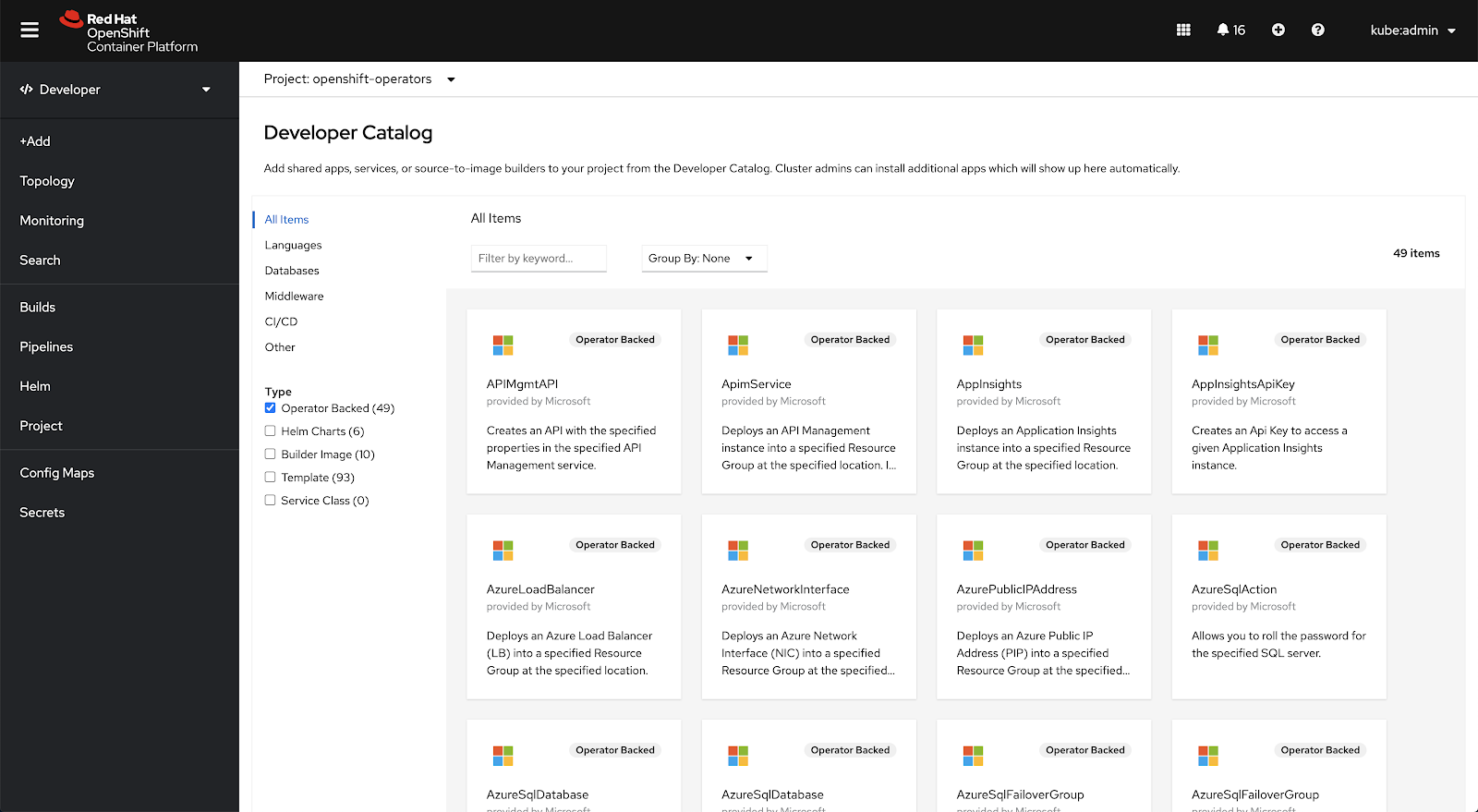
Azure services deployable in the OpenShift Developer Console in a self-service manner
Developers using Azure services in conjunction with applications running in OpenShift can easily discover, provision and manage the lifecycle of their Azure services from within the OpenShift Console. If your app deployments are driven by automation and a GitOps mindset, these Kubernetes objects can be quickly dropped into your existing workflows.
Get started
OpenShift cluster admins can install the Operator directly from OperatorHub. The Operator works in cluster-wide mode, allowing for all teams on a cluster to create and manage their Azure services.
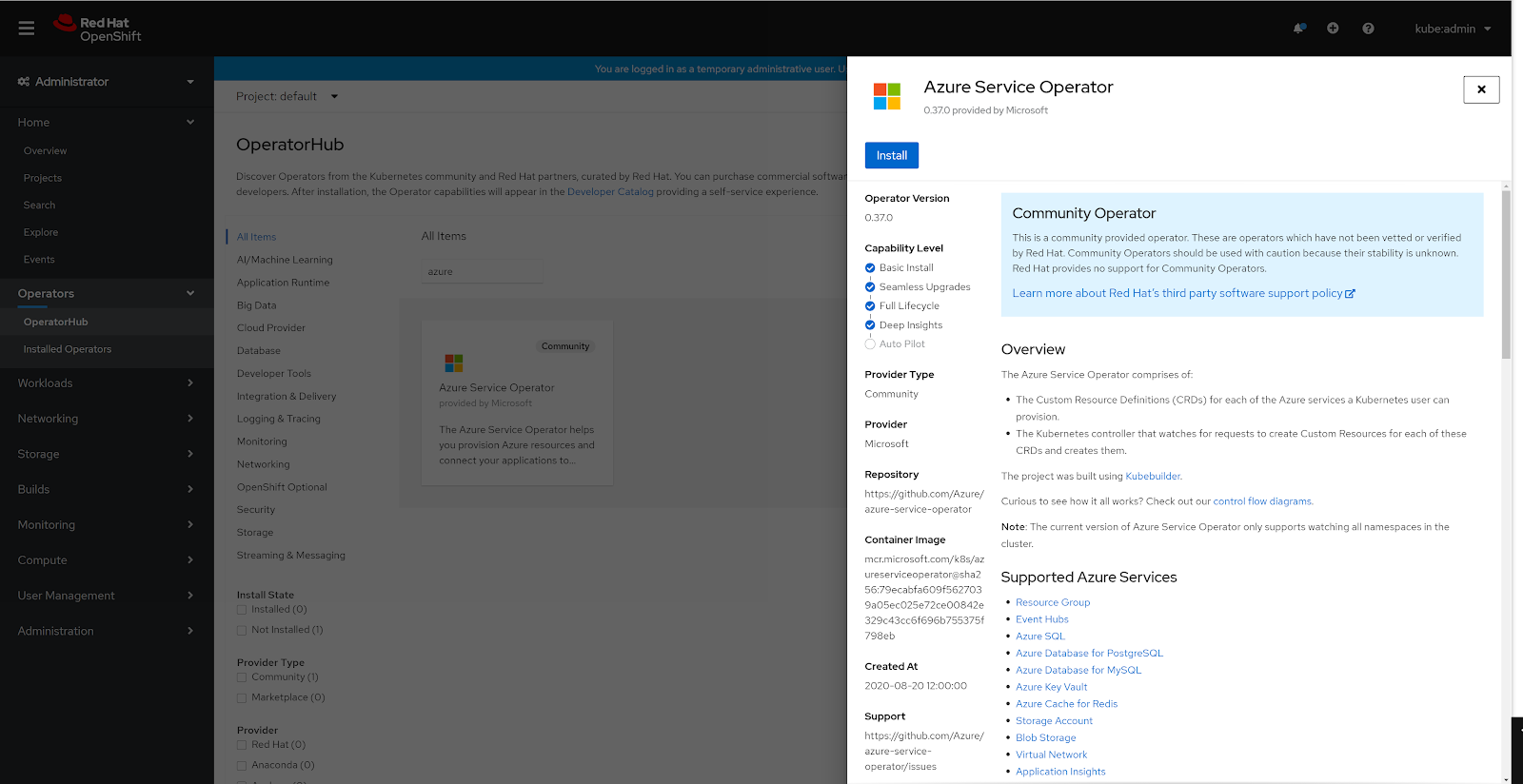
Cluster administrator experience when installing & configuring the Azure Service Operator
Users of the Operator Framework can also find instructions on getting started on the Azure Service Operator listing on OperatorHub.io.
Contributing to the Azure Service Operator
Red Hat and Microsoft continue to work together on the Azure Service Operator and would love for you to get involved as well. For more information on the project, see our GitHub repository here and the contribution guide.
About the author
More like this
NVIDIA BlueField security and acceleration arrive on the Red Hat AI Factory with NVIDIA and Red Hat OpenShift
Streamlining container security: Red Hat Hardened Images now supported in AWS InspectorScan API and ECR Basic scanning
Shaping Extended Reality Through AI | Code Comments
Edge computing covered and diced | Technically Speaking
Browse by channel

Automation
The latest on IT automation for tech, teams, and environments

Artificial intelligence
Updates on the platforms that free customers to run AI workloads anywhere

Open hybrid cloud
Explore how we build a more flexible future with hybrid cloud

Security
The latest on how we reduce risks across environments and technologies

Edge computing
Updates on the platforms that simplify operations at the edge

Infrastructure
The latest on the world’s leading enterprise Linux platform

Applications
Inside our solutions to the toughest application challenges

Virtualization
The future of enterprise virtualization for your workloads on-premise or across clouds
