Red Hat Ansible Automation Platform 2.4 reaches its end of Maintenance Support on June 30, 2026. Originally launched in June 2023, Ansible Automation Platform 2.4 was a major milestone in the automation landscape, introducing Event-Driven Ansible to the platform for the first time.
Why Maintenance Support matters
When a version of Red Hat software reaches the end of Maintenance Support, it means Red Hat no longer actively develops it. For your organization, that means:
- No new critical fixes: Routine bug fixes and security patches (CVEs) are no longer backported.
- Support limitations: While you can still open a support ticket, the resolution for most issues will be a recommendation to upgrade to a supported version.
- No feature enhancements: No new software enhancements are provided once full support ends.
In order to keep your platform secure and supported, we recommend upgrading to our latest version, Ansible Automation Platform 2.6. Check out the lifecycle page to learn more.
What’s new in Ansible Automation Platform 2.6
Upgrading to Ansible Automation Platform 2.6 offers you the latest security patches and fixes, plus it delivers new features, platform enhancements, and strategic integrations to help you continue to build a resilient, trusted foundation for the next generation of IT automation. Three major features in the 2.6 release include:
- Automation dashboard: A utility to help your organization demonstrate value and measure return on investment (ROI). It provides real-time actionable insights, enabling smarter data-driven decisions.
- Automation intelligent assistant: A generative AI chat embedded directly into the UI. It provides support for platform administration and management, complemented by the automation coding assistant for automation code creation.
- Self-service automation portal: Enables IT operations teams to adopt a platform engineering approach to automation. It simplifies automation service delivery with a user-friendly point-and-click interface for non-experts, allowing platform administrators to share automation while maintaining full control and consistency.
In addition to these features, we've made improvements to Event-Driven Ansible, simplified the platform user experience, and released new content integrations and ecosystem collections.
Navigating your upgrade path
Transitioning to Ansible Automation Platform 2.6 is a significant architectural milestone, especially when you're planning for the long term. Because direct upgrades from legacy 2.4 deployments to Ansible Automation Platform 2.7 or beyond won't be available, adopting 2.6 now stages your data and containerized configurations correctly for future releases and platform innovations.
Here are some example upgrade scenarios:
Scenario 1: Ansible Automation Platform 2.4 RPM on Red Hat Enterprise Linux 8
If you are currently running a standard RPM installation on Red Hat Enterprise Linux 8 (RHEL), then your journey involves moving to the latest version of RHEL before the final platform jump. You first must migrate your existing Ansible Automation Platform 2.4 RPM installation to RHEL 9. Then, you can upgrade to Ansible Automation Platform 2.6 RPM on your RHEL 9 host.
Scenario 2: Ansible Automation Platform 2.5 Containerized on RHEL 9
If you're already utilizing a containerized setup on RHEL 9, then the upgrade process is streamlined for modern infrastructure. You can upgrade directly to Ansible Automation Platform 2.6 containerized in your current RHEL 9 environment.
Scenario 3: Legacy environment (Ansible Automation Platform 2.3 RPM) on RHEL 8
Legacy versions require a multi-step approach to modernize your stack safely. First, you must upgrade to Ansible Automation Platform 2.4 RPM, while remaining on RHEL 8. Then migrate your 2.4 environment to Ansible Automation Platform 2.6 RPM on RHEL 9. Finally, perform a migration to the Ansible Automation Platform 2.6 containerized deployment on RHEL 9.
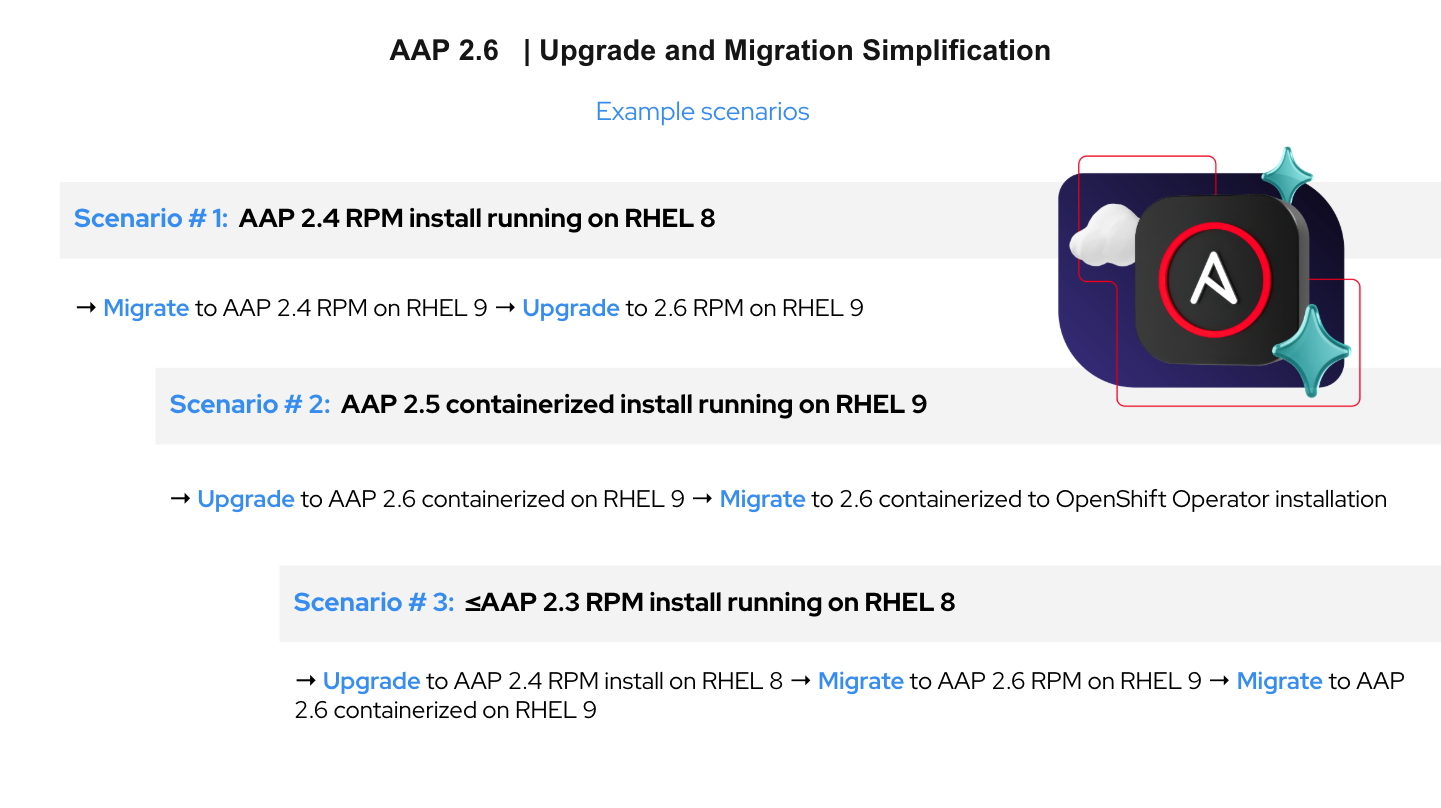
It's important to note that RPM-based installations will no longer be available after Ansible Automation Platform 2.6. Additionally, all customers currently on RHEL 8 must migrate to RHEL 9 before they can complete the upgrade from 2.4 to 2.6.
Additional resources
Upgrading to Ansible Automation Platform 2.6 is an essential and manageable process that keeps your automation environment fully supported. By making this transition now, whether through a streamlined direct update or a multi-step migration, you're staging your infrastructure for long-term success and preparing to leverage powerful platform innovations. Take this opportunity to get familiar with new tooling, like the Ansible Automation Platform intelligent assistant and the automation dashboard, to discover how you can build resilient automation into your infrastructure.
- Learn how Red Hat Services can help with your upgrade journey
- To learn more about upgrading to Ansible Automation Platform 2.6, join our webinar
- Check out the documentation for more details on your upgrade
- Read more about the latest updates for Ansible Automation Platform
- Watch more videos about Ansible Automation Platform 2.6 on YouTube
執筆者紹介

Catherine Choi is a Product Marketing Manager at Red Hat.
チャンネル別に見る

自動化
テクノロジー、チームおよび環境に関する IT 自動化の最新情報

AI (人工知能)
お客様が AI ワークロードをどこでも自由に実行することを可能にするプラットフォームについてのアップデート

オープン・ハイブリッドクラウド
ハイブリッドクラウドで柔軟に未来を築く方法をご確認ください。

セキュリティ
環境やテクノロジー全体に及ぶリスクを軽減する方法に関する最新情報

エッジコンピューティング
エッジでの運用を単純化するプラットフォームのアップデート

インフラストラクチャ
世界有数のエンタープライズ向け Linux プラットフォームの最新情報

アプリケーション
アプリケーションの最も困難な課題に対する Red Hat ソリューションの詳細

仮想化
オンプレミスまたは複数クラウドでのワークロードに対応するエンタープライズ仮想化の将来についてご覧ください
